

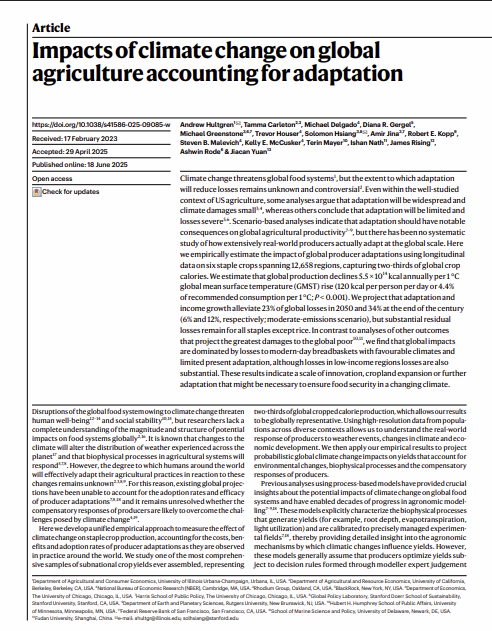
Impacts of climate change on global agriculture accounting for adaptation
This study estimates global climate change impacts on six staple crops using subnational data and observed adaptation. Yields fall by about 4.4% of recommended calories per 1 °C warming. Adaptation and income growth offset losses partially, but substantial global and regional yield declines remain.
Please login or join for free to read more.

OVERVIEW
This study examines how climate change affects global agricultural production while explicitly accounting for real-world producer adaptation. Using longitudinal subnational data for six staple crops—maize, rice, wheat, soybean, cassava and sorghum—across 12,658 regions in 54 countries, the analysis represents around two-thirds of global crop calories. The focus is on observed adaptation rather than assumed optimal behaviour.
A data-driven approach that accounts for adaptation
The authors develop a reduced-form econometric framework that jointly captures biophysical crop responses and producer decision-making. Instead of imposing adaptation scenarios, the model recovers the net effects of actual adaptations, including varietal choice, fertiliser use and irrigation intensity, and explicitly accounts for adaptation costs. High-resolution weather, yield and income data are combined with cross-validation techniques to identify the most relevant climate variables. Adaptation is allowed to vary with local climate, income and irrigation access, producing globally representative estimates.
The global distribution of impacts
Projected climate impacts vary widely across regions and crops. Temperature changes dominate long-run yield outcomes, while precipitation mainly drives inter-annual variability. Increasing extreme heat depresses yields, partially offset by fewer cold days in cooler regions. Losses are largest in many present-day breadbaskets with moderate climates, including parts of North America, Europe and China, where current heat adaptation is limited. Some higher-latitude regions show gains, while high-rainfall equatorial regions experience mixed effects.
Impacts on global yields
When aggregated across current croplands and accounting for adaptation costs and benefits, global yields decline for all crops except rice. Under a high-emissions scenario (RCP 8.5), central end-of-century losses are estimated at about 28% for maize, 36% for soybean, 30% for cassava, 28% for wheat and 22% for sorghum, while rice shows a smaller average loss of around 6%. Moderate-emissions outcomes (RCP 4.5) reduce but do not eliminate these losses.
Impacts by climate
Yield losses are not driven primarily by the hottest regions. After accounting for adaptation, the largest proportional losses occur in regions with moderate average temperatures. Hotter regions are already more adapted to heat, reducing marginal impacts of further warming, while cooler regions benefit from warming. High rainfall in many hot regions further dampens negative effects, highlighting the importance of differentiated adaptation patterns.
Impacts by income
Climate impacts on calorie production are uneven across income groups. High-income regions experience large absolute losses because they account for a substantial share of global production. The lowest-income decile also faces significant losses due to reliance on cassava. Middle-income regions experience more moderate average losses. These patterns indicate that global food security risks are driven largely by impacts in wealthy but climatically moderate agricultural regions.
Global calorie production
Across all six crops, global calorie production declines by an estimated 5.54 × 10¹⁴ kcal per year for each 1 °C increase in global mean surface temperature. This equates to roughly 120 kcal per person per day, or about 4.4% of recommended daily intake, per 1 °C of warming. The relationship between warming and calorie loss is close to linear over the century.
The role of adaptation and development
Observed adaptation and income growth substantially reduce projected damages but do not offset them fully. Relative to a no-adaptation scenario, adaptation lowers global calorie losses by about 23% in 2050 and 34% by the end of the century under high emissions. Benefits vary by crop and region, with rice showing the largest proportional gains from adaptation and wheat the least.
Adjustments for CO2 fertilisation
Post-estimation adjustments for CO₂ fertilisation reduce projected end-of-century yield losses by roughly 5–10 percentage points and increase the likelihood of positive outcomes for some crops. However, these adjustments do not change the overall conclusion of net global losses and do not account for potential declines in crop nutritional quality.
Conclusions and discussion
The findings show that real-world adaptation is widespread but insufficient to prevent significant global agricultural losses under climate change. The results highlight the scale of further adaptation, innovation and structural change required to maintain food security, particularly in major producing regions, and the importance of incorporating empirically observed adaptation into climate risk and policy assessments.




