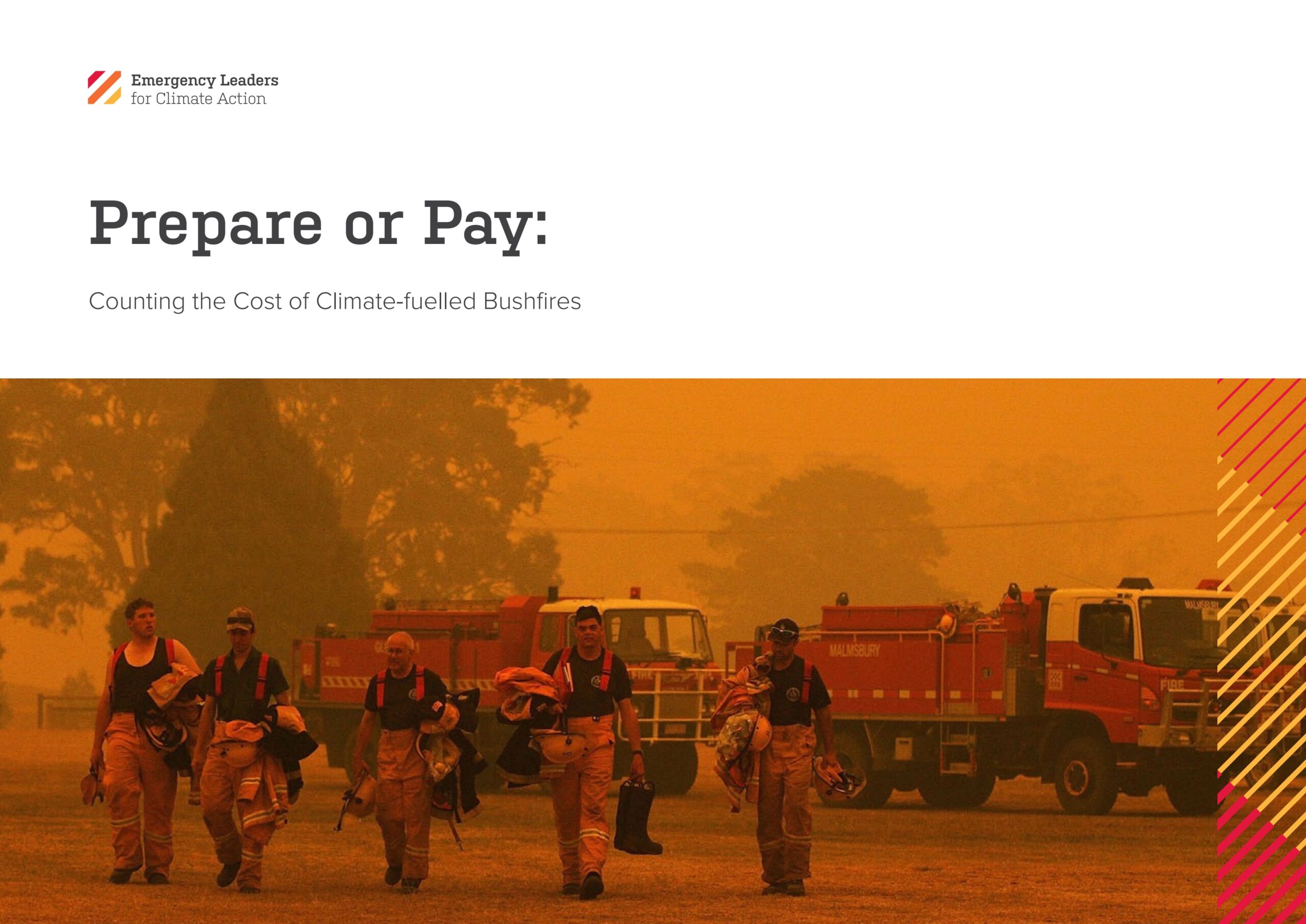
Prepare or pay: Counting the cost of climate-fuelled bushfires
This report quantifies the economic burden of climate-fuelled bushfires in Australia, projecting an average annual cost of $6 billion. It examines how climate change intensifies fire weather and provides recommendations for federal investment in preparedness, community resilience, and the rapid reduction of coal, oil, and gas pollution.
Please login or join for free to read more.

OVERVIEW
Key findings
New economic modelling indicates that bushfires will cost the Australian economy an average of $6 billion per year over the next 30 years. This projection is driven by climate change, which is causing more frequent and severe major fire events. The total annual cost includes several components: harm to health and wellbeing (32%), lost trade and output (25%), damage to business and public infrastructure (20%), lost homes and private property (17%), and lost labour productivity (6%). The modelling suggests that reducing fire damage by one-fifth could protect more than 5,600 jobs annually. Furthermore, almost half of the 14,000 homes lost to bushfires in Australia since 1901 were destroyed after 2001.
Introduction
While the human and emotional toll of bushfires is immeasurable, the financial burden is escalating as more Australians live in high-risk areas. Climate pollution from coal, oil, and gas has significantly altered Australia’s fire seasons, making them longer and more dangerous. Significant fires causing insured losses exceeding $500 million have become more frequent over the last 25 years. This report quantifies the economic burden, projecting a cumulative cost of more than $181.7 billion over the next three decades if current trends continue without improved preparedness and deeper cuts to global emissions.
Fuelling the fire: how climate pollution worsens bushfires
Climate change is ‘loading the dice’ for catastrophic fire conditions by drying out forests and soils while increasing temperatures and wind speeds. Southeast Australia now experiences 14 more days of extreme fire weather annually than it did before 1998. Fire seasons have lengthened by 21% since 1979, which reduces the window available for vital hazard reduction burning. Additionally, fire-generated storms, known as pyrocumulonimbus (pyroCb) events, have seen a six-fold increase, rising from 20 recorded events between 1983–2003 to 121 events between 2004–2024. Dry lightning strikes in southeast Australian forests also increased by 50% between 2000 and 2016 compared to the previous two decades, often sparking fires in remote, inaccessible locations.
Bushfire damage costs Australians $6 billion per year
The economic modelling categorises bushfire severity into three bands: compound major disaster-level events (costing $27.7 billion per event), major fire events ($16.1 billion), and other damaging fires ($1.2 billion). Modelling assumes a Black Summer-scale event recurs roughly once every 30 years, with major fires occurring every four years until 2040, and every three years thereafter. The direct impact on health and wellbeing represents the largest cost share at 32%. The report notes that these figures are conservative as they exclude environmental losses, destruction of cultural heritage, and growth in the value of assets exposed to fire.
Fire agencies and communities paying the price
Firefighting resources are under increasing strain. Australia had 10,336 fewer firefighting volunteers in 2023/24 than it did four years earlier, a decline of seven per cent. Meanwhile, paid positions grew by only 433 in the same period. The overlapping of fire seasons between the northern and southern hemispheres is also problematic; during the Black Summer, 11 of the 12 large air tankers used in Australia were sourced from overseas. This reliance on international contracts is under pressure as global fire seasons increasingly coincide. Furthermore, insurance costs are rising sharply, with premiums in some high-risk areas increasing by as much as 400%, leading to an increase in underinsurance and non-insurance among households.
Preparation pays off
Investment in preparedness provides strong economic returns. For instance, land-use planning that limits development in high-risk areas could avoid $54 billion in damages between 2026 and 2100. Resilient housing upgrades return an estimated $1.40 for every dollar spent, while vegetation management returns $1.30 per dollar. Targeted technology, such as aerial detection using drones, could cut suppression costs by 31% compared to using helicopters alone. Overall, modelling shows that increased government investment in preparedness can reduce the disruptive impact of fires on the national economy and prevent significant job losses.
Recommendations
The report provides several key recommendations for the Australian Government to mitigate risks. These include funding at least 48 hours of backup power for mobile towers in high-risk areas and investing in microgrids for isolated towns. The report also suggests establishing a household resilience programme focused on high-risk residents, trialling large water-dropping drones for rapid response, and building a national, sovereign aerial firefighting capability. To limit the worsening of fire conditions, the government is urged to strengthen the Safeguard Mechanism, stop approvals for new or expanded coal and gas projects, and cap diesel fuel tax handouts for big mining corporations to reinvest savings into disaster preparation.
Conclusion
Australia has entered a new era of fire risk that requires a national response. The escalating costs and the increasing frequency of catastrophic events mean that firefighting is no longer the sole responsibility of individual state or territory governments. Phasing out climate pollution from coal, oil, and gas is the most effective way to limit future fire intensity, while urgent investment in resilience and fire service capacity is required to protect communities from the threats they already face.