

Reconsidering Limits to Growth: Integrating energy transition and circular economy in an extended World3 framework
This research extends the World3 model to analyse the impact of the energy transition and circular economy on global sustainability. Findings indicate that while these strategies delay systemic overshoot and collapse, they cannot prevent decline under continued growth. Structural changes in consumption patterns are identified as necessary for stability.
Please login or join for free to read more.

OVERVIEW
Introduction
The research addresses the increasing pressure on the Earth system from population growth, climate change, and the depletion of finite fossil fuel reserves. It builds upon the 1972 study, The limits to growth, which utilised the World3 system dynamics model to simulate interactions between population, industrial production, food, resources, and pollution. The original study highlighted risks of systemic overshoot and collapse but was criticised for underestimating technological adaptation. This paper revisits the thesis by extending the World3 framework to include two contemporary transformation strategies: the energy transition (ET) toward renewable sources and the circular economy (CE). The research asks to what extent combined strategies alter overshoot-and-collapse dynamics and whether they can prevent systemic decline.
Methods
The study implemented all modifications in Vensim with scenario evaluations conducted in Python. The methodology involved disaggregating the aggregated stock of non-renewable resources into distinct energy and material flow components. This enabled explicit modelling of cross-resource interactions, such as the material requirements for renewable infrastructure and the energy demand of recycling processes. The CE module represents material life cycles with a maximum recyclability rate of 90%, a recycling delay of five years, and a material lifetime delay of 15 years. The ET module simulates renewable energy expansion under economic and environmental constraints. Historical cost reductions are captured through learning curves, while a 40% cost markup is added to the Levelised Cost of Energy (LCOE) for grid integration and storage requirements.
Results
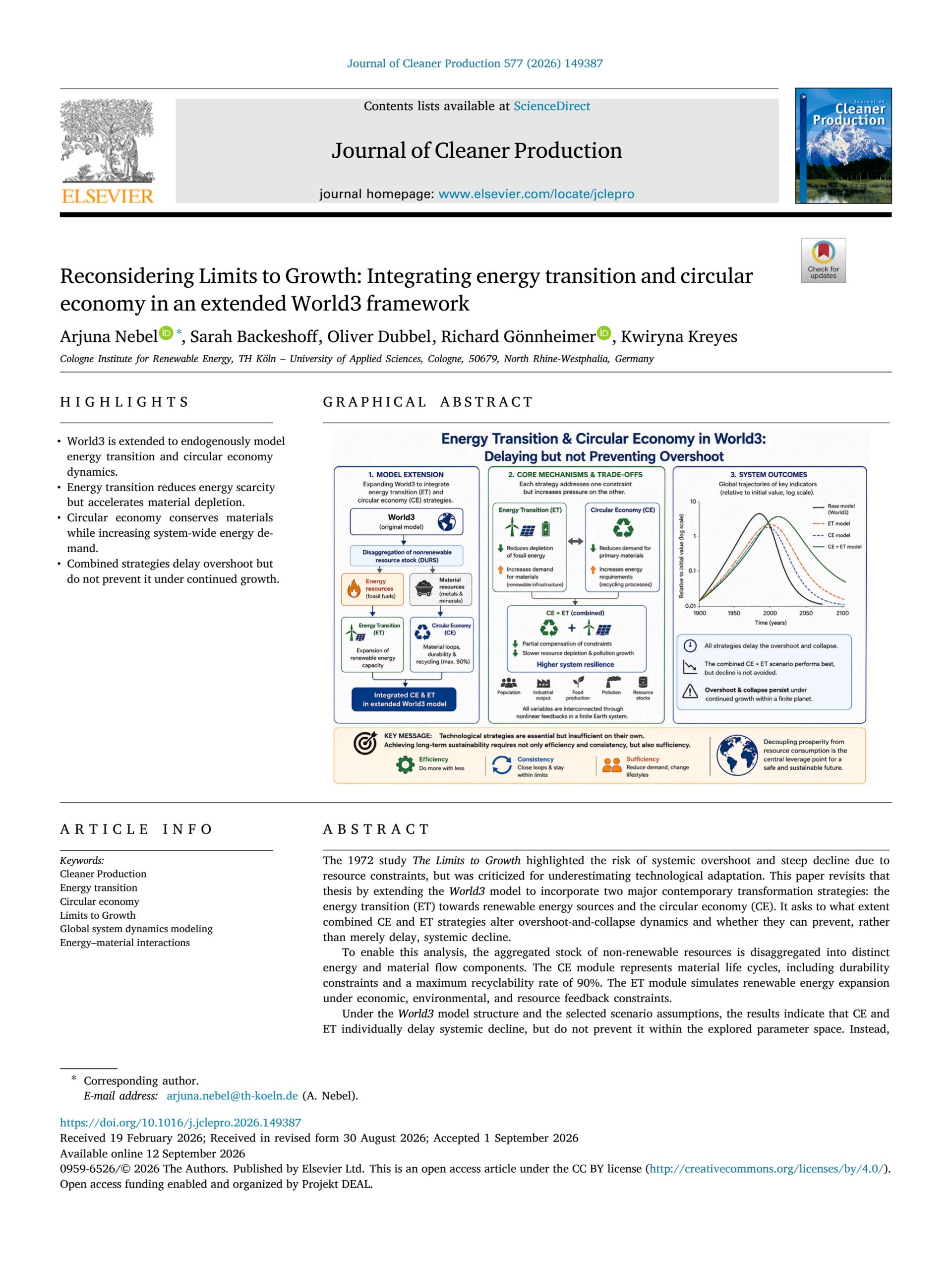
The simulations show that while CE and ET individually delay systemic decline, they do not prevent it within the explored parameter space. The ET pathway reduces dependence on fossil fuels but accelerates the depletion of structural materials required for infrastructure. Conversely, the CE reduces primary material extraction but increases the system’s aggregate energy demand due to the requirements of the recycling sector and rebound effects. The combined CE & ET scenario exhibits the highest resilience, extending population stability and industrial output longer than any isolated pathway. In this integrated scenario, renewable energy increasingly powers recycling while circular material flows reduce the material intensity of the energy transition. Despite these improvements, the system eventually encounters biophysical limits as continued growth in industrial production outweighs the efficiency gains achieved through technological change.
Discussion
The findings indicate that technological transitions primarily delay rather than prevent systemic decline. Under the most resilient configurations, the system eventually collapses because continued growth in population and industrial production outweighs gains in resource productivity. This reinforces the central hypothesis of The limits to growth that overshoot-and-collapse dynamics remain structurally robust even when technological adaptation is considered. From a cleaner production perspective, the interaction between circular resource use and renewable energy deployment is central; improvements in one domain may shift burdens to another. The study suggests that CE and ET should be treated as coupled policy domains, integrating material-efficiency and design-for-recycling with renewable energy policies.
Conclusion
The study concludes that technological strategies such as the circular economy and energy transition are essential components of a long-term sustainability pathway, but they are insufficient on their own to stabilise the global system within planetary boundaries. As long as economic growth remains strongly coupled to material and energy throughput, efficiency improvements are likely to be outweighed by rising aggregate consumption. Achieving true long-term sustainability requires not only technological innovation but also structural changes in consumption patterns, economic organisation, and societal conceptions of prosperity. Future research should extend the model to represent critical minerals like lithium and cobalt to better capture material security constraints.




