

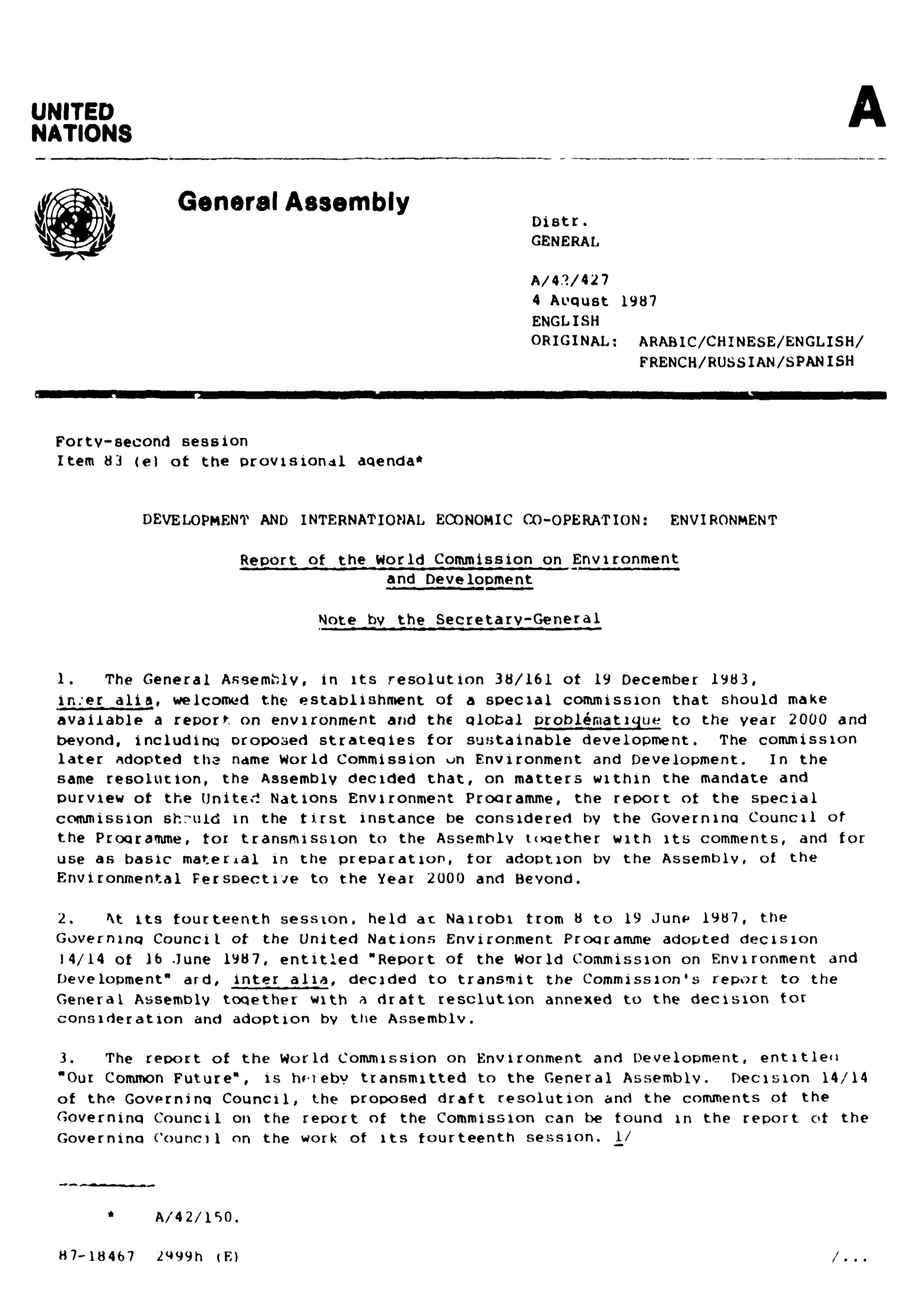
Report of the World Commission on Environment and Development
This United Nations report identifies sustainable development as a global priority, addressing the interlinked crises of poverty and environmental degradation. It advocates for urgent multilateral co-operation and presents a strategic agenda for institutional and legal change to protect the planet’s resources for current and future generations.
Please login or join for free to read more.

OVERVIEW
Chairman’s foreword
The Chairman’s foreword, authored by Gro Harlem Brundtland, introduces the “global agenda for change” requested by the United Nations General Assembly in 1983. The World Commission on Environment and Development was tasked with formulating long-term environmental strategies for achieving sustainable development by the year 2000 and beyond. This urgent call sought to define shared perceptions of long-term environmental issues and recommend ways to translate environmental concerns into greater co-operation among nations at different stages of economic and social development. The Commission aimed to identify interrelationships between people, resources, environment, and development to foster mutually supportive objectives.
Brundtland reflects on the “mandate for change” that was abundantly clear upon her acceptance of the chairmanship in December 1983. She notes that the environment is not a separate sphere from human actions, ambitions, and needs; it is where everyone lives. Similarly, “development” is defined as the collective attempt to improve human conditions within that abode. The foreword emphasises that the two are inseparable. The transition to a sustainable future requires closing the gap between rich and poor nations and moving away from the downward spiral of linked ecological and economic decline. The report is presented as a unanimous document, despite the diverse backgrounds of the commissioners, who served in their individual capacities rather than as national representatives.
From one earth to one world: An overview by the World Commission on Environment and Development
This overview addresses the “global problématique” and the necessity for new approaches to environment and development. It highlights the shift from viewing the earth as a physical entity to understanding it as a single world with interconnected social, economic, and ecological systems. The report observes that during the Commission’s tenure, several tragedies underscored the urgency of its work, including the African famines, the pesticide leak at Bhopal in India, and the nuclear disaster at Chernobyl in the USSR. These events illustrated that grave predictions about the human future were becoming commonplace. The Commission stresses that the current era requires co-ordinated political action and responsibility to safeguard the interests of coming generations.
Common concerns
The report identifies a “threatened future” where current development paths are clearly unsustainable. Sustainable development is established as a strategic imperative, defined as development that meets the needs of the present without compromising the ability of future generations to meet their own needs. This section examines the role of the international economy, noting how the economic decline of the 1980s hindered sustainable development. It calls for a transition to a sustainable world economy that integrates environmental considerations into the heart of economic decision-making processes.
Common challenges
Critical survival issues are linked to uneven development, poverty, and population growth. The Commission explores the links between “population and human resources” and the environment, noting the downward spiral of poverty and environmental degradation in many developing nations. Other identified challenges include food security, the preservation of species and ecosystems, energy choices, industrial productivity, and the “urban challenge” in developing countries. The report notes that while the 1970s offered hope for greater co-operation through UN conferences, the 1980s have been marked by a retreat from social concerns and a focus on industrial growth that often ignores the survival of the poorest nations.
Common endeavours
This section discusses the management of “the commons”, specifically focusing on the oceans, space, and Antarctica as keys to global co-operation and sustainable development. It also explores the critical relationship between peace, security, development, and the environment. The Commission argues that environmental stress can act as a source of conflict and that true security must include the sustainable management of environmental resources. It calls for a return to multilateralism to address these interlocked global threats.
Towards common action: Proposals for institutional and legal change
The Commission concludes with a call for a “common endeavour” and the establishment of new norms of behaviour at all levels. It proposes institutional and legal changes to ensure that environment and development are treated as a single, integrated issue in political and economic decision-making. The report includes a summary of proposed legal principles for environmental protection and sustainable development to guide international action. Finally, the Commission appeals to citizens’ groups, non-governmental organisations, and the scientific community to lead the debate and public participation necessary to correct the course of global development.




