

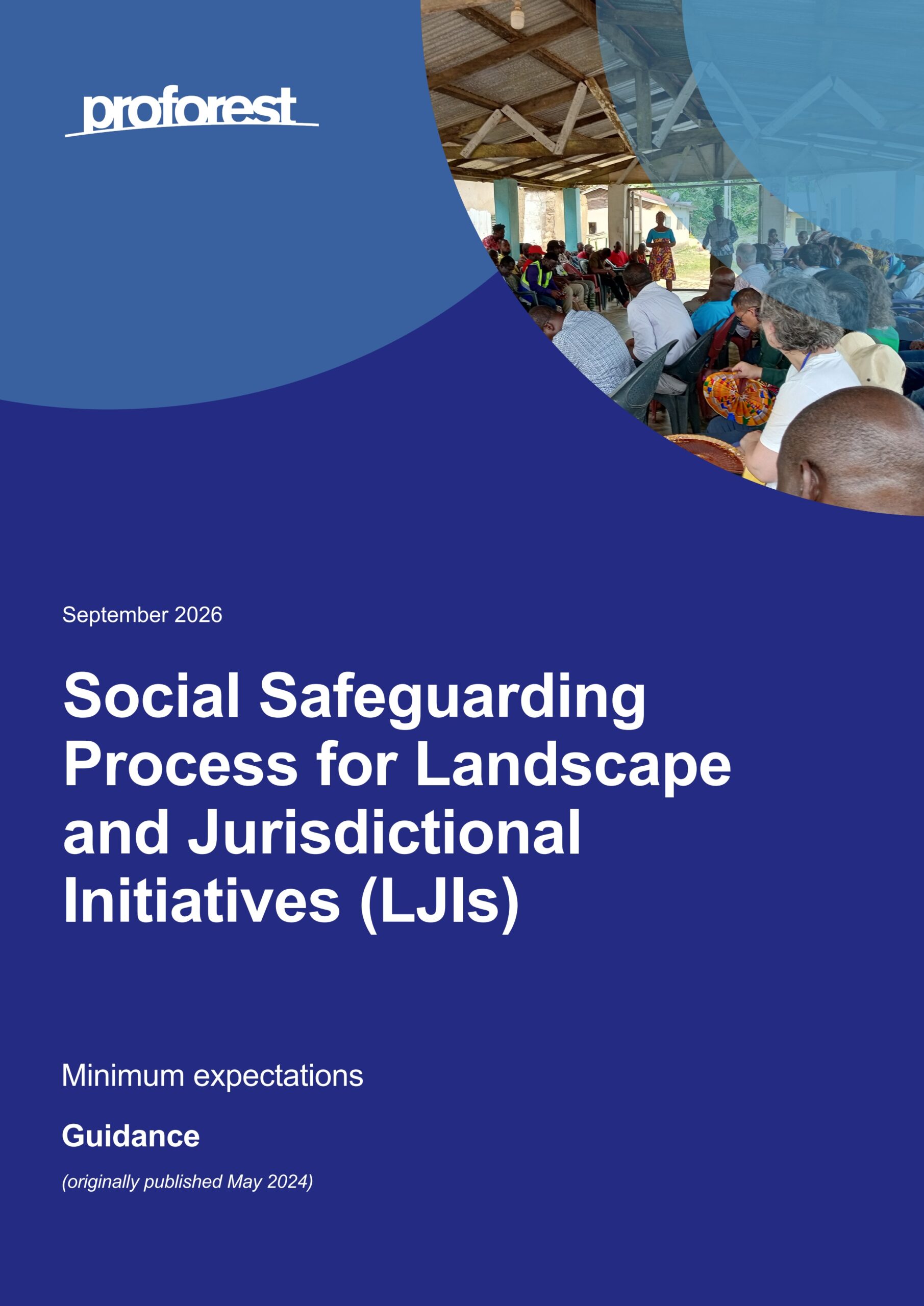
Social safeguarding process for landscape and jurisdictional initiatives (LJIs): Minimum expectations guidance
This guidance outlines a minimum social safeguarding process for Landscape and Jurisdictional Initiatives. It details four core stages—commitments, assessment, planning, and monitoring—supported by governance and grievance enablers. The report provides practical recommendations and case studies to help organisations protect stakeholders from unintended harm during project implementation.
Please login or join for free to read more.

OVERVIEW
Introduction
This guidance is designed for organisations implementing Landscape and Jurisdictional Initiatives (LJIs). It provides recommendations for a globally applicable minimum safeguarding process and outlines practical steps for designing and implementing safeguards. While the focus is on LJIs, other projects with field activity components may find the process applicable. The guidance serves as a practical reference rather than a prescriptive standard, as appropriate safeguards vary depending on local contexts, stakeholders, and regulatory requirements. It builds on field-based insights from various implementers to ensure relevance across diverse global contexts.
Understanding safeguarding
Social safeguarding is defined as a process for protecting people from being harmed by interventions intended to do good. It involves understanding how activities might put people at risk, identifying mitigation measures, and checking that those measures are effective. Safeguards are measures managed by organisations to avoid negative impacts on individuals and communities. This document focuses specifically on social safeguarding, addressing a gap in existing guidance that often prioritises environmental outcomes. While environmental safeguards follow similar principles, they are considered beyond the scope of this particular document.
Social safeguarding process and minimum expectations
The social safeguarding process consists of four core stages: commitments, assessment, planning and implementation, and monitoring and reporting. These stages are supported by three critical enablers: governance and accountability, capacity building of staff, and the provision of remedy. LJIs are encouraged to integrate minimum expectations within one to two years of establishing funding agreements. The guidance recognises that implementation may be phased over time as the capacity and maturity of the initiative grow.
Safeguard system enablers: governance, capacity, and provision of remedy
Effective implementation requires clearly identifying roles and responsibilities. Key positions include a designated safeguarding lead or focal point and a grievance manager. In collaborative LJIs involving multiple partners, these arrangements must be established early to ensure coordination. Capacity building is essential for ensuring staff have the skills to identify risks and apply policies consistently. For example, the Sustain Kutim Landscape Initiative in Indonesia conducted workshops for staff and village facilitators, identifying the need to translate materials into local languages for wider reach.
Provision of remedy is a foundational enabler, requiring accessible channels for people negatively affected by an intervention to seek redress. Organisations should establish clear procedures for receiving and responding to grievances, ideally aligning with UN Guiding Principles (UNGP) effectiveness criteria.
Four core stages of safeguarding
1. Commitments
The first stage involves establishing a high-level shared commitment to safeguarding within the LJI’s official documentation, such as cooperation agreements or partnership documents. Best practice involves developing these commitments through participatory approaches with rightsholders and beneficiaries. In the Central Paraguayan Chaco, Solidaridad Paraguay successfully embedded safeguarding commitments within local multi-stakeholder platform processes, adapting them to the local legal framework and cultural context.
2. Risk assessment
Risk assessment involves identifying stakeholders, conducting desk-based reviews, and consulting key informants to prioritise risks based on saliency—the severity of potential impacts on people. Cumulative and combined impacts must be considered when multiple partners or operations overlap. Case studies from the Ecuador Northern Amazon Landscape highlight the use of internal screening forms to categorise projects. In that region, the project was categorised as medium-high risk due to intensive work with Indigenous communities and agricultural production activities.
3. Planning and implementation
LJIs should develop a safeguarding and implementation plan that sets out specific measures, roles, and timelines. Mitigation strategies include avoiding risks, reducing the likelihood of occurrence, transferring risks to third parties, or accepting them if the costs of mitigation outweigh the harm. This stage also includes the design of grievance procedures suited to the local context. Conservation International Ecuador utilized their “CI-Escucha” mechanism to provide virtual and physical channels for stakeholders to report issues, with established response timelines such as five days for confirming receipt and 30 days for addressing requests.
4. Monitoring & reporting
The final stage requires a monitoring system with clear indicators relating to implementation and outcomes. Regular reviews and adaptive management ensure that safeguards remain effective as risks evolve. Stakeholder engagement in monitoring can include community-based monitoring (CBM) to complement project-level systems. The Western Mato Grosso Landscape Initiative established specific KPIs and a Communications Plan to ensure transparency and involve Indigenous Peoples and Local Communities (IP&LCs) in governance. Public disclosure of grievance resolutions, while respecting confidentiality, is recommended to build trust and prevent the escalation of concerns.




