

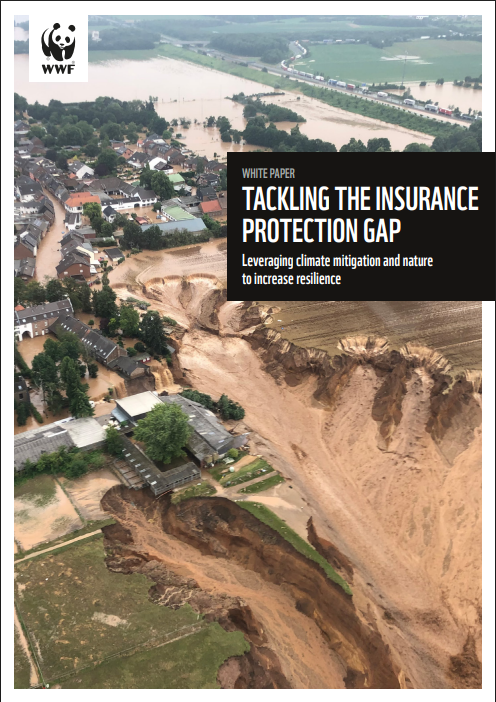
Tackling the insurance protection gap: Leveraging climate mitigation and nature to increase resilience
This white paper analyses how climate change and nature loss are widening insurance protection gaps in advanced economies. It outlines impacts on affordability and coverage, and recommends combining climate mitigation, nature-based solutions, and regulatory reforms to strengthen resilience and maintain insurability.
Please login or join for free to read more.

OVERVIEW
Introduction
This report examines how climate change and nature loss are undermining insurability and widening the insurance protection gap in advanced economies. It is directed at governments, regulators, central banks and the insurance sector, and argues that addressing root causes of risk is essential to maintain economic resilience, financial stability and social welfare.
How Climate Change And Nature Destruction Are Driving Economic Losses From Extreme Weather Events
Rising temperatures and ecosystem degradation are increasing the frequency, severity and reach of extreme weather events. Degraded forests, wetlands and coastal ecosystems are less able to buffer floods, storms and heat, significantly amplifying damages. Globally, disaster costs in 2023 were estimated at around US$2.3 trillion, including indirect and ecosystem losses. In areas of widespread deforestation, flood risk can increase by up to 700%. Nature-based solutions often provide more cost-effective protection than engineered alternatives.
Climate Risk And The Insurance Protection Gap
The insurance protection gap is defined as the difference between total economic losses from climate-related events and the portion insured. As losses rise, this gap is widening even where insurance penetration remains high. In the US, the gap averaged around US$64 billion per year between 2021 and 2024, while in the EU it averaged about €59 billion per year between 2021 and 2023. Insurers’ reliance on historical data is increasingly ineffective, leading to higher premiums, reduced coverage and market withdrawal in high-risk areas. Since 2018, more than 1.9 million US home insurance contracts have not been renewed.
The Financial, Economic, Social And Fiscal Consequences Of The Protection Gap
Higher premiums and reduced coverage weaken household financial resilience and slow post-disaster recovery. In Australia, around 15% of homeowners spend more than one month’s income on annual premiums. Businesses face higher interruption costs and competitiveness risks, while infrastructure and natural assets are often uninsured. Governments are increasingly exposed through subsidies and post-disaster relief, such as Spain’s €2.2 billion drought response in 2023. These pressures strain public finances and can create dependency on emergency aid. The report also highlights intergenerational equity concerns, as uninsured losses reduce wealth accumulation and increase future fiscal liabilities.
Regulatory And Policy Responses To The Widening Protection Gap
Governments and supervisors are stepping up monitoring and intervention, including public–private insurance schemes, risk pooling and enhanced disclosures. Central banks and supervisors are increasingly recognising protection gaps as a source of systemic financial risk. However, responses remain fragmented. The report stresses the need for holistic, forward-looking risk and resilience assessments that capture indirect economic and social impacts, regular publication of protection gap analyses, and integration of climate and nature risks into supervisory frameworks. Macroprudential approaches, including stress testing, are identified as necessary but insufficient on their own.
WWF Recommendations To Contain The Protection Gap For The Benefit Of People, Nature, Businesses And Governments
The report sets out four interconnected action areas. First, authorities should undertake holistic risk and resilience assessments that incorporate climate change, nature loss and indirect losses. Second, reducing greenhouse gas emissions and halting nature destruction are essential to contain future risks. Third, nature and nature-based solutions should be central to adaptation, response and recovery planning, with insurers accounting for ecosystem risk-reduction benefits in models and pricing. Fourth, policy incentives and insurance regulation should support risk transfer and innovation, including parametric insurance, catastrophe bonds and carefully designed multi-year contracts. Public–private partnerships are critical to scale these approaches.
Conclusions
Climate change and nature loss are creating insurability challenges that extend beyond insurance markets into economic, social and fiscal stability. Without coordinated action to address underlying risks, the insurance protection gap will continue to widen. Integrating climate mitigation, ecosystem restoration and regulatory reform is essential to sustain insurability and long-term resilience in advanced economies.




