

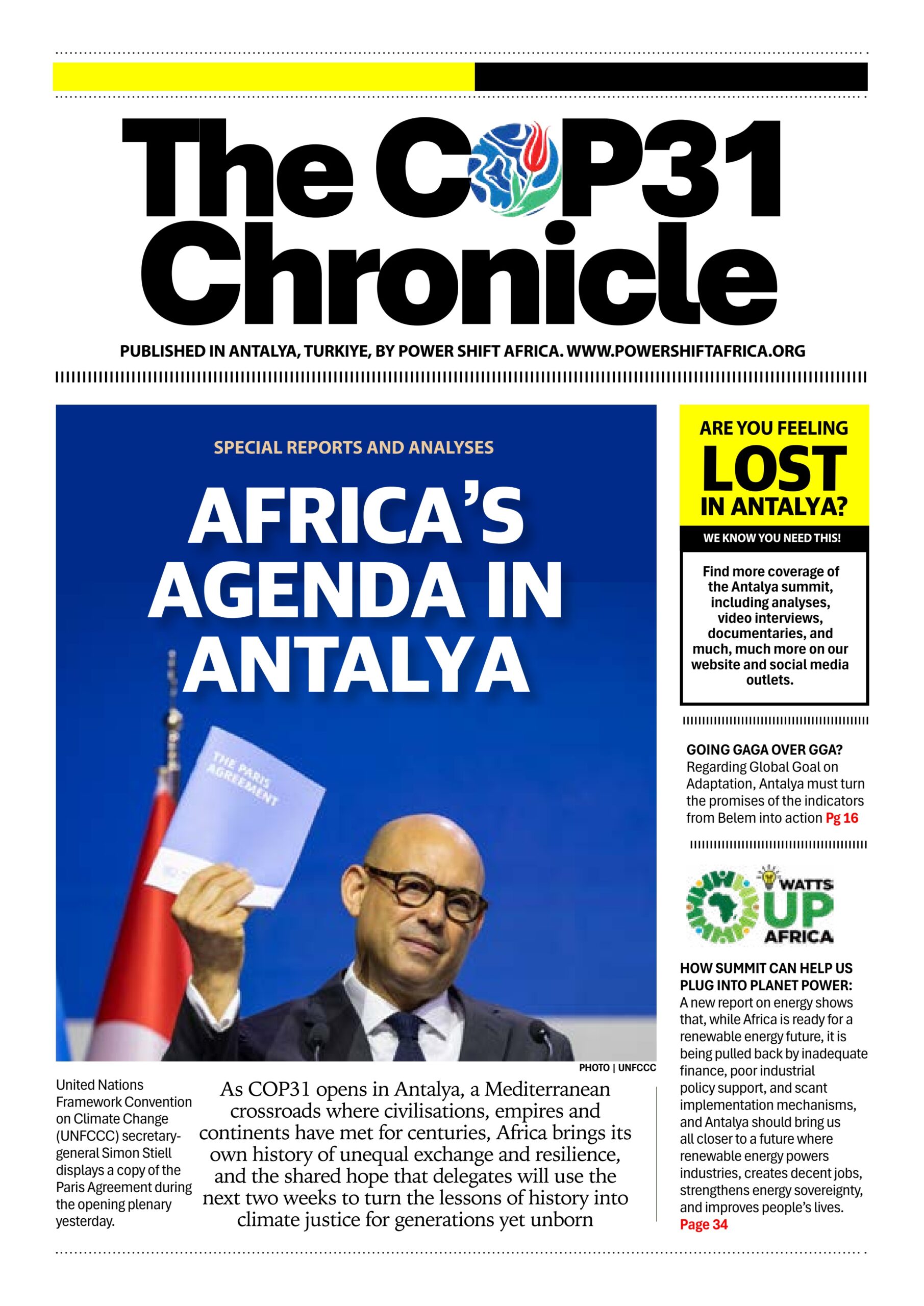
The COP31 Chronicle
This newspaper report outlines Africa’s strategic agenda for COP31, emphasising the urgent need to close the climate finance gap. It highlights that while Africa requires up to $277 billion annually for climate goals, it currently receives a fraction of this, primarily through debt-creating loans rather than grants.
Please login or join for free to read more.

OVERVIEW
Turn pledges into action, leaders say as talks open
The COP31 climate summit opened in Antalya with United Nations climate chief Simon Stiell and Turkish COP president Murat Kurum urging governments to move beyond setting targets to deliver practical results in clean energy, finance, and resilience. Stiell emphasised that 90% of large renewable projects are now cheaper than fossil-fuel alternatives. Renewables saved approximately $500 billion globally last year and a further $265 billion in the first half of 2026. Kurum highlighted the ‘Climate Implementation Bridge’ to connect national needs with finance and technology, noting that countries must deliver on commitments including at least $300 billion annually for developing countries by 2035.
Editor’s note
Ten years after the Paris Agreement, Africa enters negotiations as a region bearing some of the heaviest climate costs. Africa needs an estimated $190–277 billion annually to meet its 2030 climate goals, yet received only $43.7 billion in 2021/22. The gap in loss and damage is severe; of the $822 million pledged to the Fund for Responding to Loss and Damage, less than half has been received, while global requests from developing countries total $2.8 billion.
Diplomacy
The African Group of Negotiators (AGN) identified three priority clusters: finance, adaptation, and climate and development. Key demands include substantive discussion on Article 9.1 regarding developed countries’ finance obligations and a clear signal on replenishing the Green Climate Fund (GCF). The AGN also seeks to tripling adaptation finance by 2035 and establishing a Just Transition Mechanism (JTM) that addresses how transitions will be financed, incorporating both technical and political dimensions.
The watchdog
A new report titled A Just Transition for Adaptation: A Framework and Vision for Africa argues that African vulnerability is not an accident of geography but shaped by history and unequal development. Currently, Africa’s annual adaptation needs are close to $70 billion, but finance flows are only $14 billion. Alarmingly, a growing proportion of this is delivered through commercial loans rather than grants, forcing vulnerable countries to borrow to protect themselves from a crisis they did little to cause. The report advocates for justice based on recognition, participation, distribution, and restoration.
Opinion & analysis
African negotiators insist that tripling adaptation finance must be a floor, not a ceiling. Using a $40 billion baseline for 2025, a tripling would mean at least $120 billion annually by 2035. However, even this would only cover one-third of the estimated $310–365 billion annual requirement for developing nations. Recommendations include anchoring this floor in public, grant-based finance and ensuring direct access for national and local institutions to avoid lengthy, seven-year approval processes seen in previous projects.
Just transition
African countries are pushing to ensure the global shift to a low-carbon economy delivers development rather than new burdens. Key priorities for a just transition include giving the JTM clear governance, clarifying its functions to support countries beyond dialogue, and prioritising green industrialisation. This includes supporting local manufacturing and mineral beneficiation so African nations capture more value from clean-energy supply chains. Concerns were raised regarding the European Union’s Carbon Border Adjustment Mechanism (CBAM) and its potential impact on African fiscal revenues.
Mitigation
For Africa, mitigation must support energy security and economic diversification. Five key priorities were identified: extending the Mitigation Work Programme (MWP) beyond 2026, prioritising grant-based and highly concessional finance, turning opportunities into investable projects, putting energy access at the centre, and connecting mitigation with job-creating industrialisation.
Renewable energy
Findings from the African Renewable Industry Readiness Index (A-RIRI) show that Africa’s challenge is not its resource endowment but its readiness to turn potential into shared prosperity. Recommendations for Antalya include addressing constraints in technology transfer, plugging industrial readiness gaps, and promoting ‘energy democracy’ to ensure communities benefit directly from renewable infrastructure, rather than merely acting as deployment sites.
The last word
While regional initiatives like the ‘Watts Up Africa’ campaign empower communities to build local renewable solutions, such as wind turbines in Zanzibar, some nations are looking toward nuclear power. Kenya’s proposed nuclear plant in Siaya County aims for 2,000–5,000MW, yet critics raise significant concerns regarding the long-term management of high-level nuclear waste (HLW) and the independence of the national safety regulator.




