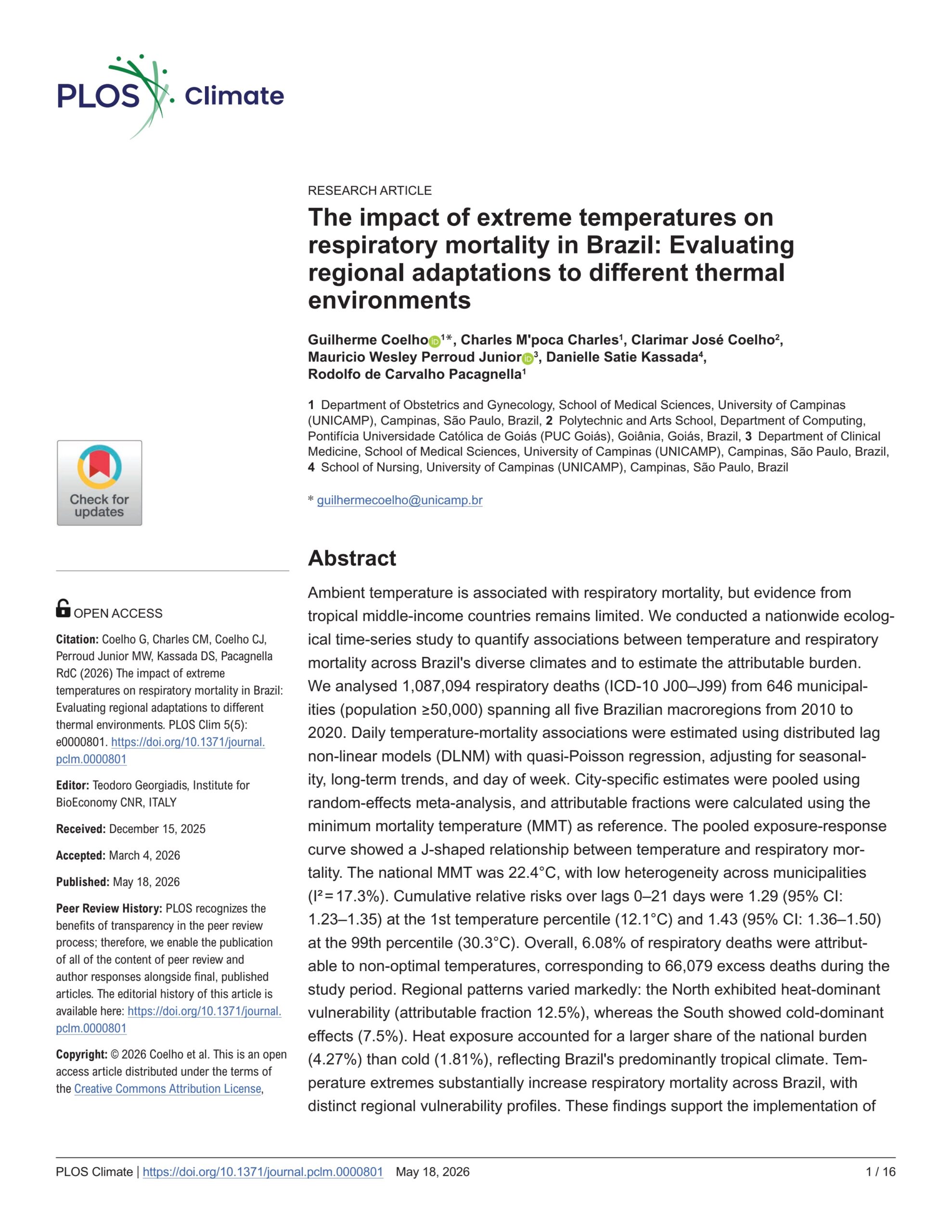
The impact of extreme temperatures on respiratory mortality in Brazil: Evaluating regional adaptations to different thermal environments
This report analyses the impact of extreme temperatures on respiratory mortality across 646 Brazilian municipalities from 2010 to 2020. Findings reveal a J-shaped exposure-response curve, with heat-related deaths dominating in tropical northern regions, whilst cold-related mortality predominates in the subtropical south, underscoring the need for region-specific climate adaptation policies.
Please login or join for free to read more.

OVERVIEW
Introduction
Respiratory diseases account for an estimated 4.2 million deaths annually, with disproportionate burden in low- and middle-income countries (2). Climate change is intensifying these challenges by increasing the frequency of temperature extremes (2). We conducted a nationwide ecological time-series study across 646 municipalities from 2010 to 2020 to quantify the association between ambient temperature and respiratory mortality and estimate the attributable burden by geographic region (2). These findings aim to inform targeted climate-health policies and Brazil’s National Adaptation Plan to Climate Change (2).
Methods
The study examined associations between daily ambient temperature and respiratory mortality across Brazil from 1 January 2010 to 31 December 2020 (3). The primary exposure was the daily mean ambient temperature, and the primary outcome was the daily count of deaths from respiratory diseases (3). Municipality-specific exposure-response associations were pooled using multivariate random-effects meta-analysis to obtain cumulative exposure-response curves (5). The minimum mortality temperature was identified, and attributable fractions and numbers of deaths due to non-optimal temperatures were calculated (5).
Results
A total of 1,087,094 respiratory deaths were recorded (6). The analysis revealed a J-shaped relationship between daily mean temperature and respiratory mortality, with the minimum mortality temperature estimated at 22.4°C (6). Mortality risk increased as temperatures decreased, corresponding to a 29% increase in respiratory mortality relative to the minimum mortality temperature at the 1st percentile of temperature (6). Heat-related mortality risk increased more steeply, indicating a 43% increase in mortality during extreme heat events at the 99th percentile (6).
Nationally, 6.08% of all respiratory deaths were attributable to suboptimal temperatures, corresponding to 66,079 excess deaths over the 11 years (8). Heat exposure accounted for a larger proportion of attributable mortality than cold: 4.27% (46,429 deaths) versus 1.81% (19,650 deaths) (8). The North exhibited the highest total attributable fraction (12.51%), with virtually all temperature-related mortality due to heat (8). The South exhibited a reversed pattern, with cold-attributable mortality (5.97%) exceeding heat-attributable mortality (1.54%) (8).
Discussion
This study provides the first comprehensive assessment of temperature-attributable respiratory mortality across a tropical middle-income country, observing a J-shaped exposure-response relationship with minimum mortality at 22.4°C (10). Regional heterogeneity was striking: the North exhibited almost exclusively heat-related mortality, whereas the South was dominated by cold effects (10).
The predominance of heat-attributable mortality contrasts with temperate regions, reflecting limited adaptation to heat extremes (10). A noteworthy finding is the substantial cold-attributable mortality burden even in tropical regions, suggesting climate adaptation policies in Brazil should not neglect cold-weather preparedness (11).
The substantial burden of temperature-attributable respiratory mortality underscores the need for integrated climate-health surveillance systems (13). Brazil’s existing monitoring infrastructure could be augmented with temperature-based early warning triggers (13). The striking regional heterogeneity argues against adopting uniform national policies, whilst adaptation strategies should prioritise vulnerable populations (13). Investment in heat-resilient urban design, expansion of air-conditioning access, and strengthening of healthcare capacity will be essential components of effective adaptation (13).
Conclusions
Temperature extremes are associated with substantial respiratory mortality across Brazil (13). Heat exposure accounts for the larger share of the national burden, whereas cold effects predominate in the subtropical South (13). These findings support the implementation of region-specific early warning systems and targeted adaptation strategies (13).