

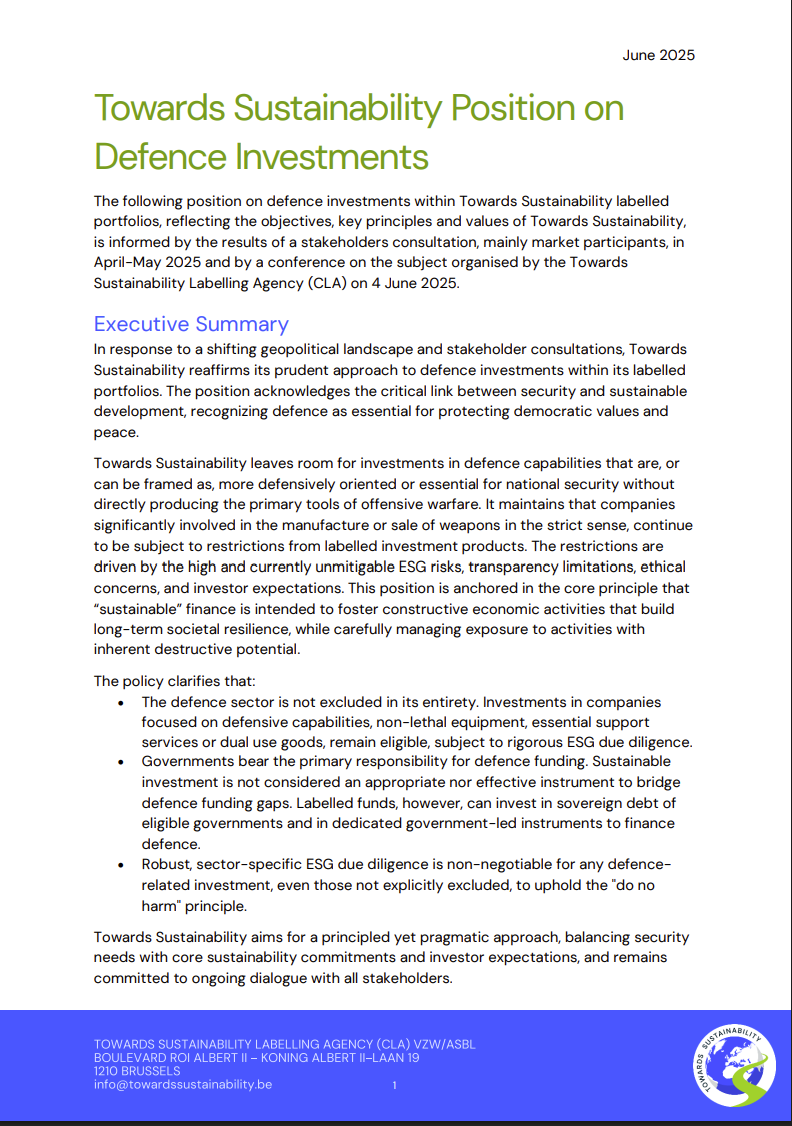
Towards sustainability position on defence investments
The report sets a pragmatic policy on defence investments for Towards Sustainability-labelled funds, permitting defensive, non-lethal and dual-use activities with strict ESG due diligence, while excluding weapons producers. It affirms defence funding as primarily a government responsibility.
Please login or join for free to read more.

OVERVIEW
1. A new geopolitical reality and the role of sustainable finance
The report responds to heightened geopolitical tensions by reassessing the role of defence within sustainable finance. It argues that security and sustainability are interdependent: security enables sustainable development, while sustainability supports long-term stability. Sustainable finance may acknowledge defence as necessary but must remain focused on constructive, long-term societal outcomes and material ESG risk management.
2. Guiding principles on defence
Defence is framed as a public necessity rather than a profit-driven activity. Governments bear primary responsibility for financing and controlling defence, particularly lethal armaments, due to democratic accountability and incentives to limit conflict. The report warns that profit-oriented investment in weapons may conflict with sustainability objectives. Rigorous, defence-specific ESG due diligence is considered essential.
3. Distinction: Direct funding vs listed equity investment
A clear distinction is made between direct funding and secondary market investment. Direct funding, such as loans or primary issuance, can support defence capabilities but generally falls outside ESG-labelled products. Most sustainable funds operate in secondary markets, where trading existing securities does not provide new capital, limiting their ability to address defence funding needs.
4. The towards sustainability label’s approach to defence investments
The Quality Standard applies only to products that voluntarily carry the label. Defence is not excluded entirely. Investments may be allowed in defensive, non-lethal, support and dual-use activities, subject to strict ESG assessment. Sustainable finance is not viewed as an appropriate mechanism to close defence funding gaps, which should primarily be met through public finance. Investments in eligible sovereign debt and government-led defence instruments are permitted.
4.1. Public vs private financing
Defence is characterised as a public good aimed at societal protection rather than investor returns. Governments are considered best placed to fund defence through transparent budgets and democratic oversight. The report notes that defence companies generally have adequate capitalisation and access to funding, limiting the marginal impact of sustainable investors on defence capacity.
4.2. Rationale for weapons exclusion
Companies significantly involved in weapons manufacturing or sales remain excluded from labelled portfolios. The rationale includes high and largely unmitigable ESG risks, limited transparency regarding end-users, ethical concerns about incentives linked to conflict, and investor expectations for sustainable products. Market observations suggest investors prefer to separate defence and sustainability exposures into different investment vehicles.
4.3. Why towards sustainability chooses exclusion as a tool
Exclusion is adopted as a pragmatic response to the absence of credible, granular ESG criteria that could adequately mitigate weapons-related risks. Environmental intensity, global export exposure and human rights concerns make sufficient risk management difficult. While exclusions are maintained, the report remains open to future dialogue if more workable standards emerge.
5. Clarifications to the current towards sustainability quality standard criteria
Stakeholder consultation did not require fundamental policy changes but led to clarifications and fine-tuning. The framework avoids blanket defence exclusions and applies targeted thresholds to specific activities.
5.1. Limited scope of exclusions under the towards sustainability label
Exclusions focus narrowly on weapons and essential lethal components. Companies deriving more than 5% of revenue from weapons or their essential components are excluded, while any involvement in indiscriminate weapons is excluded at a 0% threshold. A 25% threshold applies to bespoke services enabling weapons manufacture. Non-lethal equipment, cybersecurity, communications, surveillance, maintenance, training, R&D, dual-use goods and unprocessed materials remain eligible, subject to ESG due diligence.
5.2. Sovereign exposures to weapons defence
Investments in sovereign debt of eligible governments are permitted. The threshold defining a “particularly high” military budget is increased from 4% to 6% of GDP. Government-issued defence bonds and similar instruments are also eligible.
6. The indispensable role of ESG due diligence
All defence-related investments require enhanced ESG due diligence covering governance, export controls, human rights and environmental management to uphold the “do no harm” principle.
7. Conclusion
The framework maintains targeted weapons exclusions while allowing limited defence exposure aligned with sustainability objectives. Defence financing is reaffirmed as primarily governmental, with sustainable finance playing a complementary and constrained role consistent with ESG risk management and investor expectations.




