

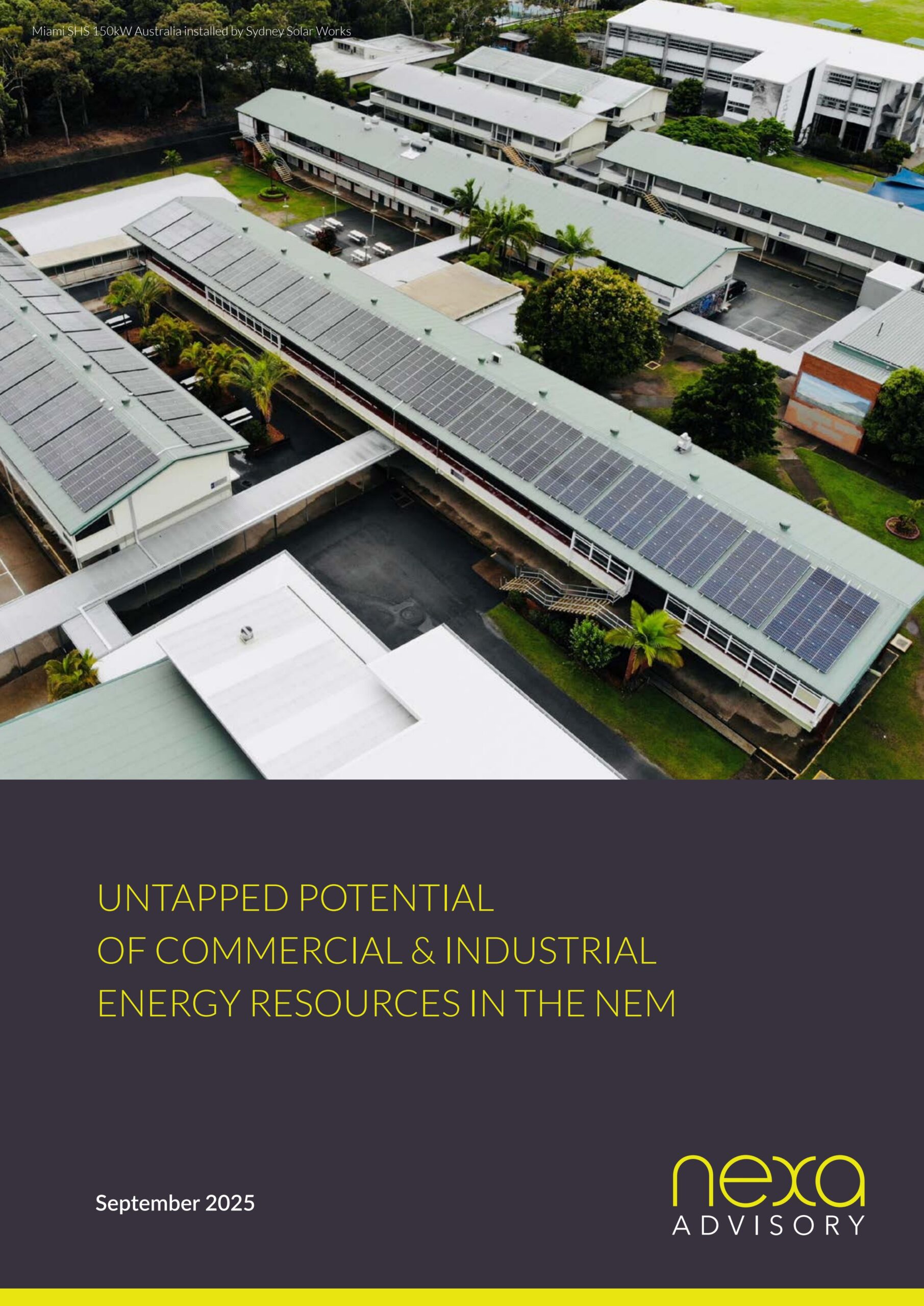
Untapped potential of commercial & industrial energy resources in the NEM
Analysis by Nexa Advisory identifies Australia’s commercial and industrial energy resources as a 28 GW untapped opportunity. With only 5 GW currently installed, the report recommends dedicated tenders and tariff reforms. Unlocking this capacity could avoid $11 billion in network costs and accelerate the clean energy transition.
Please login or join for free to read more.

OVERVIEW
Executive summary
Australia’s commercial and industrial (C&I) consumer energy resources (CER) represent a vast, untapped opportunity to reduce energy costs, enhance grid reliability, and accelerate the clean energy transition. Despite a potential of more than 28 GW of rooftop solar, only 5 GW is installed today, with a forecast of 15.4 GW by 2035. This slow uptake is primarily due to policy gaps, outdated tariff structures, and complex grid connection processes. Delivering on the potential capacity would cut the need for major transmission upgrades and could avoid $11 billion in network costs by 2040.
The opportunity
The economic and system-wide benefits of scaling C&I CER are compelling. Businesses consume more energy than residential users but have enormous potential to supply renewable energy at a very low cost. Rooftop solar offers businesses massive savings by delivering power at around $1.30 per watt, while batteries can cut annual power bills by up to $92,000 for large facilities such as warehouses. Unlike large-scale transmission or generation projects, C&I CER can be deployed quickly—often within weeks—avoiding land-use conflicts.
Barriers
C&I CER uptake remains weak because mid-scale projects fall into a policy ‘missing middle’: they are too large for Small-scale Renewable Energy Scheme (SRES) rebates and too small for Large-scale Renewable Energy Target (LRET) or Capacity Investment Scheme (CIS) support. Additionally, outdated tariffs punish flexibility, and Distribution Network Service Providers (DNSPs) impose complex and opaque grid connection processes. Demand-side participation (DSP) schemes, such as the Wholesale Demand Response Mechanism (WDRM), remain underutilised due to restrictive eligibility and complex baselines.
Summary of recommendations
Nexa Advisory calls for urgent action to unlock C&I CER opportunities. Key recommendations include establishing a dedicated C&I tender within the CIS with lower entry thresholds (e.g. 1 MW) and expanding support from the Clean Energy Finance Corporation (CEFC) and Australian Renewable Energy Agency (ARENA). Governments should accelerate reforms to value energy services, strengthen DSP mechanisms, and ensure competitive neutrality by preventing DNSPs from competing in C&I CER delivery while mandating stronger transparency and data-sharing obligations.
Introduction
The C&I segment comprises businesses and organisations that consume significantly more energy than residential users. Analysis suggests current C&I solar capacity is only 5 GW but could grow to 15.4 GW by 2035. The estimated potential of over 28 GW includes 8.1 GW in New South Wales, 6.3 GW in Queensland, 6.1 GW in Victoria, and 3.7 GW in South Australia. AEMO projects strong growth in both business rooftop PV (under 100 kW) and PV non-scheduled generation (between 100 kW and 30 MW).
Case study: early examples of C&I projects highlight untapped potential
Competitive providers have already delivered successful C&I CER projects across the NEM. SolarEdge monitors 7,373 systems nationwide totalling 2.31 GW, though most are under 100 kW due to incentive structures. At the industrial end, AGL’s Cadell Orchards microgrid pairs 4.9 MW of solar with a 5.4 MWh battery, illustrating what larger sites can deliver when properly supported.
The untapped potential of C&I CER
Australia is a world leader in rooftop PV, which contributed 12.1 per cent of generation across the NEM in 2024. Behind-the-meter battery storage systems have also seen growth, with small-scale residential and business capacity surpassing 4.3 GWh. However, the lack of focus and supporting schemes for C&I consumers has led to a lag in this sector.
The nascent C&I battery market will play a role in enabling CER uptake
Batteries turn passive solar rooftop PV into dispatchable, high-value energy assets. Australia’s C&I battery market is at an early stage, with less than 700 MWh installed by 2024. Momentum is building as costs fall and real-world business cases emerge for sites seeking bill savings and resilience.
Business loads are projected to grow significantly
Business consumption is projected to grow by 61 per cent on average across states from 2025 to 2054. Low-cost electricity is recognised as the foundation for industrial competitiveness, with the Future Made in Australia plan emphasising that cheap renewable energy will underpin new industries and up to 400,000 new jobs by 2040.
Case study: CER opportunities for data centres in Australia
Electricity demand from data centres is expected to surge from 3.9 TWh in FY2025 to 34.5 TWh by FY2050. This creates a challenge for integration but provides an opportunity for onsite CER. Mandatory onsite generation or storage, similar to policies proposed in Ireland, could transform data centres from a grid liability into a grid asset.
C&I CER is a win-win for consumers, government and the system
C&I CER reduces operating costs, enhances grid flexibility, and lowers network costs for all consumers. It can be deployed faster and more efficiently than many large-scale alternatives, providing a hedge against delays in major transmission projects.
Alignment of C&I loads with solar generation captures greater value for these installations
C&I consumers use a significant proportion of their energy during the day. This alignment with solar generation enables greater self-consumption and a smaller risk of ‘spill’ compared to residential installations, where peak loads often fall outside solar hours.
Faster, lower impact deployment, at similar cost to large-scale solar installations
A 1 MW rooftop PV array comes in at approximately $1.30 per watt, which is comparable to the $1.45 per watt for a 20 MW solar farm. C&I projects avoid greenfield land acquisition issues, environmental approvals, and social licence barriers, taking weeks rather than years to deliver.
Case study – Caribbean Business Park
The Caribbean Business Park in Melbourne has approximately 300,000 square metres of roof space, enough for up to 50 MW of solar panels. Unlocking this potential would minimise the need for network augmentation by AusNet. However, policy gaps and grid connection hurdles risk the project being downsized or delayed.
There is untapped potential for businesses across C&I CER and DSP
C&I businesses have significant potential to deliver demand-side participation (DSP). However, as of mid-2025, only 74.4 MW of registered capacity has been enrolled in the WDRM. Participation is deterred by eligibility restrictions for multi-site businesses and the administrative complexity of demonstrating load reductions against historical baselines.
Barriers to C&I CER uptake
C&I CER uptake is constrained by current settings where incentives remain supply-side focused and large-user tariffs do not reward flexibility. For institutional investors, CER deployment typically represents a non-core activity, meaning ease of participation must be comparable to residential systems to attract interest.
Gaps in incentives for large flexible C&I loads
The Capacity Investment Scheme (CIS) underwrites large-scale renewables but currently excludes C&I-scale installations. Similarly, C&I projects are often too large for STCs and face high administrative burdens to earn LGCs under the LRET, leaving a structural gap in the market.
Outdated tariff structures for large C&I customers
Most C&I customers remain subject to legacy pricing structures that rely on maximum demand charges. This penalises short demand spikes while failing to recognise the potential for sustained load management, voltage control, or frequency response.
Complex and costly network connection processes
Connecting a large embedded generation system can cost between $1.7 million and $4 million per kilometre. A lack of transparency on connection criteria and varying DNSP requirements introduces significant uncertainty into project timelines and financing.
Recommendations to unlock the untapped potential
Priority actions include creating a dedicated CIS tender for demand-side participation with a 1 MW threshold and expanding CEFC and ARENA grants. Reforms should accelerate the implementation of the NEM Wholesale Market Settings Review to value price-responsive resources. Furthermore, DNSPs should be prevented from competing in C&I CER delivery while grid connection processes are streamlined and standardised to reduce costs and delays.




