
Library | ESG issues
Social
The social pillar in ESG (environmental, social, and governance) assesses a organisation’s impact on people and society. It covers labour practices, diversity and inclusion, human rights and community engagement. Prioritising social responsibility not only benefits society but also mitigates risks, strengthens reputation, and creates long-term value for businesses and investors.
Refine
1325 results
REFINE
SHOW: 16



Delivering the digital economy: African migrant workers in the United Arab Emirates e-commerce and delivery sectors
This report examines the exploitation of African migrant workers within the United Arab Emirates' e-commerce and delivery sectors. It details systemic abuses including recruitment debt, deceptive contracts, and excessive working hours, highlighting how subcontracting models fragment accountability. The findings advocate for stronger international labour standards to protect vulnerable platform workers.

Beyond energy infrastructure: A flexibility-first approach cuts costs and boosts security
This report argues that power system flexibility is core infrastructure essential for energy security and affordability. It demonstrates how quantifying flexibility can reduce costs, citing potential annual savings of £9.6–£16.7 billion in Great Britain by 2050. Policymakers are encouraged to prioritise flexibility-first design over traditional infrastructure-heavy build-out.
Stewarding a just transition: Frontiers of practice in listed equities
This report analyses just transition practices among 25 investment managers in listed equities. While policy recognition is high, active engagement remains a low priority concentrated in energy and mining. The research identifies barriers such as geopolitical headwinds and provides recommendations for investors, governments, and regulators to mainstream practice.

Natura Future P&L Tool
The Natura Future P&L Tool is a free digital platform that enables businesses to measure and monetise their environmental, social, and human impacts. It helps finance professionals integrate ESG externalities into traditional financial analysis to assess a company’s total value creation.
Toward a more human pace for data center development
This research examines the environmental and social impacts of rapid data centre expansion in the United States. It highlights how generative AI infrastructure disproportionately burdens marginalised communities through pollution, increased utility costs, and resource depletion. The authors call for a "more human pace" centred on environmental justice.
AI-driven productivity gains enable more CO₂ emissions than they avoid in a global energy–economy model
Research using a global energy-economy model indicates that AI-driven productivity gains increase net annual CO2 emissions by 0.47–1.8 gigatonnes under parallel adoption. Enabled emissions from fossil sectors consistently exceed avoided emissions from renewables. Achieving net reductions requires renewable productivity gains to be four to five times greater than fossil gains.
Leveraging technological solutions for human rights due diligence
This report distils lessons from 25 organisations on leveraging technology to strengthen human rights due diligence in value chains. It categorises various tools, provides case studies, and outlines practical steps for responsible AI adoption, emphasising that technology must complement, rather than replace, human judgement and meaningful stakeholder engagement.

Hidden in plain sight: Unlocking actionable insights in client data
CGAP introduces Precision Causal Modelling to help financial providers identify which product configurations work for specific client segments. Piloted across five institutions, the methodology revealed delivery gaps of 32 to 84 percentage points. Key findings highlight the importance of right-sizing loans and monitoring delinquency trajectories to improve client outcomes.
Measuring financial health: A framework
This working paper introduces a multidimensional framework for measuring financial health, grounded in 70 global initiatives. It translates G20/GPFI definitions into 17 indicators across six constructs, providing financial sector authorities with practical tools for diagnostic, evaluative, and early warning analysis using administrative and survey data.
Assessing digital traceability systems for critical mineral value chains: Aligning upstream and downstream agendas
This report assesses digital traceability systems for critical raw materials, evaluating their architecture, feasibility, and impact. It emphasises aligning downstream regulatory demands with upstream producer realities, recommending that traceability should support due diligence and inclusion—particularly for artisanal mining—rather than serving as a standalone compliance burden.
Advancing competition for financial inclusion: Six policy considerations for financial sector authorities
This report provides six policy considerations for financial sector authorities to promote competition and advance financial inclusion. Drawing on eight country case studies, it explains how regulators can use existing mandates, coordinate across sectors, and leverage infrastructure design to address market concentration and support digital financial innovation.

Solutions to protect consumers from fraud in digital finance
Curating 56 successful fraud protection solutions, this report details strategies across intelligence sharing, telecom security, and biometrics. It highlights how AI-driven oversight and multi-sector collaboration, such as Malaysia's NSRC and UK's reimbursement rules, can reduce losses and restore consumer trust in digital financial ecosystems.
Just adaptation: An introduction for institutional investors
This report introduces institutional investors to 'just adaptation', highlighting the financial materiality of fair and equitable climate resilience. It outlines how incorporating social equity into adaptation strategies protects long-term returns, maintains social licence, and identifies priority actions for investors to support vulnerable communities while managing systemic climate risks.
Innovations in sustainability systems to support corporate due diligence
A resource hub from ISEAL Alliance providing case studies on how sustainability systems support corporate due diligence. It explores innovations like gamified worker training and digital risk assessments to improve supply chain transparency and human rights monitoring.
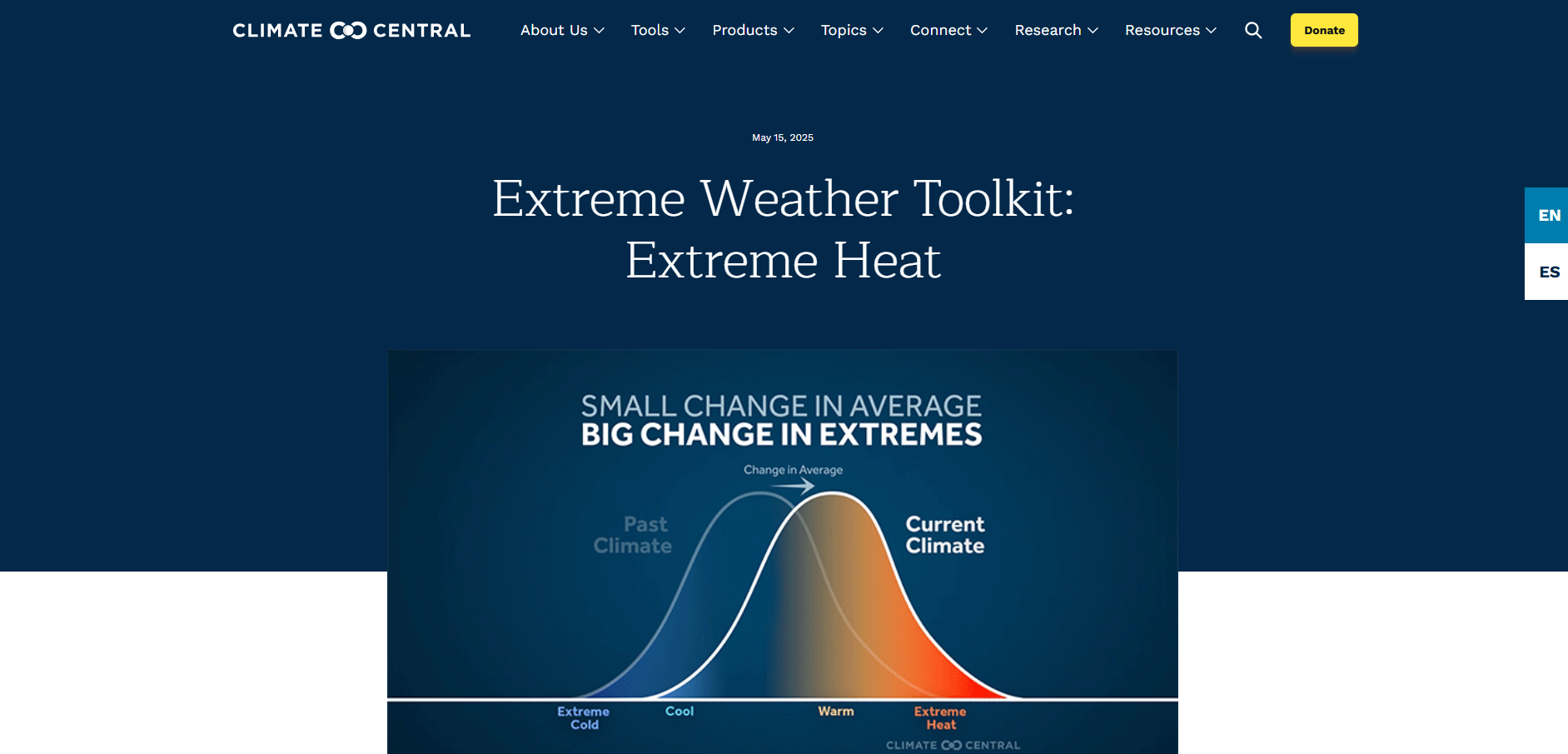
Extreme Weather Toolkit: Extreme Heat
A resource hub from Climate Central providing data, analysis, and visualisations on the trends and local impacts of extreme heat, including the Climate Shift Index and urban heat island studies.
2026 Sustainable investment trends
This report analyses sustainable investment trends for 2026, examining physical climate risk, the energy transition, and Asia’s leadership. It addresses the influence of artificial intelligence on power demand and emission targets, alongside structural challenges in the health care and food production sectors, highlighting resilience and adaptation as key priorities.


