

Trillions or billions: Reassessing the potential for european institutional investment in emerging markets and developing economies
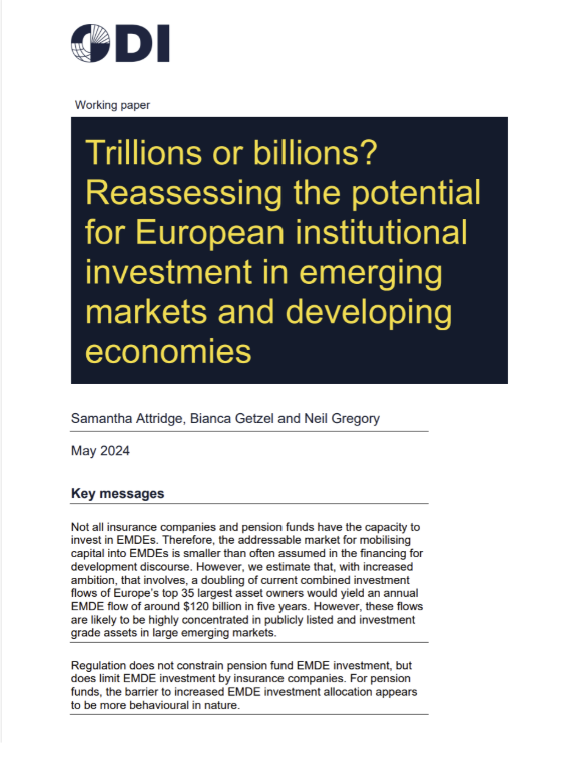
The report finds European pension funds and insurers have limited capacity to scale EMDE investment. Even doubling allocations by the 35 largest asset owners would yield about USD 120 billion annually, concentrated in investment-grade assets. Regulation constrains insurers more than pension funds.
Please login or join for free to read more.

OVERVIEW
Introduction
The report examines whether European insurance companies and pension funds (ICPFs) can materially increase investment in emerging markets and developing economies (EMDEs). Despite managing USD 25.7 trillion, institutional investment flows to EMDEs have stagnated since 2015. Changed financial conditions, evolving regulation and growing ESG expectations require a reassessment of realistic mobilisation potential.
Market overview
The analysis focuses on France, Germany, the Netherlands, Switzerland and the UK, which together manage USD 17.6 trillion in ICPF assets. The 35 largest ICPFs alone manage USD 6.9 trillion, representing the realistic addressable market. In 2022, these institutions allocated about USD 250 billion to EMDEs. Pension funds allocated on average 5–15% of assets, while insurance companies allocated 0–5%, with investment concentrated in investment-grade, publicly listed assets in large emerging markets.
Drivers of ICPFs’ investment behaviour: changing stakeholder expectations
Investment decisions are shaped by governments, trustees, beneficiaries, shareholders and civil society. Governments promote SDG and climate alignment, while beneficiaries increasingly express sustainability preferences, particularly in defined contribution (DC) schemes. However, most DC members remain in default funds, limiting active demand for EMDE exposure. Shareholders and civil society pressure insurers and asset managers to address ESG risks, especially climate and human rights, influencing asset selection.
Drivers of ICPFs’ investment behaviour: financial market conditions, cost and performance
From 2008 to 2021, low interest rates encouraged EMDE investment. Since 2022, higher developed-market yields and rising EMDE risk premia have reduced appetite. Over the long term, EMDE equities matched developed-market returns between 2002 and 2021, and EMDE bonds outperformed developed-market bonds in most years since 2008. However, EMDE investment carries higher management fees and transaction costs, particularly in private markets. Large funds can offset these costs through scale and manager selection.
Drivers of ICPFs’ investment behaviour: legal and regulatory frameworks
Pension fund EMDE investment is generally not constrained by regulation but by conservative interpretation of fiduciary duty. Insurance companies face binding constraints under Solvency II, including high capital charges and a “BBB cliff” that limits sub-investment-grade exposure. Capital requirements for non-OECD infrastructure are not aligned with historical credit performance. The report calls for recalibration of Solvency II and clearer guidance on fiduciary duty and sustainability preferences.
Findings and recommendations
Only a subset of ICPFs has capacity to invest in EMDEs. If the top 35 asset owners doubled current flows, annual EMDE investment could reach around USD 120 billion within five years, equivalent to total World Bank Group commitments but far short of EMDE financing needs. Achieving this would require sustained annual growth of around 20%. The report highlights roles for governments, MDBs and DFIs in de-risking investments, improving data, providing pooled vehicles and supporting market development.
Conclusion
Expectations of rapidly mobilising trillions from European institutional investors are unrealistic in the medium term. Incremental increases are feasible if regulatory barriers, investor behaviour and market infrastructure are addressed in a targeted manner. Progress will depend on tailored reforms, improved risk-sharing mechanisms and better alignment between sustainability objectives and investment frameworks.




