

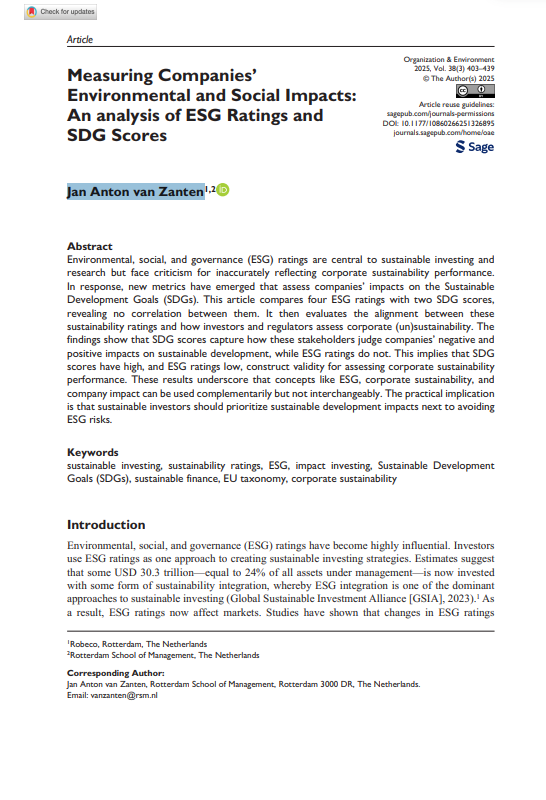
Measuring companies’ environmental and social impacts: An analysis of ESG ratings and SDG scores
This study compares ESG ratings with SDG scores across major providers. It finds little correlation. SDG scores align with investor exclusions and EU Taxonomy assessments, while ESG ratings largely measure financial risk exposure, not real-world environmental or social impacts.
Please login or join for free to read more.

OVERVIEW
Introduction
The paper examines whether ESG ratings accurately measure corporate sustainability performance. While ESG ratings are widely used in investment practice and research, they are criticised for reflecting financial risk exposure rather than companies’ real environmental and social impacts. The study compares ESG ratings with Sustainable Development Goal (SDG) scores to assess their alignment with how investors and regulators judge corporate sustainability.
Background and hypotheses
ESG ratings have evolved from a broad sustainability concept towards a focus on financially material ESG risks. This shift has created ambiguity, as ESG, sustainability performance, and impact are often used interchangeably. In response, SDG scores have emerged to assess companies’ positive and negative contributions to sustainable development using an “impact materiality” perspective.
The study hypothesises that SDG scores and ESG ratings should be negatively associated with investor exclusions and EU Taxonomy “do-no-significant-harm” (DNSH) violations, and positively associated with inclusion in sustainable thematic funds and EU Taxonomy-aligned revenues.
Data and methodology
The analysis uses SDG scores from Robeco and MSCI, and ESG ratings from MSCI, Sustainalytics, Refinitiv, and S&P. An intersection sample of 6,607 companies with complete coverage is constructed.
Stakeholder perceptions are proxied using: (i) exclusion lists from 28 large asset owners, covering 690 companies; (ii) holdings in 17 sustainable thematic funds (energy, water, healthcare); and (iii) EU Taxonomy indicators, including DNSH breaches and the share of taxonomy-aligned revenues.
Correlation analysis, quartile matching, treatment–control comparisons, and regression models are applied, controlling for sector, region, size, and financial fundamentals.
Results
Correlation between SDG scores and ESG ratings is low, ranging from −0.03 to 0.33. Companies ranking highly on SDG scores are almost equally likely to fall into any ESG rating quartile. SDG scores vary strongly by sector, with energy companies scoring poorly and healthcare and water-related firms scoring better, but show limited regional variation. ESG ratings show the opposite pattern, with stronger regional differences and weaker sectoral tilts.
Treatment–control tests show that companies excluded by investors or breaching the EU Taxonomy DNSH principle have significantly lower SDG scores, while companies held in sustainable thematic funds or generating high taxonomy-aligned revenues have higher SDG scores. These effects are statistically and economically significant, particularly for the Robeco SDG score.
By contrast, ESG ratings show weaker and inconsistent alignment. MSCI and Sustainalytics ESG ratings capture some negative impacts but largely fail to reflect positive sustainability contributions. Refinitiv and S&P ESG ratings often do not distinguish between sustainable and unsustainable companies once controls are applied.
Discussion
The findings indicate that SDG scores have high construct validity for measuring corporate sustainability impacts, while ESG ratings primarily measure exposure to ESG-related financial risks. As a result, ESG ratings and SDG scores are not interchangeable but complementary. For investors, reliance on ESG ratings alone risks greenwashing, as such strategies may include companies with harmful impacts and overlook firms providing sustainability solutions. Incorporating SDG scores alongside ESG ratings can better support “double materiality” approaches, aligning with European sustainable finance regulation.
Limitations and future research
The study focuses mainly on Western investors and environmental aspects of regulation, which may limit generalisability. It also uses aggregated scores rather than sub-components and examines current, not transition, sustainability performance. Future research could extend the analysis to other regions, social dimensions, and dynamic measures of corporate sustainability transitions.
Conclusion
The study concludes that SDG scores better reflect how investors and regulators assess corporate sustainability impacts, while ESG ratings do not. Using SDG scores alongside ESG ratings can improve sustainable investing practices and research by distinguishing financial risk management from real-world environmental and social impact.




