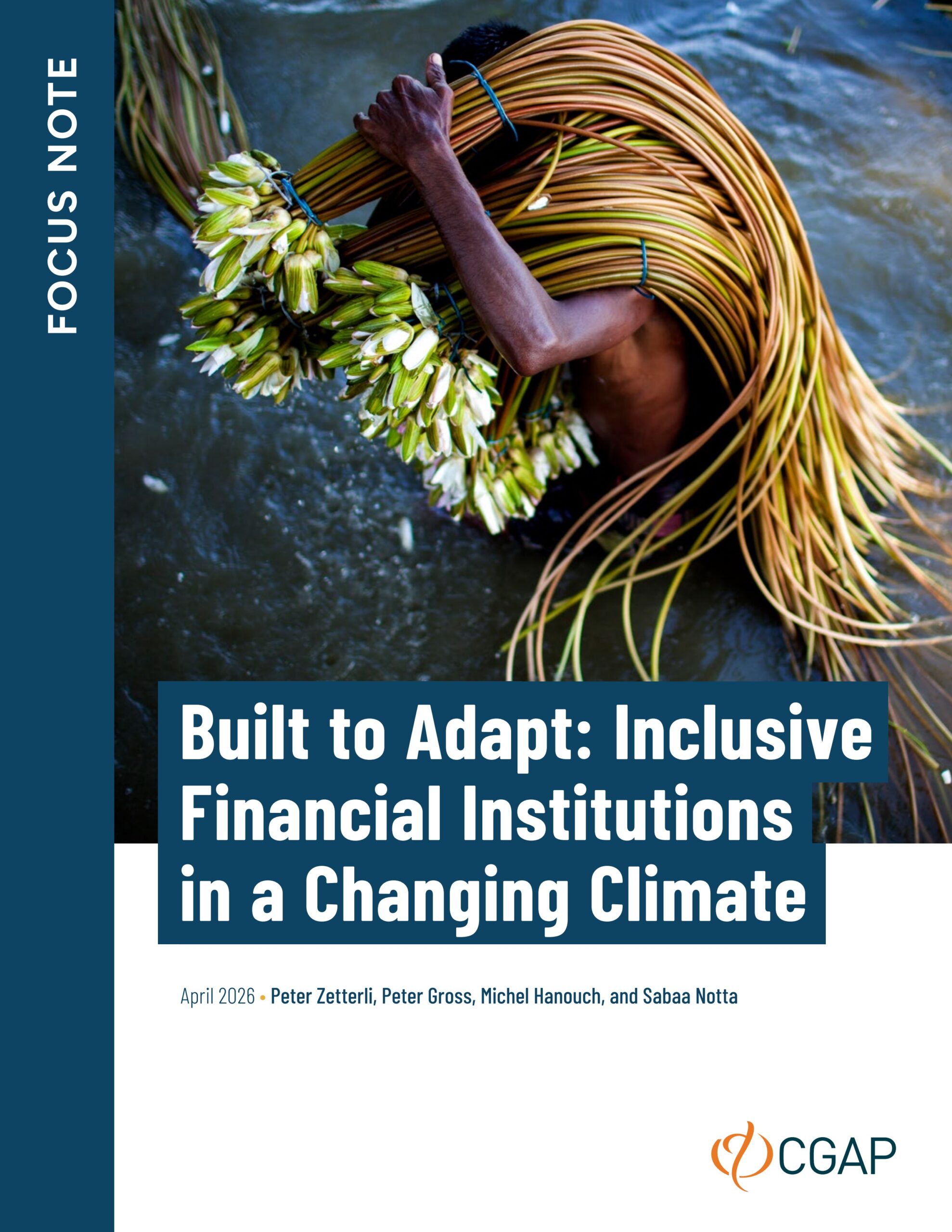
Built to adapt: Inclusive financial institutions in a changing climate
This report explores how inclusive financial institutions can build climate resilience for themselves and their clients. It outlines strategies for risk assessment, innovative risk financing, and adapting product offerings. By adopting a mutually beneficial approach, providers can maintain their social mission while navigating intensifying climate impacts.
Please login or join for free to read more.

OVERVIEW
Chapter 1: Introduction
Climate change poses a systemic threat to financial inclusion. In low-income countries, 1 in 3 adults personally suffered climate impact in the last three years (page 3). However, global funding is largely focused on mitigation, with just 3.4 percent dedicated to financing adaptation (page 4). Financial service providers (FSPs) face the dual challenge of protecting their portfolios and supporting vulnerable clients. Traditional post-shock responses can exacerbate crises; for example, in Pakistan, 40 percent of microfinance institutions have reduced or stopped lending to climate-affected sectors (page 3).
Chapter 2: Developing a climate-resilient strategy
FSPs currently exhibit six common but often insufficient responses to climate risk, ranging from risk avoidance to a focus solely on green finance. A more effective strategy requires a win-win approach that prioritises both customer and FSP resilience in lockstep. By asking targeted questions about the likelihood and impact of climate risks, institutions can identify priority gaps in their product portfolios and risk management practices.
Chapter 3: Risk assessment
Physical climate risk assessments must function as strategic decision-making tools rather than mere compliance exercises. If treated as a tick-box activity, these assessments risk pushing institutions to exit vulnerable regions entirely. When executed effectively, they provide actionable data that allows strategy, product, and risk teams to make informed decisions that support clients who need adaptation assistance the most.
Chapter 4: Risk financing
Managing climate risk on the balance sheet requires moving beyond economically inefficient capital buffers. The report advocates for a risk-layering approach to safeguard solvency and liquidity following a disaster. By leveraging a combination of reserves, meso-level insurance, and contingent finance tools, FSPs can remain robust enough to continue lending responsibly in affected areas instead of retreating during crises.
Chapter 5: Adapting the product suite for climate resilience
To better support client resilience, institutions must iterate on their existing product offerings and introduce new solutions. This includes quick wins such as extending loan tenors, offering more flexible repayment terms, and implementing post-disaster loan management policies. At the next level, FSPs should explore innovations like recovery lending programmes, contingent lines of credit, and anticipatory financing. Crucially, these adaptation solutions must be designed to work effectively for women, who are often disproportionately affected by climate shocks.
Final reflections: Looking forward
For institutions built on financial inclusion, transitioning to a model built to adapt is essential. The choices FSPs make regarding climate resilience will shape the future viability of their business and the long-term wellbeing of their clients. Prioritising these strategies is no longer optional but a fundamental requirement for sustainable operations.