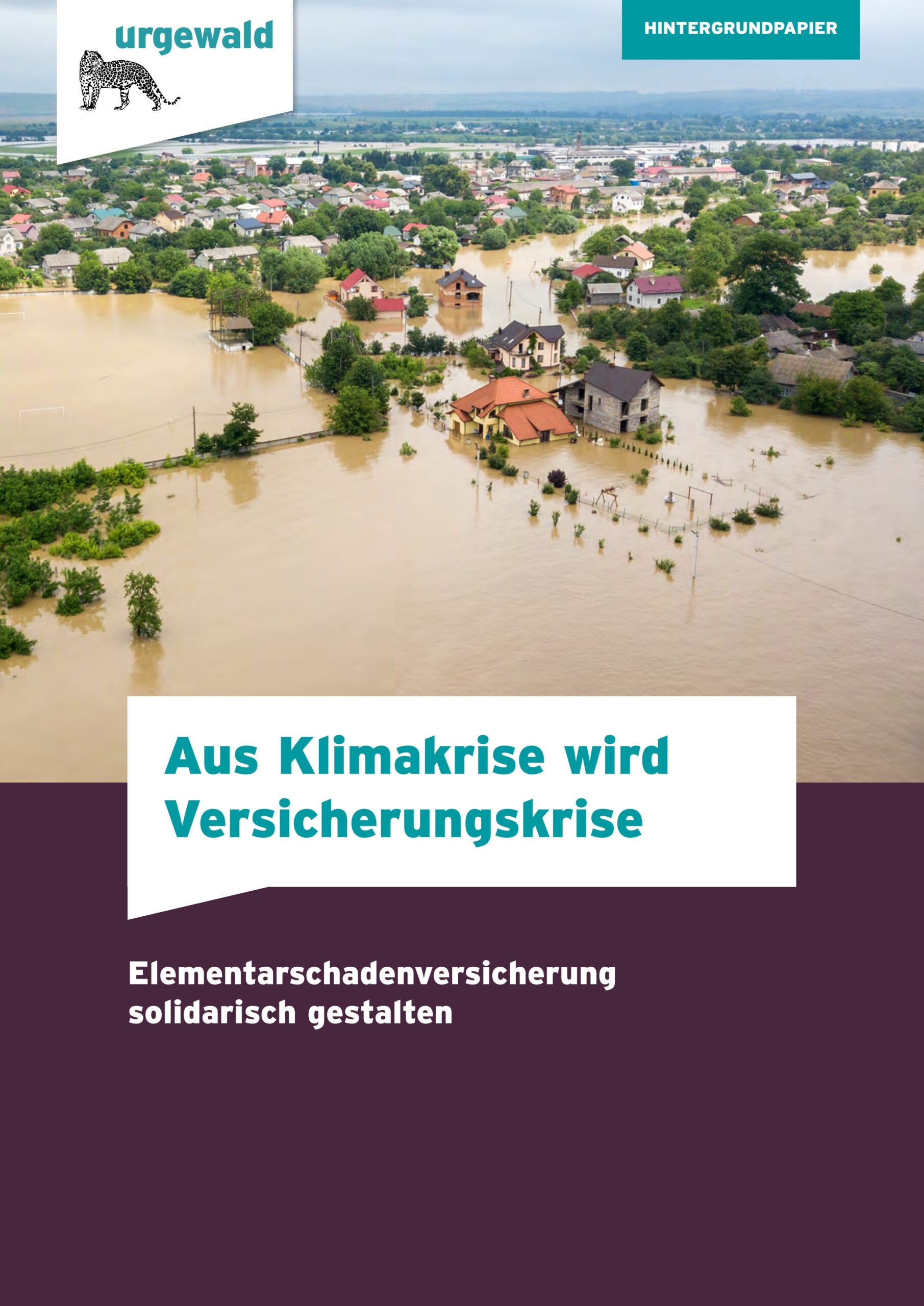
From climate crisis to insurance crisis: Designing solidarity-based natural disaster insurance
This report examines rising climate-related insurance losses and Germany’s lack of comprehensive natural disaster coverage, with only 57% of residential buildings insured against such risks. It analyses international public-private insurance models — particularly France’s CatNat system — and recommends a solidarity-based approach alongside measures to hold the fossil fuel industry financially accountable.
Please login or join for free to read more.

OVERVIEW
Introduction
The climate crisis is driving rising economic losses from extreme weather events. Munich Re estimates global natural disaster damages at USD 224 billion in 2025 (p. 7) and USD 320 billion in 2024 (p. 7). The report examines how insurance systems can equitably share climate risk, with a focus on Germany and international models.
Development Of Climate-Related Damages
Anthropogenic climate change caused USD 2.86 trillion in damages from 2000 to 2019, representing 53% of all recorded weather-related losses (p. 9). Globally insured climate-related losses were estimated at USD 475–720 billion for 2002–2022 (p. 10). EU natural disaster costs totalled EUR 900 billion from 1981 to 2023, with approximately one fifth concentrated in 2021–2023 (p. 11). Germany’s 2021 Ahrtal flood disaster killed more than 180 people and generated approximately EUR 11.55 billion in insured losses (p. 11).
The Insurance Crisis
Countries in the European Economic Area with public-private insurance systems averaged 47% natural disaster coverage, versus just 18% in countries without such systems (p. 13). In Germany, only 57% of residential buildings hold natural disaster insurance despite at least 96% having basic building cover (p. 13). Federal and state governments provided EUR 30 billion in emergency funds after the Ahrtal disaster (p. 14).
The Role Of Insurers As Drivers Of The Crisis
Despite facing rising climate damages, major insurers continue to support fossil fuel industries. Total fossil fuel investments by 24 insurers reviewed in the Insure Our Future Scorecard 2024 amounted to USD 159 billion as of May 2024 (p. 17). The global fossil insurance market was estimated at USD 22.5 billion in gross premiums in 2024 (p. 17). Of 36 German building insurers reviewed, 71% had coal exclusion criteria, but fewer than half excluded oil and oil sands (p. 17–18).
The Debate On Natural Disaster Insurance In Germany
Germany’s federal-state working group (BLAG) concluded without consensus: states favour mandatory insurance while the federal government prefers an opt-out model. The GDV’s December 2025 “Elementar Re” proposal aims to reduce premiums for high-risk homes from EUR 1,500 to EUR 1,200 (p. 22), but urgewald and the Bund der Versicherten criticise this as insufficient and unsolidary. The current coalition agreement provides for an offer obligation with opt-out and state reinsurance. The report recommends construction bans in high-risk zones and expanded flood protection infrastructure.
The French “CatNat” System
Since 1982, France’s CatNat system has mandatorily coupled natural disaster coverage to basic building and motor insurance, achieving 98% coverage at an average annual premium of approximately EUR 42 (p. 24–25). State funds were drawn on only once — EUR 263 million after storms Lothar and Martin in 2000, against total damage of approximately EUR 21 billion (p. 25). Legal analysis confirms a comparable system would be compatible with German law. Prevention is funded through the Barnier Fund, financed directly from insurance premiums.
Insurance Systems In Other Countries
Switzerland achieves approximately 95% building coverage through cantonal public-law insurers, with around 30% of premiums invested in prevention (p. 28–29). Spain’s 1954 state monopoly is effective but cannot be replicated under current EU law (p. 29). The UK’s Flood Re (established 2016) benefits approximately 2% of homeowners in high-risk zones and is set to expire in 2039 (p. 30).
Holding The Fossil Fuel Industry Accountable
Insurers could employ “subrogation” to recover climate damage payouts from fossil fuel companies, though no insurer has yet done so (p. 31). Vermont and New York enacted “Climate Superfunds” in 2024, requiring fossil fuel companies to contribute based on historical emissions; New York’s fund is set at USD 75 billion over 25 years (p. 32). The report recommends comparable mechanisms for Germany and Europe.
Conclusion
The report calls for a solidarity-based, affordable public-private natural disaster insurance model in Germany — citing France as the primary reference — combined with stringent fossil fuel exclusions for insurers and mechanisms to hold the fossil fuel industry financially accountable for climate damages.