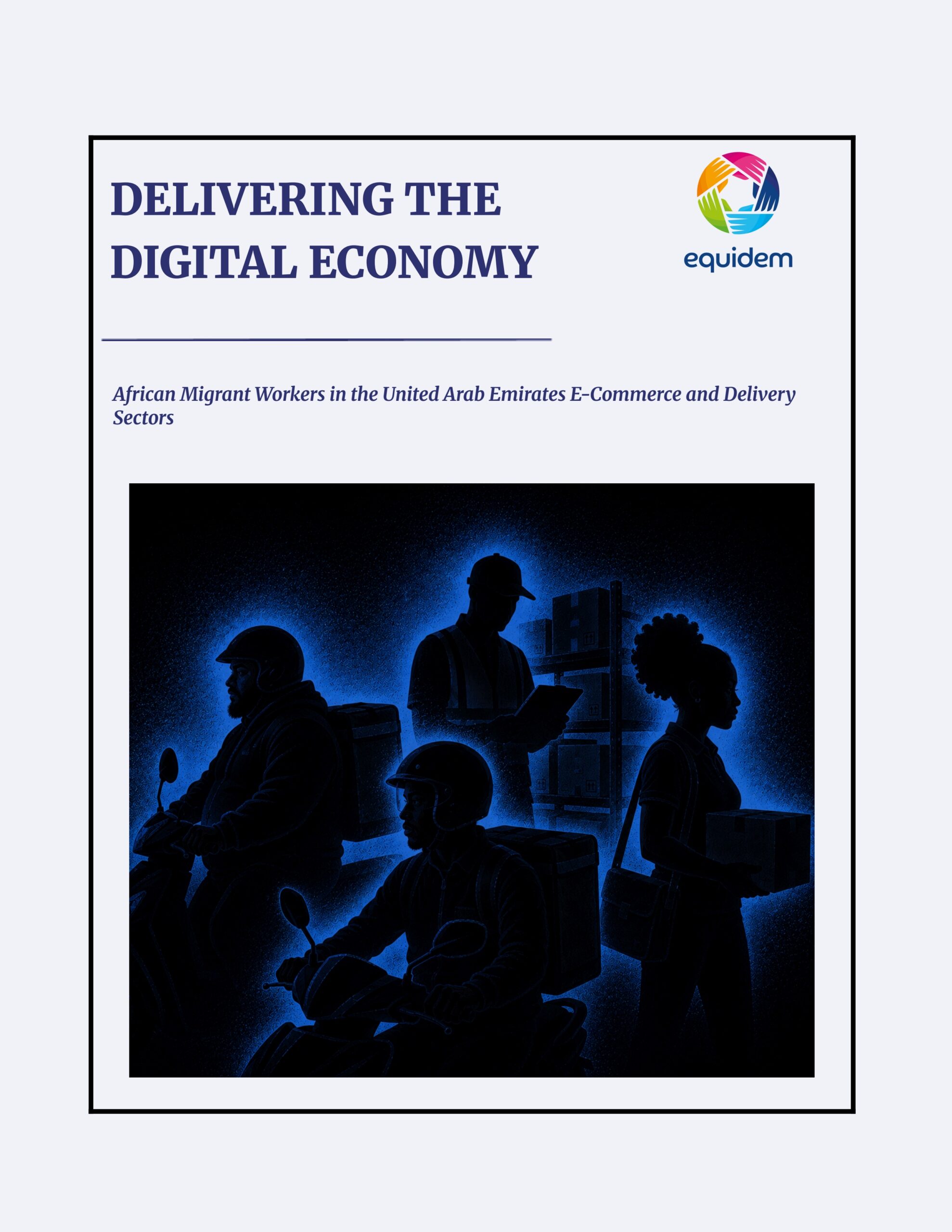
Delivering the digital economy: African migrant workers in the United Arab Emirates e-commerce and delivery sectors
This report examines the exploitation of African migrant workers within the United Arab Emirates’ e-commerce and delivery sectors. It details systemic abuses including recruitment debt, deceptive contracts, and excessive working hours, highlighting how subcontracting models fragment accountability. The findings advocate for stronger international labour standards to protect vulnerable platform workers.
Please login or join for free to read more.

OVERVIEW
Introduction
The rapid growth of the digital platform economy in the United Arab Emirates (UAE) has transformed urban life, but this system is sustained by a hidden workforce of migrant workers. African migrant workers from countries including Kenya, Uganda, Ghana, Cameroon, and Sudan are increasingly central to this labour force. Research by Equidem reveals that these individuals often encounter labour systems marked by debt-financed migration, subcontracting, surveillance, and precarious work. Their experiences highlight how technological innovation in the platform economy relies on deeply unequal labour systems, where vulnerabilities are shaped by race, migration status, and debt. Exploitation often begins long before workers log onto an application, driven by recruitment debt and migration dependency.
Methodology
This briefing is based on testimonies collected from 13 African migrant workers employed in e-commerce logistics and delivery systems in the UAE and Saudi Arabia. The participants originated from Cameroon, Ghana, Uganda, Kenya, and Sudan. The research provides new evidence reinforcing Equidem’s previous report, “Free To Be Exploited”, which documented rights violations such as forced labour, wage theft, and extreme weather exposure. To protect workers from retaliation, all testimonies have been anonymised with pseudonyms, as many expressed fear that speaking publicly could result in dismissal, visa cancellation, or deportation.
African migrant workers in UAE e-commerce logistics
The UAE has emerged as one of the fastest-growing digital commerce markets in the Gulf region, generating high demand for low-cost labour to sustain rapid delivery infrastructures. African workers are increasingly entering these markets due to unemployment and economic insecurity in their home countries. They often migrate based on promises of stable employment and higher wages, only to find themselves dependent on restrictive migration regimes and platform logistics systems.
Third-party logistics firms and fragmented accountability
A defining feature of the UAE delivery sector is the widespread use of third-party logistics firms (3PLs). Rather than directly employing riders, platform companies outsource recruitment, management, and payroll to subcontractors. This model creates confusion for workers regarding their actual employer and where responsibility lies when abuses occur. Workers often wear the branding of major platforms while being formally employed by separate firms. Testimonies suggest this structure allows platform companies to maintain operational control over work allocation and productivity while distancing themselves from direct labour responsibility, creating major barriers to accountability and remedy.
Rights violations facing African migrant workers in e-commerce and delivery
Workers reported paying substantial recruitment fees to secure employment, often borrowing money or selling personal property. For example, one rider reported paying USD 650 in Ghana and later having AED 4,800 deducted from his salary for a driver’s licence. Deceptive recruitment practices are common; workers frequently find that the salary and benefits promised differ substantially from reality. One Ghanaian rider noted that a promised basic salary of AED 2,080 was actually AED 500 upon arrival. Additionally, workers are often required to work significantly longer hours than specified in their contracts without receiving overtime pay.
Excessive working hours and unsafe conditions
Workplace systems are organised around strict delivery targets and algorithmic pressure. Failure to meet these targets results in wage deductions, disciplinary threats, or loss of incentives. Workers described shifts of 12 to 18 hours, sometimes working 14 consecutive days without a rest day. These conditions lead to severe physical exhaustion, chronic pain, and heat stress. One Ugandan worker described an accident caused by the combined pressure of 18-hour shifts and constant calls from customers and supervisors. The research underscores the need for international standards to address target-based overwork as an occupational safety risk.
Wage insecurity and financial pressure
Migrant workers reported not receiving overtime payments despite consistently exceeding contractual hours. Unexplained salary deductions and delays are frequent, with some payments delayed by up to five days. These opaque incentive systems transfer substantial economic risk onto workers. The findings reinforce the need for binding standards requiring transparency in wage calculations and protection against unfair deductions.
Workplace violence
African migrant workers experience overlapping forms of workplace violence, including racial and nationality-based discrimination. Testimonies indicate that African workers are often assigned more difficult routes, denied promotions, or subjected to verbal abuse and intimidation from supervisors. One Ugandan worker reported a supervisor telling him, “You black people want to behave like lawyers but soon you’ll be eliminated.” This environment of racialised control and humiliation inflicts significant psychological harm and emotional distress.
Barriers to remedy and fear of retaliation
Fear of retaliation is a major barrier to seeking remedy. Workers reported that raising complaints often leads to direct retaliation, such as contract non-renewal. The fragmented accountability of the 3PL model leaves workers uncertain about where to file grievances. One Ghanaian associate noted that if workers expressed dissatisfaction, they were simply told, “if you don’t like it, leave.”
Annex: recommendations by draft article for ILC negotiations on decent work in the platform economy
The report provides specific recommendations for International Labour Organization (ILO) negotiations. Key suggestions include ensuring the Convention explicitly covers workers in subcontracting chains and 3PLs where platforms exercise operational control. It recommends strengthening remuneration provisions to prohibit workers from bearing recruitment or licensing costs and requiring transparency in algorithmically managed wage systems. Furthermore, the report calls for enforceable limits on working hours, guaranteed rest periods, and explicit recognition of racial discrimination and psychosocial risks as forms of workplace violence and harassment that must be mitigated by platform companies.