

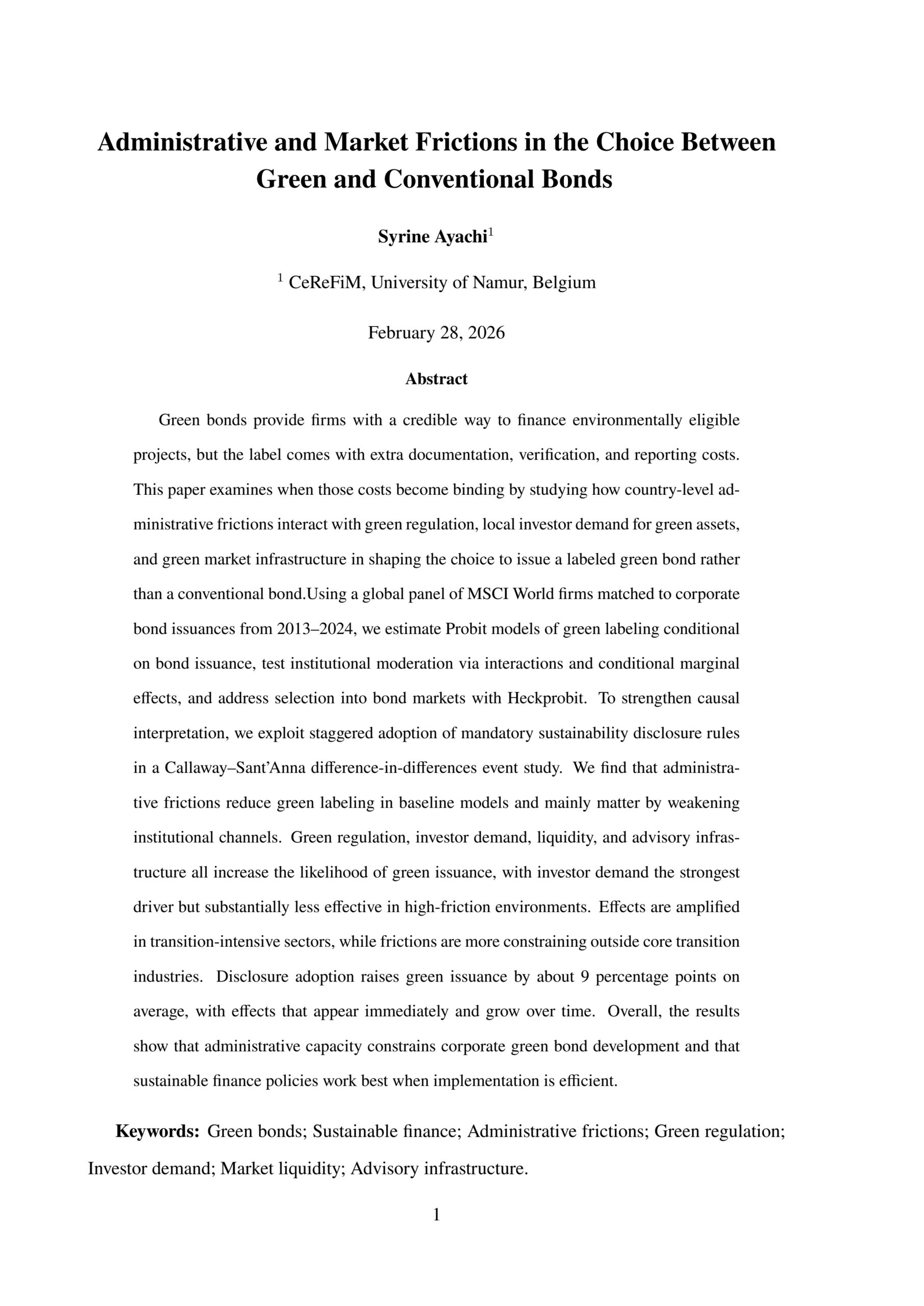
Administrative and market frictions in the choice between green and conventional bonds
This research investigates how administrative frictions and institutional environments influence corporate green bond issuance. Using global data from 2013–2024, it finds that bureaucratic complexity reduces green labelling probability, particularly outside transition-intensive sectors. Mandatory sustainability disclosure significantly increases issuance, highlighting the importance of efficient implementation for sustainable finance policies.
Please login or join for free to read more.

OVERVIEW
Introduction
Green bonds have emerged as a significant instrument within sustainable corporate finance, providing a labelled channel for firms to fund environmentally eligible projects and commit to specific reporting standards. Over the past decade, the market has expanded rapidly alongside the development of green taxonomies and disclosure regimes. However, this growth raises the question of why firms choose to bear the additional costs of documentation, verification, and reporting associated with green labels when they could finance projects through conventional debt. This research examines how country-level administrative frictions, green regulatory frameworks, local investor demand, and market infrastructure jointly shape the probability that a bond issuance is labelled green rather than conventional.
Literature review and hypotheses
The existing literature on green bonds is categorised into three strands: pricing effects, real environmental outcomes, and institutional determinants. Evidence suggests a “greenium” or yield differential may exist, where investors accept lower yields for certified green securities. This paper builds on these insights by developing testable hypotheses regarding administrative frictions. It posits that higher country-level administrative costs and bureaucratic complexity reduce the likelihood of green bond issuance. Furthermore, it explores how stronger regulatory frameworks, local investor demand, and developed market infrastructure increase the propensity for green labelling, though these effects are conditional on the administrative environment.
Data
The study uses a global panel of MSCI World firms matched to corporate bond issuances from 2013 to 2024. This dataset combines labelled green bonds from the Climate Bonds Initiative and Refinitiv with conventional corporate bonds. Firm-level financial characteristics and country-level institutional variables are drawn from multiple sources, including the International Country Risk Guide (ICRG). Administrative frictions are constructed as the inverse of the bureaucratic quality index, ensuring higher values consistently reflect greater procedural burdens.
Methodology
The empirical design treats green labelling as a discrete choice conditional on bond issuance, utilising Probit models with year and industry fixed effects. The analysis tests institutional transmission channels by interacting administrative frictions with green regulation, demand, and advisory infrastructure. To address potential selection bias into bond markets, a Heckprobit model is estimated. For causal interpretation, the study exploits the staggered adoption of mandatory sustainability disclosure regulation using a Callaway–Sant’Anna difference-in-differences event-study framework with doubly robust inverse probability weighting.
Results
The findings indicate that institutional and market features are first-order determinants of green labelling. Administrative frictions are negatively associated with issuance, primarily by weakening institutional channels. Green regulation, investor demand, liquidity, and advisory infrastructure all increase the likelihood of green issuance. Investor demand emerges as the strongest driver; however, its effectiveness is substantially reduced in high-friction environments. In high-transition sectors, investor demand increases issuance probability by 56 percentage points, compared to 11.7 percentage points in low-transition sectors.
The quasi-experimental analysis shows that mandatory sustainability disclosure adoption raises the probability of green bond issuance by approximately 9 percentage points on average. These effects appear immediately and strengthen over time, reaching a 14.2 percentage point increase five years after adoption. Within low-transition sectors, a one-unit increase in administrative frictions reduces issuance probability by approximately 7.8 percentage points, while the effect in high-transition sectors is not precisely estimated despite being economically large.
Discussion
Administrative frictions represent a significant institutional wedge that can dampen the effectiveness of enabling mechanisms like investor appetite and regulatory clarity. While financial and reputational benefits of green labelling exist, they are conditional on a broader implementation environment that keeps incremental costs manageable. The results explain why the supply of green assets responds unevenly across countries despite similar investor preferences. Market infrastructure, including liquidity and advisory depth, facilitates adoption but cannot fully substitute for efficient public administration. Sectoral heterogeneity suggests that frictions are most constraining outside core transition industries where green financing is less structurally embedded.
Conclusion
The research concludes that expanding corporate green bond markets requires more than ambitious frameworks or investor interest; it necessitates an implementation environment that maintains manageable costs. Administrative capacity is identified as a core institutional mechanism rather than a background condition. Policy recommendations for regulators include streamlining administrative procedures and strengthening verification ecosystems. Sustainable finance policies, such as taxonomies and disclosure mandates, are most effective when paired with efficient administrative systems, particularly when aiming to broaden adoption beyond concentrated sectors and jurisdictions.




