

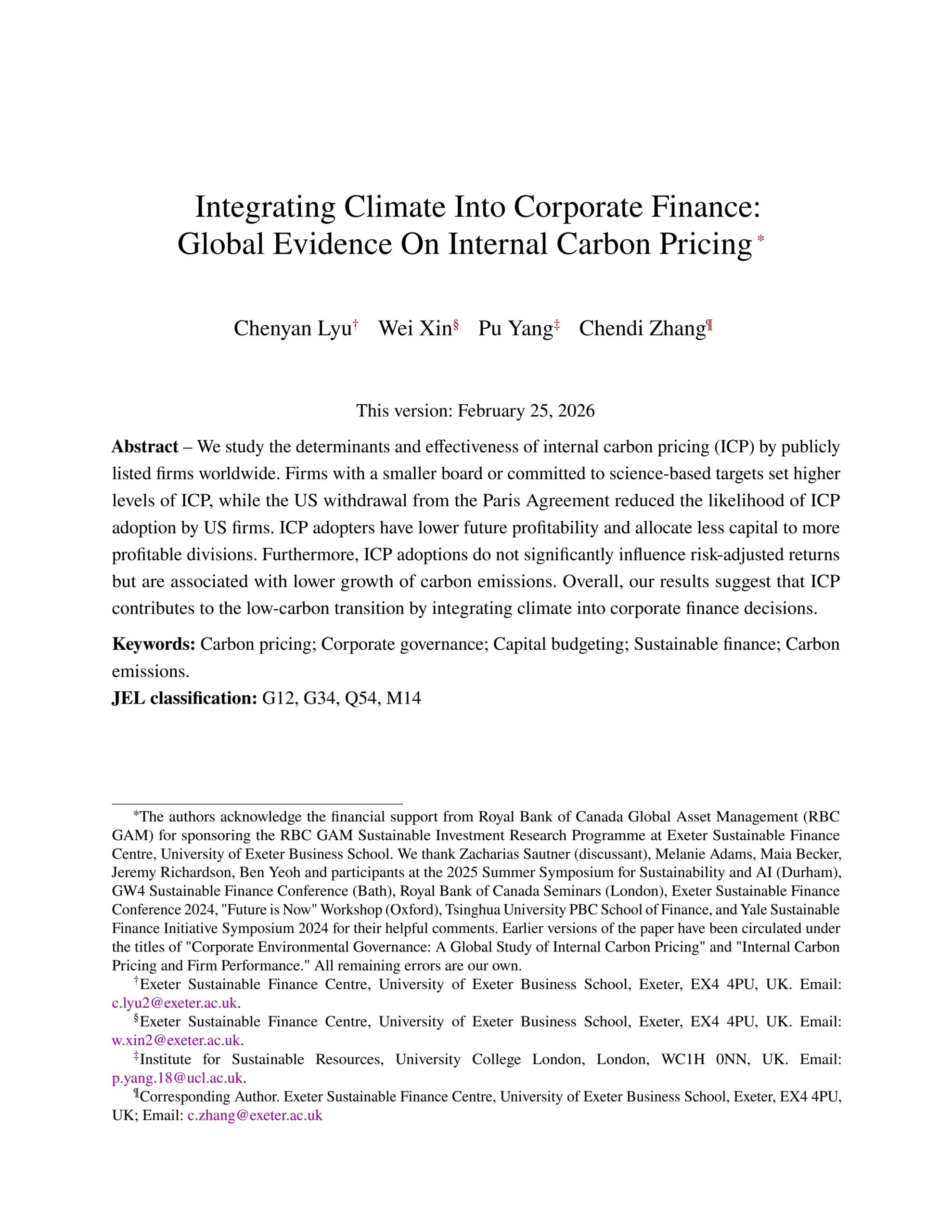
Integrating climate into corporate finance: Global evidence on internal carbon pricing
This report analyses the determinants and effectiveness of internal carbon pricing (ICP) globally. It finds that smaller boards and science-based targets drive higher pricing. While ICP adoption reduces short-term profitability due to capital reallocation, it successfully slows emission growth, even as absolute emissions remain linked to production.
Please login or join for free to read more.

OVERVIEW
Introduction
Climate change is now one of the most significant global challenges, compelling policymakers and businesses to take action. As nations aim to meet the objectives of the Paris Agreement, corporations are increasingly implementing voluntary mechanisms. Amongst these, internal carbon pricing (ICP) has emerged as a prominent tool for integrating climate action into corporate finance and governance. By 2021, nearly half of the world’s 500 largest companies had implemented or planned an ICP. Regulatory pressures are also increasing, with the IFRS Sustainability Disclosure Standard requiring entities to disclose how ICP is utilised in decision-making from January 2024.
Institutional background and related literature
The adoption of ICP has grown steadily over the last decade, following early experiments like BP’s internal emissions trading system in 1998. Existing research suggests that firms adopt these strategies to support internal decision-making, signal environmental commitment, or anticipate future explicit carbon policies. Previous empirical evidence links adoption to stringent climate regulations, carbon-intensive sectors, and strong corporate governance. This study provides a comprehensive global analysis of the drivers and effectiveness of these mechanisms across 54 jurisdictions.
Five types of ICP
The Carbon Disclosure Project (CDP) classifies ICP into six categories: shadow price, implicit price, internal fee, internal trading, offset, and others. Shadow prices dominate the landscape, accounting for approximately 53% of all type-level ICP, followed by implicit prices at 16.6%. Shadow prices typically carry the highest median value at $33/tCO2e, while offsets reflect the lowest at approximately $14/tCO2e. These mechanisms differ fundamentally in purpose, ranging from strategic forward-looking tools to operational market-based substitutes.
Data
The research utilises a panel of 2,024 unique listed firms (8,604 firm-year observations) reporting to the CDP between 2014 and 2021. This sample includes 697 adopters across 54 developed and developing markets. ICP engagement is highly concentrated in five jurisdictions: Japan, the United States, the Republic of Korea, the United Kingdom, and Canada. Sectorally, technology, financials, industrials, energy, and basic materials show the highest concentration of firms engaging in ICP reporting. Average price levels vary significantly, with health care exhibiting the highest average price of $117.95/tCO2e.
The determinants of ICP
Research findings indicate that firms with smaller, more agile boards set significantly higher internal carbon prices; each one-member reduction in board size is associated with a 5% increase in the ICP level. Furthermore, adopting science-based targets (SBTs) increases the probability of ICP adoption by 14.5% and raises average price levels by 18.5%. External policy signals also play a critical role. For instance, the United States’ withdrawal from the Paris Agreement in 2017 was associated with a noticeable decline in ICP adoption amongst U.S. firms.
Internal carbon pricing and financial performance
The study assesses the financial consequences of adoption using measures such as return on assets (ROA) and operating profit margin (OPM). Profitability declines significantly following adoption, with ROA falling by approximately 0.05% and OPM by roughly 0.4% in the subsequent two years. This decline is attributed to internal capital reallocation. Following adoption, firms shift capital expenditure away from divisions with high ROA towards those with lower profitability, likely investing in the low-carbon transition. However, the study finds no significant impact on future risk-adjusted stock returns, suggesting that these financial effects are already priced in by the market.
Does ICP reduce future emissions?
In terms of environmental effectiveness, ICP adoption reduces the rate of emission growth over the next two years, flattening the emissions-growth curve. Higher ICP levels predict lower emission intensity, with a 1% increase in the price associated with a 3.4% reduction in one-year-ahead intensity. Despite these efficiency gains, the overall impact remains limited; firms with higher ICP levels still produce significantly higher total emissions, suggesting their carbon footprints have not yet peaked. This indicates that voluntary internal pricing alone yields limited decarbonisation benefits in the short term.
Conclusion
Overall, the evidence suggests that internal carbon pricing is a genuine tool for integrating climate considerations into corporate finance rather than a purely symbolic gesture. However, it is not a ‘free lunch’, as it imposes measurable short-term costs on firm profitability. Achieving meaningful decarbonisation will likely require complementary measures, including stricter regulatory standards, technological innovation, and a broader integration of sustainability into overall corporate strategy alongside voluntary initiatives.




