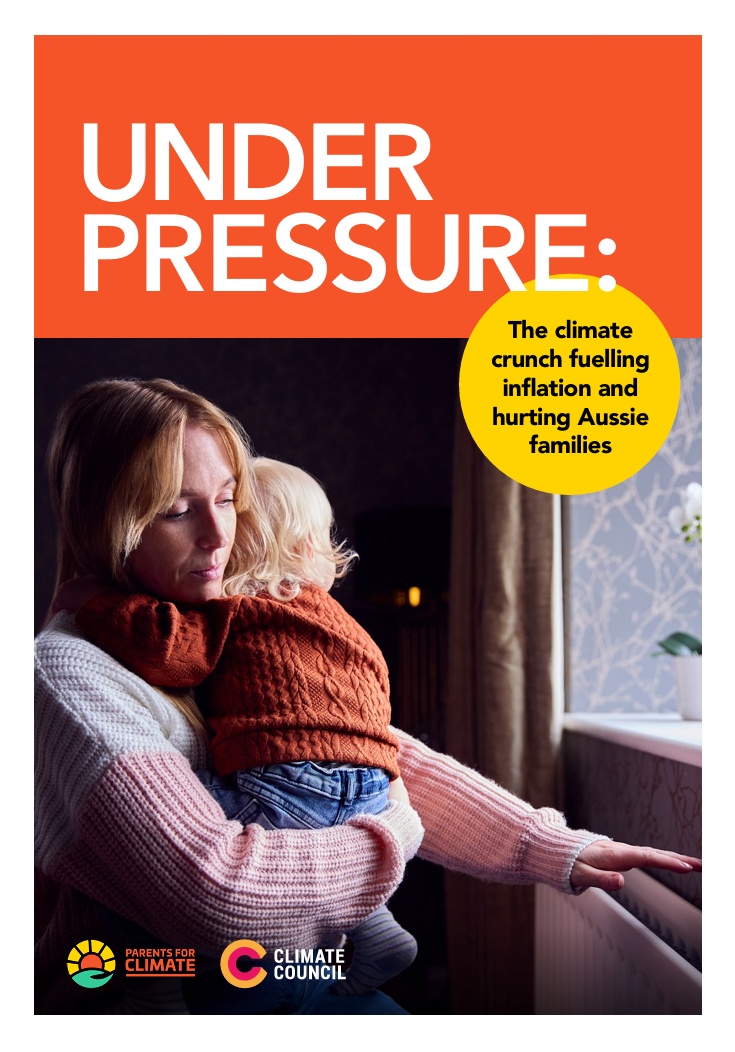
Under pressure: The climate crunch fuelling inflation and hurting Aussie families
This report examines how reliance on fossil fuels exacerbates Australia’s cost of living crisis. It highlights how climate-driven disasters inflate insurance premiums and how transitioning to clean energy could reduce household expenses, providing financial relief and health benefits for families currently struggling under the weight of rising inflation.
Please login or join for free to read more.

OVERVIEW
Key findings
The climate crisis is driving up the costs of insurance for all Australians as extreme weather events become more common and intense. Risks to life and property are worsening, and premiums are rising in response. Collectively, Australians are paying $30 billion more today on insurance than they were only 10 years ago. Many households at higher risk of extreme weather are being priced out of insurance altogether as it becomes too difficult or expensive to source coverage. Australians are also paying significantly more to power their homes with gas and refuel their cars. Filling up a 70-litre tank of petrol costs about $30 more now than it did at the start of 2020. These higher fossil fuel costs are fuelling inflation, increasing the price of everyday items like groceries. For instance, the gas bill for a four-bedroom home in Victoria has jumped by as much as $750 per year since 2020.
Rising inflation and a reliance on expensive oil and gas are crunching household budgets, with many families reporting they are under significant stress. Three in 10 parents polled reported struggling to afford food, power bills, or insurance either frequently or all of the time. As a result, 85 percent of parents polled said they were having to cut back on essential items, and 77 percent reported that this was significantly impacting their own wellbeing and that of their families. Motorists who rely on petrol cars are currently forking out $2,000 more each year on fuel than those able to drive an electric vehicle.
1. Introduction
Australia has entered the ‘era of climate consequences’, with 84 percent of households already impacted by climate change since 2019. Climate pollution from burning coal, oil, and gas is fuelling increasingly severe bushfires, floods, heatwaves, and destructive storms. This research paints a clearer picture of how fossil fuels are not only adding to pollution but also pushing up inflation. Domestic inflation reached its highest level in more than 30 years, with the cost of everyday items increasing by an average of 22 percent since the start of 2020. The price of oil and gas has risen much more than other goods, putting immense pressure on family budgets. Consequently, Australian children are suffering and missing out on necessities like quality, healthy food and meaningful activities with family and friends.
2. Fossil fuels are compounding the cost of living crisis for families
Fossil fuels like oil and gas are making inflation worse and life less affordable. Fuel prices have increased by a whopping 38 percent more than overall inflation since 2020. Higher petrol and diesel prices increase the cost of transporting consumer goods, and these costs are ultimately borne by consumers. Average household gas bills have also spiked; a four-person household may see increases ranging from $100 in Queensland to over $750 in Victoria. Using electric alternatives for heating and cooking is consistently cheaper and more efficient. However, the cost gap has become eye-watering, with the difference between electric heating and gas jumping almost 300 percent since 2018. Additionally, unnatural disasters are pushing up insurance prices, with 1.6 million Australian households experiencing home insurance affordability stress in the past year, a 30 percent increase.
3. As families cut back, kids miss out
Two in three families have been forced to cut back on heating and cooling their homes, and some have stopped using them altogether (15 percent for heating and 12 percent for cooling). Living in houses that are too hot or cold (above 24°C or below 18°C) has significant adverse health effects and is a contributing factor in at least six percent of deaths in Australia each year. Food insecurity is also rising, with 53 percent of families cutting back on the quality and quantity of food, including skipping meals. Parents report making other sacrifices that impact children, such as cutting back on sport, recreation, or missing out on school excursions. Polling reveals that 71 percent of Australian families are concerned about both the cost of living and the climate crisis, fearing that climate-driven extreme weather will lead to higher grocery prices and power bills.
4. Re-powering Aussie homes with clean energy lowers the costs of living but is out of reach for too many families
Rooftop solar can reduce energy bills by 40 to 60 percent, saving the average household more than $1,500 a year. While 88 percent of parents have or would consider rooftop solar, upfront costs remain a primary barrier for 54 percent of those without it. Renters face additional challenges, as they are three times less likely to have access to solar and are more likely to live in poorly insulated homes. Landlords often lack the incentive to make efficiency upgrades because tenants are the ones paying the electricity bills. This results in millions of families being locked out of savings because they do not own their homes.
5. Conclusion
Millions of Australian families are living on a financial tightrope, trying to make ends meet in a crisis exacerbated by fossil fuels. Failing to make practical choices that address both the cost of living and climate crises risks a more dangerous future. A 3°C warmer world would see more intense heatwaves, droughts, cyclones, and storms, resulting in devastating economic and environmental consequences for future generations. Enabling families to access cheap, efficient renewable energy and transport should be well within national capability.
6. Recommendations
The report provides four key recommendations: 1) Expand zero- and low-interest finance to allow households to install rooftop solar, batteries, or efficiency upgrades at minimal upfront cost. 2) Roll out rooftop solar and storage for all social housing, which could save the most vulnerable tenants between $600 and $1,200 per year. 3) Ensure all new homes are affordable, healthy, and all-electric. Exposure to gas stove emissions is responsible for 12.3 percent of the childhood asthma burden. 4) Introduce and strengthen minimum energy efficiency standards for rental properties to ensure all renters live in healthy, comfortable, and affordable homes.