

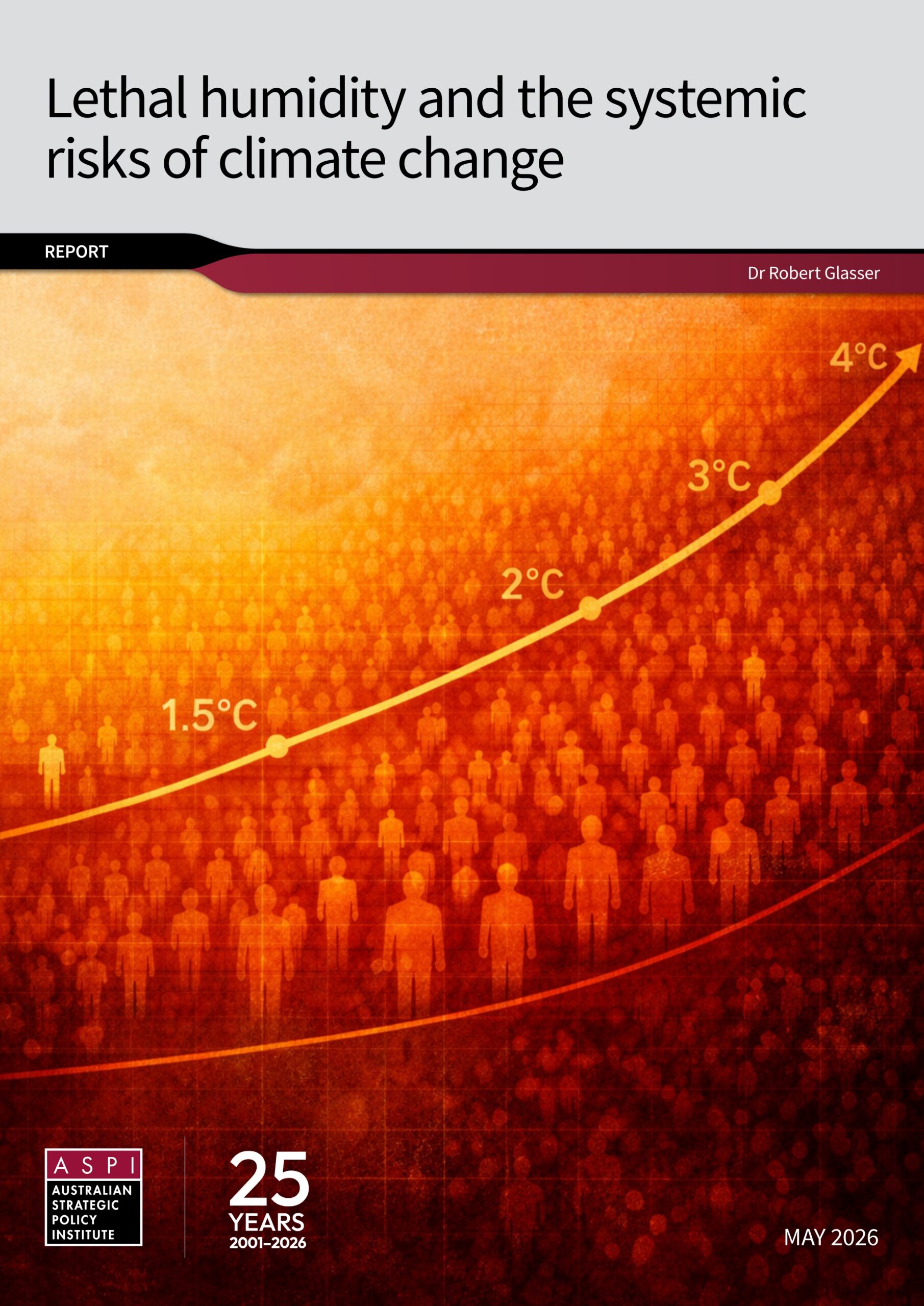
Lethal humidity and the systemic risks of climate change
This report examines the systemic threats posed by lethal humidity, where extreme heat and moisture exceed human physiological limits. Focusing on historical cases and Indonesia, it details cascading impacts on health, energy, and agriculture. It calls for urgent emissions reductions and improved global cooling strategies to mitigate escalating climate risks.
Please login or join for free to read more.

OVERVIEW
Executive summary
Climate change is shifting from a mere environmental issue into a systemic crisis affecting every aspect of society. A critical emerging threat is lethal humidity, a combination of extreme heat and high humidity that can exceed the limits of human survival. Higher temperatures allow the air to hold more moisture, which lowers the temperature at which severe health impacts occur. Large, densely populated regions are rapidly moving towards physiological survivability limits. Each new decade will expose tens of millions more people to these extremes, and by late this century, as much as 50%–75% of the global population will be exposed to life-threatening conditions.
To address this systemic threat, the Lethal Humidity Global Council identifies four urgent shifts: achieving real zero emissions through fossil-fuel phase-out, removing barriers to green industry by 2030, implementing carbon pricing, and using economic stimulants for green transformation.
Recommendations
The report provides eleven key recommendations, including accelerating research on human survivability and focusing studies on less developed tropical countries. It urges investigation into the economic and labour-productivity impacts of warming, noting that humid heat is already responsible for labour losses comparable to the Covid-19 pandemic. Policy priorities include mitigating cascading societal impacts, such as electricity demand spikes and infrastructure failure, and prioritising adaptation planning for tropical coastal cities like Chennai, Manila, and Dhaka. Additionally, governments must reform heat action plans (HAPs) to integrate human physiology and address social inequalities.
Humid heatwaves: escalating extremes and historical impacts
When high temperature and humidity coincide, the body’s cooling mechanism—perspiration—becomes insufficient. This leads to a rise in core temperature, potentially causing system-wide inflammatory reactions and organ failure. The wet-bulb temperature (Tw) of 35°C for six hours is widely considered the threshold of human adaptability. Vulnerability is highest among the elderly and young children, though research in Mexico suggests young adults working outdoors are also at significant risk.
Historical cases illustrate these dangers. The 1995 Chicago heatwave caused 733 deaths and record power demand that triggered massive outages, stranding disabled residents and causing water pumps to fail. The 2015 heatwaves in India and Pakistan were equally devastating; in Karachi, the Heat Index (HI) peaked at 66°C, and more than 80,000 people required hospital treatment. In Brazil, heatwaves have contributed to an estimated 50,000 excess deaths between 2000 and 2018, with the 2023 event exacerbated by a record dengue fever outbreak.
A new climate era: the escalating context for humid heatwaves
The planet is now warmer than it has been in at least 100,000 years, and the pace of change is accelerating. Between 2012 and 2024, the rate of warming was nearly double that of the 1980s. Community resilience is eroding as hazards become more frequent, leaving less time for recovery. Projections for 2041–2060 suggest a global average increase of 35 extreme humid-heat days, though tropical regions could see a 150-day increase. Under a 4°C warming scenario, 2.7 billion people could be exposed to at least one week of uncompensable heat stress annually.
Indonesia: rising humid-heat and compound climate risks
Indonesia has the third-highest disaster risk globally. Humid-heat extremes are increasing faster than dry-heat events, with the average number of humid-hot days rising from 10 per year (1983–2000) to 18 per year (2000–2016). By 2035, 17% of the population will be exposed to hazardous heat. These risks interact with sea-level rise, which is occurring in Indonesia at four times the global mean rate. This threatens the power sector—reducing gas power output and disrupting distribution—and agriculture. Rice production, a staple for 90% of Indonesians, could decrease by 10%–25% for every 1°C temperature increase. Disasters displaced 6.5 million Indonesians between 2010 and 2021, with numbers expected to rise as coastal inundation worsens.
From evidence to action: policy and research priorities for responding to lethal humidity
Addressing lethal humidity requires closing major gaps in research, particularly regarding physiological limits and labour productivity. Keeping populations cool must be treated as a global grand challenge. More than 1.1 billion people currently lack adequate cooling, and this number may reach 2 billion in 25 years. Expanding off-grid solar-photovoltaic cooling and implementing building-level interventions, such as reflective roofing, are essential. Governments and the private sector must act decisively to ensure that lethal humidity remains a rare occurrence rather than a deadly reality for billions.




