

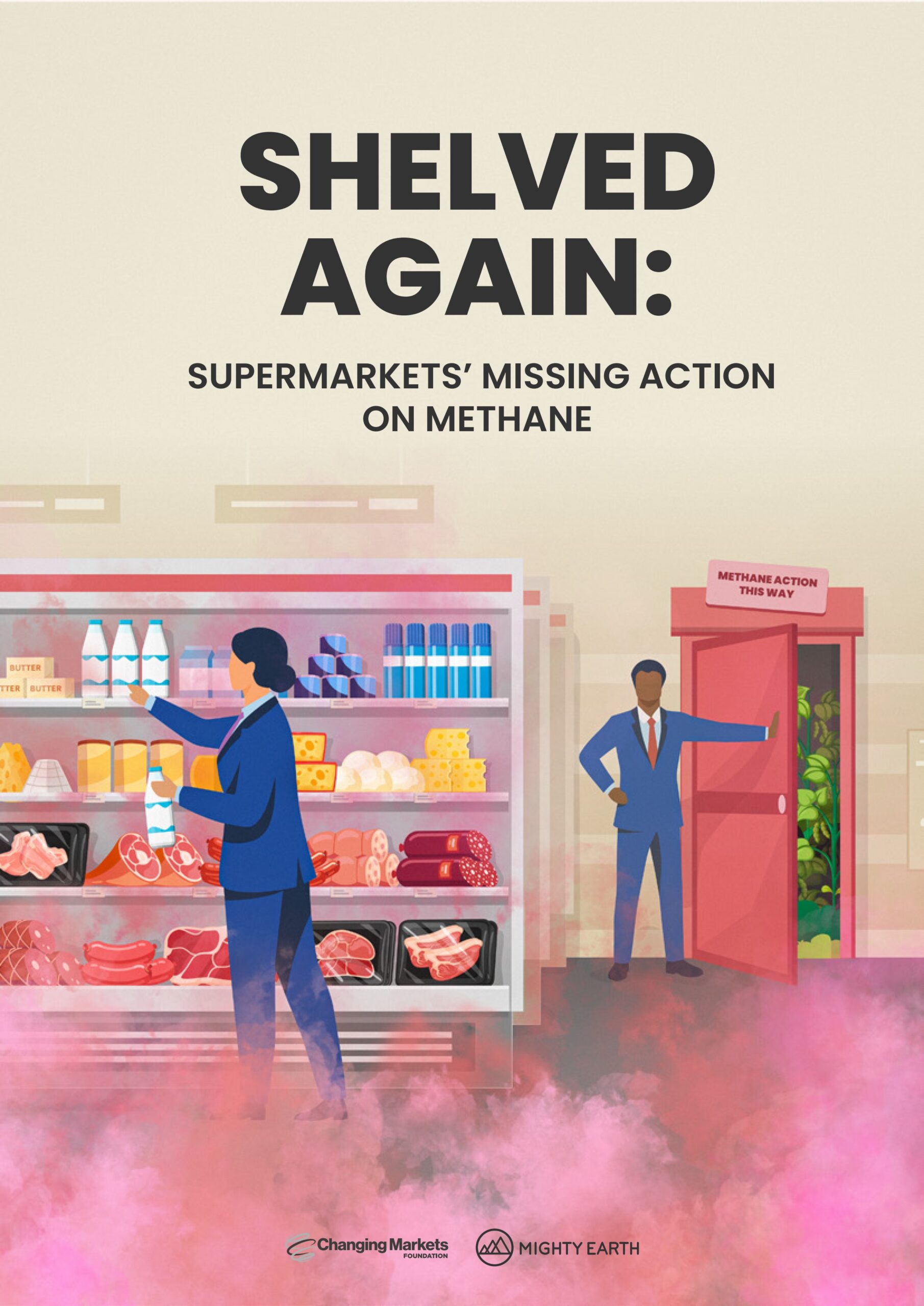
Shelved again: Supermarkets’ missing action on methane
This report assesses 20 global food retailers on their methane reduction efforts. Findings reveal a leadership vacuum, with no supermarket reporting methane emissions or setting specific reduction targets. While European retailers outperform US counterparts, the sector overall fails to address the climate impact of meat and dairy supply chains.
Please login or join for free to read more.

OVERVIEW
Executive summary
Methane is a potent greenhouse gas responsible for approximately 30% of global heating since pre-industrial levels. The global food system is the primary driver of these emissions, with agriculture—specifically meat and dairy production—accounting for 42% of human-caused methane emissions. This report, “Shelved Again: Supermarkets’ Missing Action on Methane”, evaluates 20 of the world’s largest food retailers, which collectively generate an estimated $2 trillion in annual revenue. The 2026 assessment finds a significant leadership vacuum; despite their position as gatekeepers of the global food system, no retailer has published a target to reduce methane or publicly reported their methane emissions.
Introduction
Supermarkets occupy a critical position within the food system, influencing supply chains and consumer demand through sourcing, pricing, and marketing strategies. While 93% of European food retailers’ emissions are indirect (Scope 3), meat and dairy account for nearly half of these product-related emissions. Methane remains in the atmosphere for a shorter period than carbon dioxide but has approximately 80 times the warming potential over a 20-year period. Scientists describe cutting methane as a ‘climate emergency brake’ necessary to slow near-term warming. Without intervention, agricultural methane emissions are projected to rise by 8% by 2030 and 17% by 2050 compared to 2020 levels. The report emphasises that shifting towards plant-based diets is vital for both emission reductions and protecting public health.
The role of methane
Retailers were assessed on their acknowledgement of livestock methane and its link to climate change. While 40% of assessed companies (eight retailers) publicly recognised the impact of methane from livestock, European retailers showed much stronger progress than those in the United States. Only two US retailers, Costco and Kroger, received half points for acknowledging the role of agriculture without explicitly mentioning methane. Furthermore, no retailer has successfully linked executive remuneration to methane reduction targets. Carrefour was the only company to score half points in this area by linking pay to plant-based protein sales targets, specifically aiming for €650 million in sales by 2026.
Emissions reporting
Accounting and disclosure are essential for accountability, yet not a single retailer separately discloses its methane emissions. Although 11 retailers annually report absolute greenhouse gas (GHG) emissions across Scopes 1, 2, and 3 in line with the GHG Protocol, the lack of disaggregated methane data masks the gas’s potency. A 2025 Profundo study estimated Ahold Delhaize’s global annual methane emissions at 11.7 million tonnes of CO2-equivalent, representing 44% of its 2023 Scope 3 emissions in the forest, land, and agriculture category. This figure suggests the retailer is responsible for more methane emissions than countries such as Denmark or Sweden.
Emissions reduction commitments and action plans
The report finds almost no progress in this category, with no retailer having a specific target to reduce methane emissions. While 40% have committed to net zero by 2050, none have committed to reaching this goal by 2040 across their entire value chain. Furthermore, 60% of retailers, including all US and French companies, failed to achieve full points for Science Based Target initiative (SBTi) validation. Notably, Asda’s score dropped after it removed its previously validated climate targets. No company committed to reducing absolute Scope 3 emissions by at least 50% by 2030 from a 2020 baseline.
Food and landfill waste policies
Food waste is a major source of methane in landfills. Carrefour is the only retailer to score full points in this category, sharing the Consumer Goods Forum’s goal to reduce food waste by 50% by 2025. While E.Leclerc and Tesco also achieved full points for their reduction policies, 15 other retailers scored zero. Some companies, such as Walmart and Asda, saw their scores decline due to the weakening of their absolute reduction targets or a shift toward intensity-based metrics.
Protein alternatives
This category saw the most improvement, with 75% of supermarkets offering an own-brand plant-based range. However, no retailer has committed to a target of 60% plant-based versus 40% animal-based protein sales by 2030. Ahold Delhaize set a 50% protein split target for its European brands, while Lidl in Germany achieved half points for implementing price parity between its Vemondo plant-based range and comparable animal products. Conversely, four out of five US retailers scored zero for their offering of private-label alternatives.
Conclusion
A leadership vacuum persists among the world’s largest food retailers. Tesco ranked highest with 48 points out of 100, followed by Lidl and Ahold Delhaize. At the bottom of the tracker, Albertsons, Mercadona, and Publix scored zero points. European retailers significantly outperform their US counterparts, with an average score of 27.6 compared to 6.2 for US firms. The report concludes that current net zero targets are incomplete if they continue to ignore methane from meat and dairy supply chains.
Recommendations
The report calls for retailers to implement science-based methane reduction targets of at least 30% by 2030. Retailers should publish annual methane emissions across all Scopes and develop time-bound action plans for private-label products. Additionally, they must increase financial support for plant-based products, aiming for a 60% plant-based protein ratio by 2030, supported by price parity and revised marketing strategies to incentivise sustainable consumption.




