

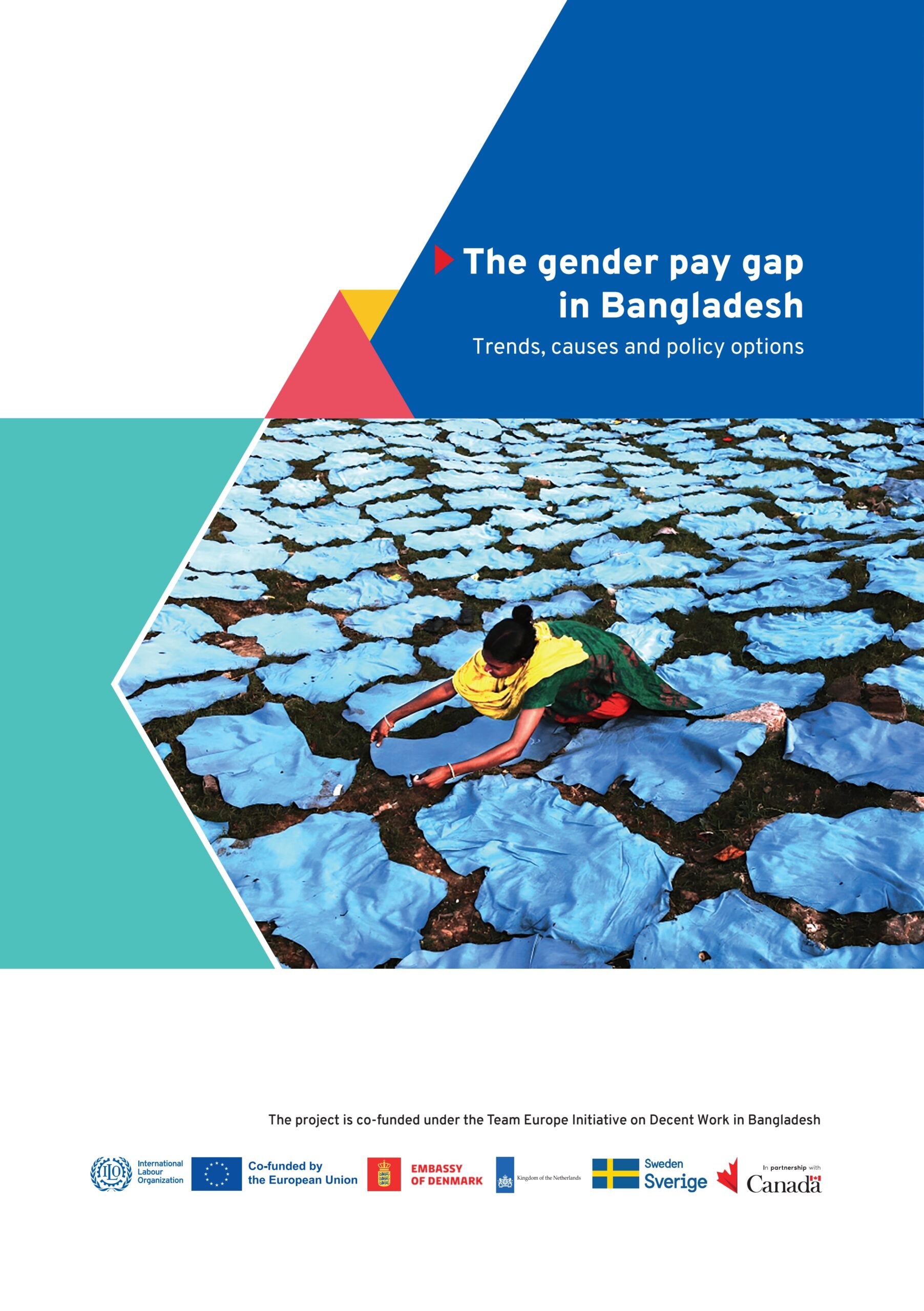
The gender pay gap in Bangladesh: Trends, causes and policy options
This report analyses the gender pay gap in Bangladesh, finding women earn 22 to 25 per cent less than men. Driven by structural discrimination and unequal care burdens, the gap persists despite legal frameworks. Recommendations include objective job evaluations, cost-sharing for maternity benefits, and strengthened labour inspection.
Please login or join for free to read more.

OVERVIEW
Introduction
This report provides a comprehensive analysis of the gender pay gap (GPG) in Bangladesh, detailing its scale, primary drivers, and potential policy interventions. Globally, women in wage employment earn approximately 20 per cent less than men, a disparity often driven by discrimination and structural norms. In Bangladesh, the monthly GPG is estimated to be between 22 and 25 per cent, meaning women earn roughly 750 to 780 taka (Tk) for every Tk 1,000 earned by men. While this figure is slightly higher than the global average, it is lower than values observed in neighbouring Pakistan and Sri Lanka. The report aligns its findings with international standards, such as the International Labour Organization (ILO) Equal Remuneration Convention, 1951 (No. 100), and the Sustainable Development Goals (SDGs), specifically target 8.5, which calls for equal pay for work of equal value by 2030.
Labour market trends
Gender inequalities in employment remain substantial. In 2023, the female employment rate was 40.2 per cent, compared to 77.9 per cent for men, resulting in a gender employment gap of 37.7 percentage points. Women represent only 17 per cent of all wage employees in the country. Among employed women, the vast majority work as own-account workers (almost 70 per cent), with only 19 per cent in wage employment. Manufacturing is the primary sector for female wage employment, accounting for 41 per cent of the total, followed by household activities as employers (19 per cent) and education (12 per cent). Women are significantly under-represented in leadership, occupying only 6.2 per cent of managerial positions. Informal employment is pervasive for both genders, covering 91 per cent of male and 87 per cent of female wage employees. On average, men in wage employment work 51.9 hours per week, while women work 46 hours.
The gender pay gap
The monthly GPG increases significantly with age, starting at 16 per cent for individuals aged 15 to 24 and rising to 43 per cent for those aged 55 to 64. Higher educational attainment mitigates the gap; women with less than basic education earn 40 per cent less than their male counterparts, whereas the gap is halved to 20 per cent for those with advanced education. The GPG is lower among formal employees (17 per cent) than informal workers (33 per cent), suggesting that legislative compliance reduces disparities. Decomposition analysis reveals that at all points of the wage distribution, the majority of the GPG remains unexplained by observable factors like education or sector, pointing to the central role of discrimination. Key structural forces include the undervaluation of feminised sectors and the unequal distribution of care work; women spend an average of 27.7 hours per week on household chores compared to just 7.6 hours for men.
Review of policies and legislation
Bangladesh has established a legal framework for gender equality, including Constitutional guarantees of equal rights (Article 28) and the Bangladesh Labour Act (BLA). Section 345 of the BLA requires equal wages for work of equal nature, but its application is often narrowly interpreted. Recent 2025 amendments expanded maternity leave to 120 days, but the costs remain entirely employer-funded, which may create hiring disincentives. The Minimum Wages Board covers 47 sectors, but many feminised industries like agro-processing and handicrafts remain outside its mandate. Enforcement is hindered by a severe shortage of labour inspectors, with a ratio of 1:150,000 workers, and only 5 per cent of inspectors are women. Furthermore, restrictions on night work (Section 109) and certain types of physical labour (Section 45) can unintentionally limit women’s access to higher-paid roles.
Views of stakeholders
Stakeholder consultations revealed four main drivers of the GPG: gaps in wage-setting systems and weak enforcement, horizontal and vertical segregation, social norms regarding care responsibilities, and labour market dynamics involving abundant low-cost labour. Workers’ organisations view the gap as structural injustice and institutional neglect. Conversely, employers often attribute disparities to individual factors such as skills and family responsibilities rather than workplace bias. Government representatives acknowledge enforcement gaps but frame them as procedural and capacity-related issues. Experts argue that the GPG is embedded in the gendered configuration of the labour market, from vocational training to promotion pathways.
Conclusions and policy options
The report proposes several actionable policy recommendations to reduce the GPG. These include clarifying and operationalising the principle of equal pay for work of equal value and broadening the legal definition of remuneration to include all wage components like bonuses and allowances. The introduction of objective, gender-neutral job evaluations is recommended to determine the true value of work. For maternity leave, a cost-sharing mechanism involving public funds or social insurance is suggested to remove disincentives for hiring women. Other options include reviewing restrictions on women’s employment, expanding flexible work arrangements, and promoting collective bargaining to address gender inequalities. Finally, reinforcing labour inspection and improving data availability for gender-focused research are deemed essential for evidence-based policymaking.




