

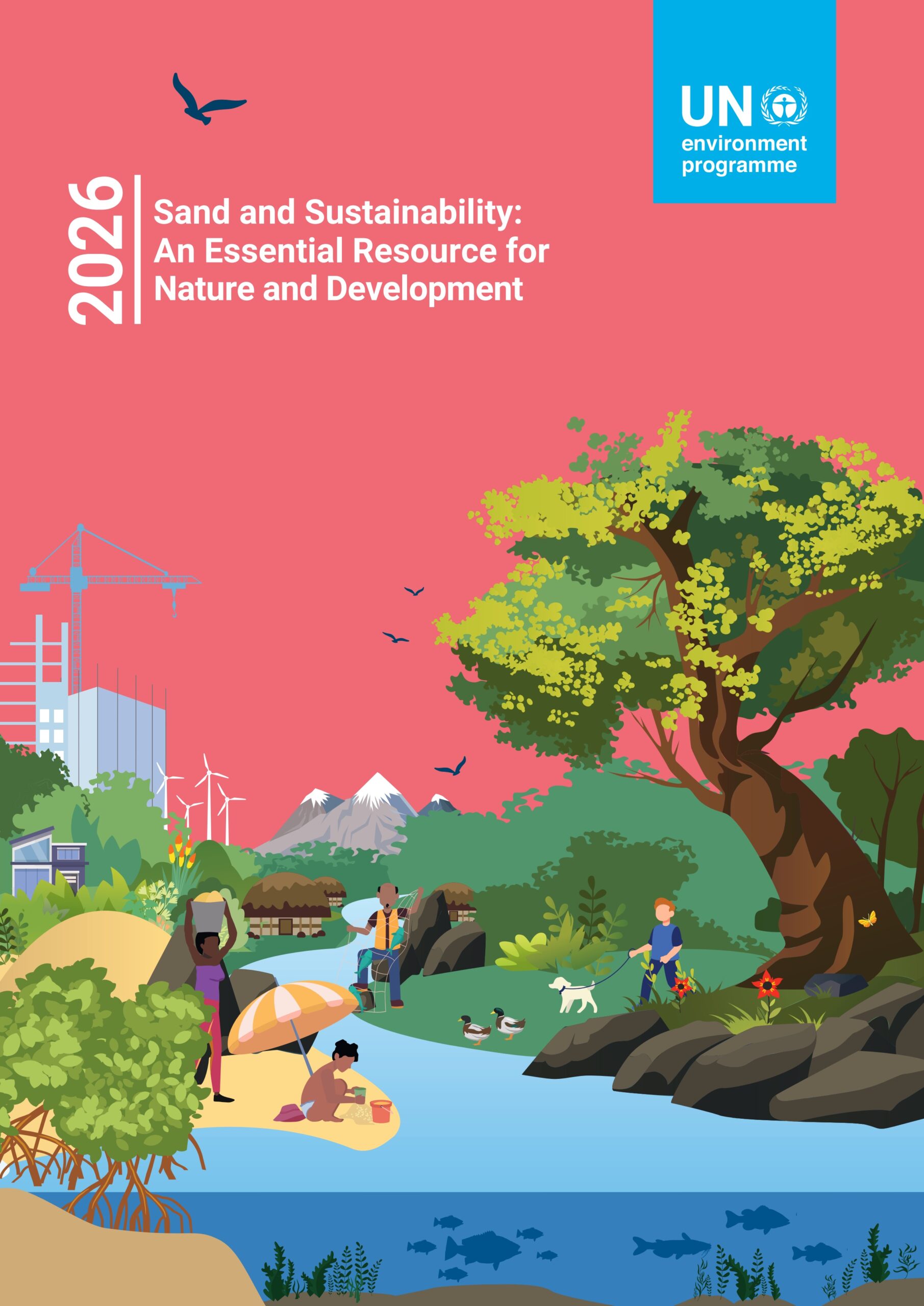
Sand and sustainability: An essential resource for nature and development
This report identifies sand as the world’s most consumed solid material, with 50 billion tonnes extracted annually. Valued at USD 569.4 billion in 2024, the market threatens biodiversity and ecosystems. The document provides 24 strategic recommendations to treat sand as a strategic national asset and improve environmental oversight.
Please login or join for free to read more.

OVERVIEW
Introduction
Sand, gravel, crushed rock, and aggregates are the most consumed solid materials on Earth. Global demand for sand tripled between 2000 and 2020, fuelled by rapid population growth, urbanisation, and economic expansion. The global sand market was valued at USD 569.4 billion in 2024 and is projected to grow at approximately 3% annually. Every year, around 50 billion tonnes of sand are extracted, a volume that vastly exceeds the projected annual extraction of 30 million tonnes of critical minerals by 2030. Despite this scale, sand often receives little strategic attention from national governments, leaving its long-term sustainable management uncertain.
Setting the scene
Sand underpins both human development and natural ecosystems. More than a third of the world’s population lives on low-lying sedimentary coasts and floodplains, which rely on sand as a first line of defence against flooding and storm surges. However, sand is frequently extracted without a clear understanding of its diverse values or the risks associated with its depletion. Effective management requires formal recognition of sand as a strategic resource and an understanding of its role within interconnected social-environmental systems.
The values of sand in biodiversity and development
Sand has both use and non-use values. Use values include its role in construction, land reclamation, and industrial applications such as glass manufacturing. Non-use values are found in natural systems where sand regulates groundwater flows, filters water, and provides critical habitats. For example, a study in Texas estimated that beaches and foredunes provide USD 141.4 million per year in storm protection value. Additionally, 2.3 billion people depend on small-scale fisheries for food security, many of which rely on sandy habitats. Coastal tourism, driven by sandy beaches, attracts over 760 million tourists annually and generates more than USD 1.5 trillion in spending.
Impact of sand extraction on biodiversity and people
Sand extraction has been linked to impacts on more than 1,000 species listed on the IUCN Red List of Threatened Species. Freshwater biodiversity is declining rapidly, with an 85% decline in vertebrate populations on average since 1970. Between 2012 and 2022, nearly half of all globally active dredging operators worked within Marine Protected Areas each year. Mismanaged extraction can cause riverbank erosion, delta subsidence, and habitat loss. For instance, in the Maldives, coral mortality from heat stress was nearly six times higher in dredged areas during the 2016 bleaching event. Human impacts include respiratory problems from dust, the creation of breeding grounds for malaria-carrying mosquitoes in unreclaimed pits, and the loss of agricultural farmland.
Current trends and future outlook
Global sand demand is expected to double by 2060 under current trajectories. In 2020, the mass of the built environment exceeded the mass of all living biomass on Earth, with 90% of that anthropomass consisting of sand and gravel. There is a dawning shift from land-based extraction to marine dredging, which can be politically more feasible but carries high environmental risks. Circular economy solutions are emerging, such as the use of ore-sand co-generated from mineral extraction. In conflict zones like Gaza, where more than 80% of structures have been damaged, debris management is a strategic imperative; as of February 2026, only 0.17% of an estimated 57.5 million tonnes of debris had been recycled.
Elevate sand to strategic national assets
Sand remains largely invisible in national policy frameworks, with responsibility fragmented across multiple ministries. Action is required to establish inter-ministerial entities and national sand resource inventories to understand the asset’s diverse values. Colombia offers a model for this by formally classifying construction materials and silica sand as minerals of strategic interest under Resolution No. 1006 of 2023, prioritising the formalisation of the sector to ensure national self-sufficiency and environmental oversight.
Resilient and future-proof sand management in a rapidly changing world
Communities are increasingly using nature-based solutions to enhance resilience. One example is the Dutch Sand Motor, a pilot coastal adaptation project that added 20 million cubic metres of sand to the natural beach system in 2011 to allow natural forces to redistribute it over 20 years. Such approaches require regional coordination and sediment budgeting to ensure that extraction does not exceed natural replenishment rates.
Governance across scales
The global sand economy faces challenges at both the industrial and artisanal scales. Artisanal and small-scale mining (ASM) provides critical income in the Global South but often operates without environmental assessments. Large-scale industrial dredging is more regulated but often governed through non-binding corporate social responsibility frameworks. Recommendations include registering artisanal miners into cooperatives to enable oversight and codifying international frameworks to strengthen corporate accountability.
Scaling environmental assessment: From fragmented supply chains to ecosystem level impacts
Current environmental impact assessments (EIAs) are often limited to site-specific footprints and fail to capture cumulative or transboundary effects. Governance should shift towards system-level assessments, such as Cumulative Effect Assessments (CEAs), that evaluate the combined pressures of multiple extraction sites. This is particularly relevant in dynamic marine and riverine systems where sediment plumes can disperse over 40 to 60 kilometres.
Sand and finance
Financial institutions are significantly exposed to risks arising from unsustainable extraction. While development banks provide approximately 18% of global infrastructure finance, only 42% have biodiversity-specific safeguards. Financing eligibility should be used to shift extraction away from harmful activities, such as excluding dredging in protected areas or Key Biodiversity Areas. Finance should also be mobilised to incentivise circular value chains and alternatives.
Responsible sourcing
Public procurement can drive market transformation by moving beyond lowest-price tendering. Governments should embed responsible sourcing criteria and international minimum environmental standards into public tenders for large infrastructure projects. This requires downstream users to implement risk-based due diligence consistent with established frameworks such as those provided by the OECD.
Sand-biodiversity nexus
Mainstreaming biodiversity across the sand value chain requires improving measurement through consolidated indicators and strengthened life cycle assessments (LCAs). Prevention through spatial planning should be prioritised over restoration, as restoration is often more expensive and less reliable. Effective action requires embedding biodiversity considerations into every decision that shapes sand extraction and use.
Measuring biodiversity impacts: Indicators, tools, and ways forward
There is currently no single footprint metric for biodiversity, making it difficult to quantify impacts compared to carbon emissions. The report recommends using guidance from the Taskforce on Nature-related Financial Disclosures (TNFD) and multi-stakeholder initiatives to develop harmonised indicator frameworks. Adopting mixed-method approaches that combine LCA tools with site-specific expertise can help address current data gaps.
Strengthen the mapping of extraction, sensitive areas and impacts
Significant data gaps persist, with many countries lacking open-access maps of mining rights and extraction zones. Initiatives like UNEP’s Marine Sand Watch advance transparency by tracking large dredging vessels, revealing that 6 billion tonnes of marine sediment are removed or displaced annually. Strengthening data infrastructure is essential for identifying ‘no-go’ zones where extraction should be restricted to protect sensitive ecosystems.
Prevent impacts on nature and promote standards-based ecological restoration
Restoration should follow international principles, such as those developed by the Society for Ecological Restoration (SER). While restoration is challenging, it can produce positive net economic benefits, with benefit-cost ratios ranging from 0.05:1 up to 35:1. Initiatives like ‘The Freshwater Challenge’ aim to restore 300,000 kilometres of degraded rivers globally by 2030, offering a framework for addressing damage caused by sand mining.
Conclusion
Sand is a strategic national asset that sits at the intersection of infrastructure, biodiversity, and climate resilience. To avoid a crisis, governments and stakeholders must move beyond short-term decision-making and project-by-project assessments. Decisive action is required to translate the 24 recommendations in this report into clear national roadmaps for responsible and sustainable sand management.




