

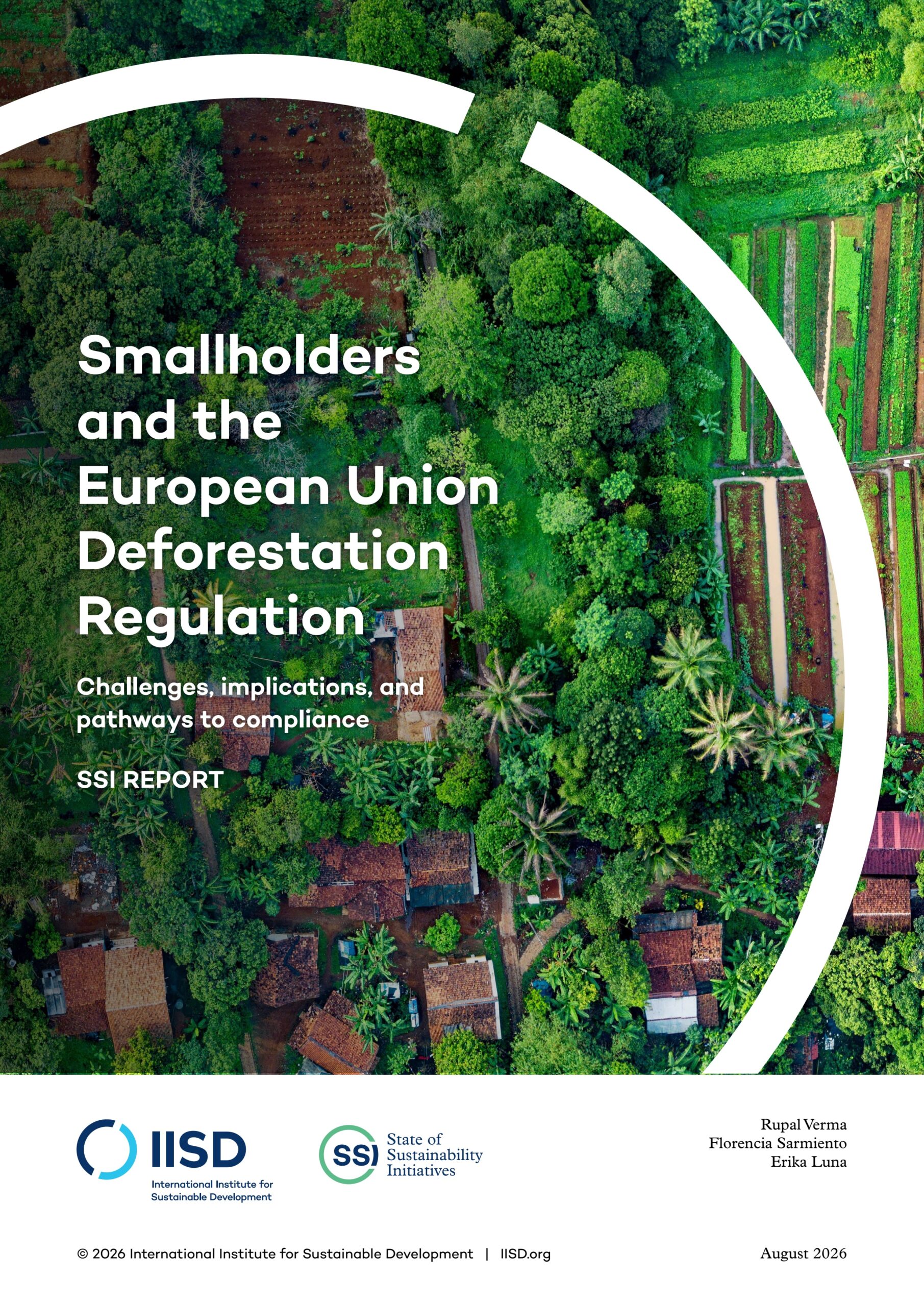
Smallholders and the European Union Deforestation Regulation: Challenges, implications, and pathways to compliance
This report examines challenges faced by smallholders under the European Union Deforestation Regulation. Based on a survey of 333 producers, it identifies land tenure, compliance costs, and technical gaps as major barriers. It recommends coordinated support from governments, the private sector, and sustainability organisations to ensure inclusive market access.
Please login or join for free to read more.

OVERVIEW
Setting the scene
The European Union Regulation on Deforestation-free products (EUDR), adopted in 2023, is a landmark initiative designed to ensure that specific commodities placed on or exported from the EU market are produced legally and do not contribute to deforestation or forest degradation. The regulation applies to seven key commodities: cattle, cocoa, coffee, palm oil, natural rubber, soy, and wood. While the EUDR does not directly regulate smallholders, its due diligence requirements are transmitted upstream through supply chains, creating significant new expectations for millions of producers, particularly small-scale farmers who typically manage up to 10 hectares of land.
Smallholders are fundamental to global food systems, producing between 20% and 31% of the world’s crops. In the context of EUDR-covered commodities, their role is even more pronounced; they produce approximately 70% of the world’s cocoa, nearly 95% of coffee from farms smaller than 5 hectares, and manage around half of global oil palm plantations. The effectiveness of the regulation, therefore, depends heavily on the ability of these millions of producers to meet due diligence and traceability requirements without being excluded from the market.
Insights from smallholder farmers
Research conducted by the International Institute for Sustainable Development (IISD) in 2025 involved a survey of 333 smallholder farmers and organisations across 16 countries in Africa, Asia, and Latin America. The findings indicate a significant gap between awareness and readiness. While 91% of respondents had heard of the EUDR, only a minority were prepared for its practical implications. Land tenure emerged as the most critical structural barrier, with only 31% of surveyed farmers reporting clear land ownership documentation. This issue was particularly acute among soy producers in West Africa, where only 16% possessed formal documentation.
Financial barriers are also substantial. Between 57% and 80% of respondents across different sectors cited costs as a major challenge. These include expenses for geolocation data collection, farm mapping, traceability systems, and certification. For example, compliance costs in Indonesia are estimated between 70 and 200 euros per farmer. Furthermore, technical capacity remains a hurdle; while 86% of respondents received some form of training, access was uneven. Every palm oil farmer surveyed anticipated challenges, yet only 20% had received specific training, compared to 100% of coffee producers, 95% of cocoa producers, and 96% of soy producers.
A significant risk identified in the report is market leakage and exclusion. Approximately 74% of respondents believed that stricter requirements could push producers towards less regulated markets. This risk is driven by the high costs of compliance and the emergence of secondary markets for non-compliant products, which could undermine the environmental objectives of the regulation while reducing smallholder incomes.
Recommendations
The report proposes three pathways to support smallholder inclusion and ensure the EUDR achieves its goals. The first pathway involves strengthening producer support through voluntary sustainability standard organisations (VSSOs). These organisations should systematically align their certification requirements with EUDR obligations, particularly regarding geolocation and legality. By leveraging existing certification systems to generate compliance data, VSSOs can reduce duplication and serve as efficient delivery channels for training and technical assistance.
The second pathway focuses on building an enabling policy environment. Producer-country governments, in collaboration with EU institutions, must improve access to land registration and invest in shared, national-level traceability and data systems. Examples such as Brazil’s Selo Verde and Thailand’s national traceability platform demonstrate how public infrastructure can support producers. Governments should also provide targeted financial support, including grants and concessional finance, to ensure compliance costs do not become a barrier to market access.
The third pathway emphasises the role of private sector actors in strengthening responsible supply chains. Operators, traders, and buyers are encouraged to share compliance costs more equitably rather than transferring them entirely to producers. The report suggests implementing Article 11 of the EUDR through long-term supplier partnerships that prioritise capacity building and technical support over simple supplier deselection. Recognising producer organisations as implementation partners is essential for managing mapping and documentation on behalf of their members.
Conclusion
The EUDR represents a shift from voluntary sustainability commitments to mandatory due diligence. However, the report concludes that the principal challenge is no longer awareness, but the structural barriers that constrain a farmer’s ability to demonstrate compliance. Success will be measured not only by reductions in deforestation but by the continued participation of smallholders in sustainable global supply chains. Inclusive implementation requires coordinated action across governments, VSSOs, and the private sector to ensure environmental ambition is matched by targeted support for the most vulnerable actors in the value chain.




