

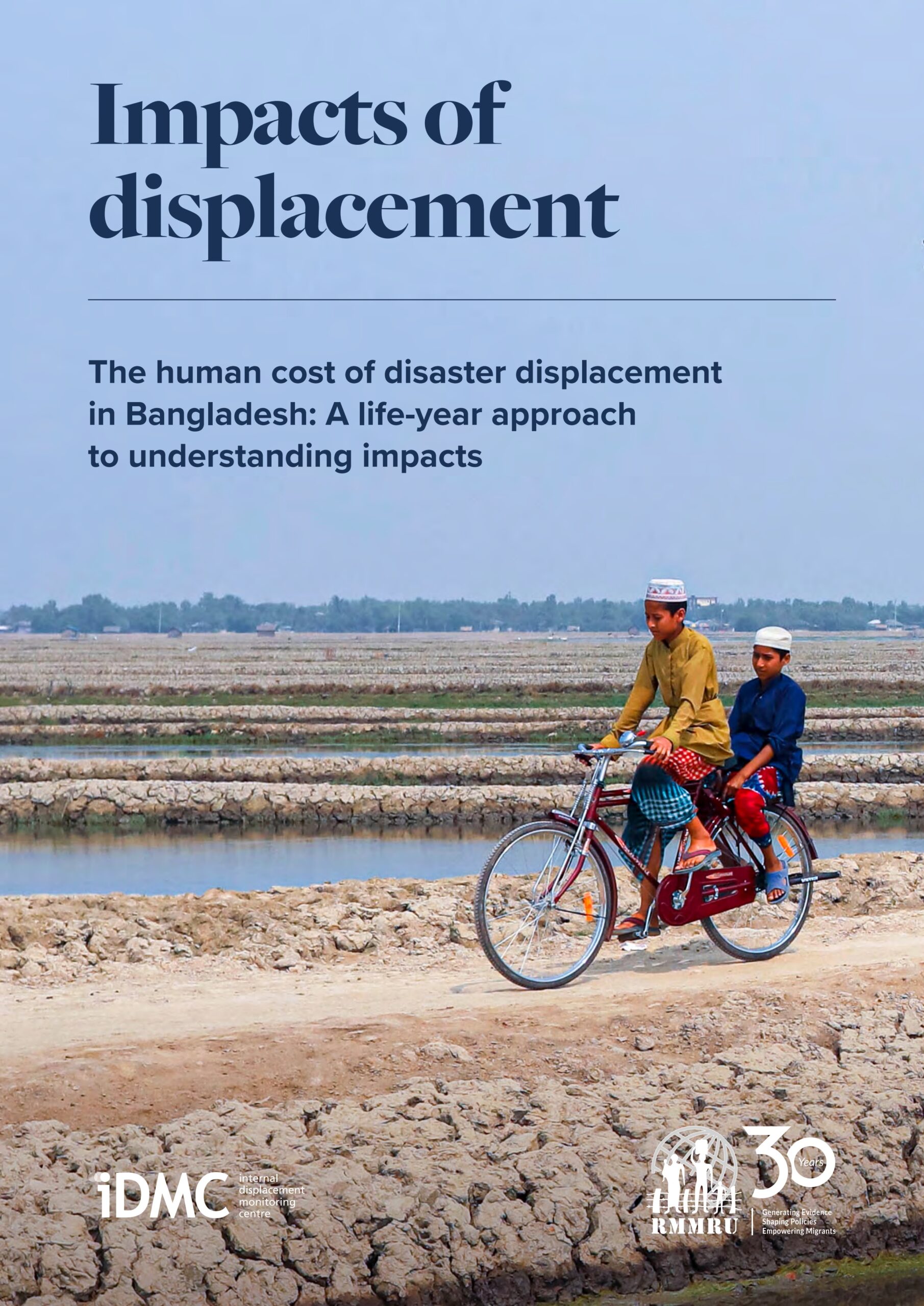
Impacts of displacement: The human cost of disaster displacement in Bangladesh: A life-year approach to understanding impacts
This report evaluates the human cost of disaster displacement in Bangladesh between 2008 and 2025 using a life-year approach. It estimates 89,000 life-years lost, valued at $1.7 billion. Findings indicate that climate change will increase future costs, particularly from floods, necessitating urgent investment in resilient housing and recovery.
Please login or join for free to read more.

OVERVIEW
Executive summary
Bangladesh is one of the nations most severely affected by disaster displacement globally. Between 2008 and 2025, disasters triggered more than 21 million internal movements across the country. While investments in early warning systems have significantly reduced mortality, displacement remains a recurrent cycle that disrupts housing, livelihoods, and access to essential services. This report estimates that disaster displacement resulted in approximately 89,000 life-years lost during this period, which translates to a cumulative human cost of roughly $1.7 billion, or an average of $102 million annually. These figures reflect welfare impacts from temporary reductions in quality of life rather than direct physical damage. Cyclone Amphan in 2020 was the most impactful event, causing 9,500 life-years lost and $184 million in human costs.
Introduction
As a densely populated delta crisscrossed by nearly 1,300 rivers, Bangladesh is highly exposed to cyclones, monsoon floods, and riverbank erosion. Although the country has seen a sharp reduction in poverty from 43 per cent in 1991 to under six per cent in 2022, climate change and sea-level rise are expected to intensify these hazards. Disasters triggered more than 21 million displacements between 2008 and 2025, with weather-related events accounting for over 99 per cent of movements. Large-scale events such as Cyclone Aila (2009), Cyclone Mahasen (2013), and the 2020 monsoon floods represent the largest documented episodes. While pre-emptive evacuations have saved lives, they do not eliminate longer-term displacement risks associated with severe housing damage and livelihood disruption.
Methodological approach
This report utilises a life-year approach to quantify the human cost of displacement, capturing the severity and duration of disruption to people’s wellbeing. Welfare losses are measured in “life-years lost,” representing a temporary reduction in quality of life during displacement and recovery. These impacts are translated into monetary equivalents using the value of a statistical life year (VSLY). The model accounts for the intensity of disruption using a recovery extension factor, which scales observed evacuation stays to reflect the assumption that displacement-related impacts, such as reduced access to services and housing damage, often persist long after the physical return of displaced populations.
Findings
Cyclones and storm surges are the primary drivers of displacement costs, accounting for 59 per cent of total human costs, equivalent to approximately $1 billion. Floods contribute an additional 32 per cent, or about $550 million. While major disasters generate the largest single-event costs, recurrent small and medium-scale events contribute nearly 70 per cent of cumulative human costs over time. Household-level surveys in Chattogram, Cox’s Bazar, Jashore, and Satkhira reveal that recovery is highly uneven. Households below the poverty line pre-displacement generally remained below it, despite recording an average proportional income gain of 79.8 per cent, compared with 30 per cent for wealthier counterparts. Higher post-displacement incomes often reflect adjustment to more expensive urban living conditions rather than improved wellbeing. Looking forward, climate change is projected to increase costs significantly; annual costs for riverine floods could rise from $22 million under current conditions to $176 million under a pessimistic scenario of a 5°C temperature rise by 2100.
Potential solutions and way forward
Reducing displacement impacts requires targeted investment in risk reduction, such as resilient housing, improved land-use planning, and flood protection in high-risk coastal and flood-prone areas. To limit the severity and duration of displacement, the report recommends faster restoration of housing and essential services. Expanding shock-responsive social protection mechanisms and providing targeted cash assistance and livelihood recovery support are critical for vulnerable households. Furthermore, displacement considerations should be integrated into urban planning and local development strategies to manage the pressures of rural-to-urban migration and reduce long-term vulnerability in informal settlements.
Conclusion
The impacts of disaster displacement in Bangladesh extend well beyond the moment of movement. Estimating the human cost complements standard loss and damage assessments by highlighting impacts not visible in physical or economic loss metrics. The findings underscore the importance of more people-centred approaches to disaster risk reduction and climate adaptation. Addressing recurrent vulnerability and persistent poverty is essential for building long-term resilience against the growing risks of climate-driven hazards.
Methodology
Welfare losses are calculated using the formula: Life-years lost = eTN, where “e” is the welfare reduction parameter (calibrated using WHO disability weights for mild anxiety), “T” is the duration of disruption in years, and “N” is the number of internally displaced people. To account for continued impacts beyond the acute evacuation phase, the duration parameter is adjusted using a recovery extension factor (F). This factor is derived from an event-level severity assessment across four dimensions: geographic scope, damage assessment, scale of displacement, and type of displacement.




