

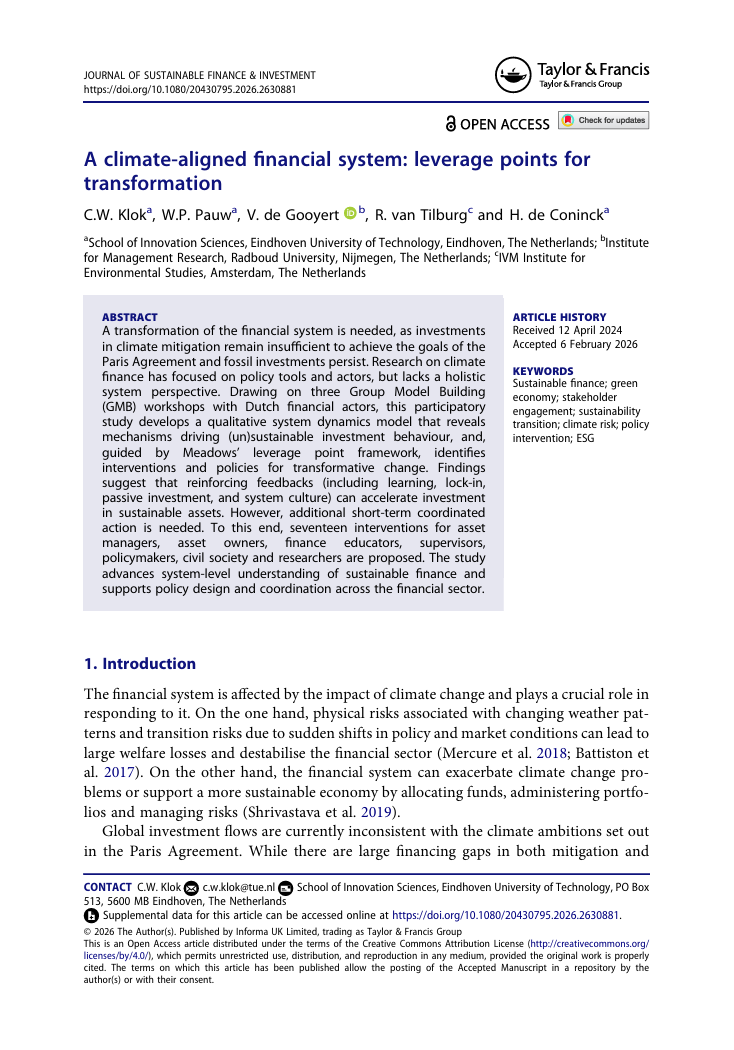
A climate-aligned financial system: Leverage points for transformation
This study models the financial system’s role in climate transition using participatory system dynamics with Dutch financial actors. It identifies reinforcing feedbacks like learning, technological lock-in, finance culture and passive investment and proposes seventeen policy and institutional interventions to redirect capital towards sustainable assets and align finance with Paris Agreement goals.
Please login or join for free to read more.

OVERVIEW
1. Introduction
The study examines how financial systems can be transformed to align investment flows with the Paris Agreement. Global financial flows remain misaligned with climate goals, with fossil fuel investment still roughly double the level compatible with limiting warming to 1.5°C. While finance faces climate-related physical and transition risks, it also plays a decisive role in allocating capital and shaping technological change. Existing climate finance research often focuses on individual actors or policy tools rather than systemic dynamics. This study addresses that gap by analysing the mechanisms influencing sustainable and unsustainable investments and identifying interventions capable of accelerating systemic financial transformation.
2. Background and theoretical framework
2.1 Financing needs and gap
Achieving global decarbonisation requires substantial investment in renewable energy, innovation and efficiency. Estimates indicate annual transition financing needs of approximately US$4–10 trillion. While this equals around 1.5–2% of global credit to the non-financial sector, it represents about 20–28% of new credit issued annually. Transition risks include potential stranded assets worth US$1–4 trillion and revenue losses of roughly US$8 trillion for fossil fuel industries. Financing gaps are particularly pronounced in developing economies where macroeconomic stability, regulatory frameworks and institutional capacity influence the ability to mobilise low-carbon investment.
2.2 The financial system
The financial system comprises private and public institutions that allocate resources and manage risks. Historically viewed as a neutral intermediary serving the real economy, finance increasingly shapes economic development and technological change. However, institutional incentives prioritise liquidity, shareholder value and short-term profitability, reinforcing continued investment in incumbent industries. Structural lock-in, experience with existing sectors and fiduciary interpretations contribute to inertia. Although regulators and financial institutions are beginning to integrate climate risk into supervision, disclosure and asset purchases, climate considerations often remain secondary to traditional financial objectives.
2.3 Leverage points
The study adopts Meadows’ leverage point framework to identify areas where small systemic changes can produce substantial behavioural shifts. Deep leverage points—such as changing system goals, rules or cultural paradigms—offer greater potential for transformation than policy tools such as subsidies or taxes. Applying this framework enables identification of structural drivers of unsustainable investment and supports coordinated policy design across financial actors.
3. Method
3.1 Causal loop diagrams
The study develops a qualitative system dynamics model using causal loop diagrams to visualise relationships between variables affecting sustainable investment. These diagrams illustrate reinforcing and balancing feedback loops within financial system dynamics.
3.2 Group model building
Participatory modelling was conducted through three Group Model Building workshops with 18 experts from financial institutions, regulators, ministries, civil society and academia. The approach integrates diverse perspectives to understand complex system interactions and identify leverage points.
3.3 Data collection and analysis
Nine preliminary interviews informed a seed model which was expanded through workshops conducted in 2023. Workshop discussions were transcribed and coded using qualitative analysis to identify causal relationships and system interventions.
4. Results
4.1 The financial system
The model highlights three interacting domains influencing investment behaviour: socio-political sustainability norms, learning and lock-in dynamics, and passive investment structures. Public support and regulation influence the financial attractiveness of sustainable investments through mechanisms such as externality pricing, disclosure requirements and transition risk. Reinforcing feedback loops also accelerate change. Technological lock-in supports deployment of sustainable infrastructure, financial learning improves risk assessment as data increases, and technological learning reduces costs through experience. Passive investment can reinforce fossil fuel exposure through benchmark tracking, although increasing sustainable assets within indices may gradually redirect passive capital.
4.2 System interventions
Seventeen interventions were identified to strengthen climate-aligned finance. Examples include embedding double materiality in finance education, increasing board diversity, extending investment time horizons, integrating transition risk into capital requirements, improving climate data transparency and establishing green investment banks or blended finance mechanisms. Additional measures include climate-aligned benchmark standards, active shareholder engagement and clearer government transition pathways.
5. Discussion
5.1 Bringing the interventions back into the model
The interventions reinforce feedback loops that increase the attractiveness of sustainable investments. Integrating transition risk into regulation, developing forward-looking risk models and establishing clear government policy signals can strengthen technological and financial learning dynamics and accelerate sustainable investment growth.
5.2 Implications and contemplations for the regulatory-institutional landscape
Financial institutions alone are unlikely to drive systemic transformation because climate objectives fall outside their primary mandates. Governments, regulators and central banks possess the system-wide authority required to coordinate policy interventions and align financial incentives with climate goals.
5.3 Limitations and future research
Limitations include potential participant bias due to expert selection and simplifications within the system model. Future research could extend the framework to emerging economies, integrate physical climate risks and explore policy implementation barriers.
6. Conclusion
Transforming the financial system requires coordinated interventions addressing structural incentives and institutional norms. Reinforcing dynamics—such as technological learning, financial learning and passive investment flows—can accelerate sustainable investment if supported by policy, regulatory and governance reforms.




