

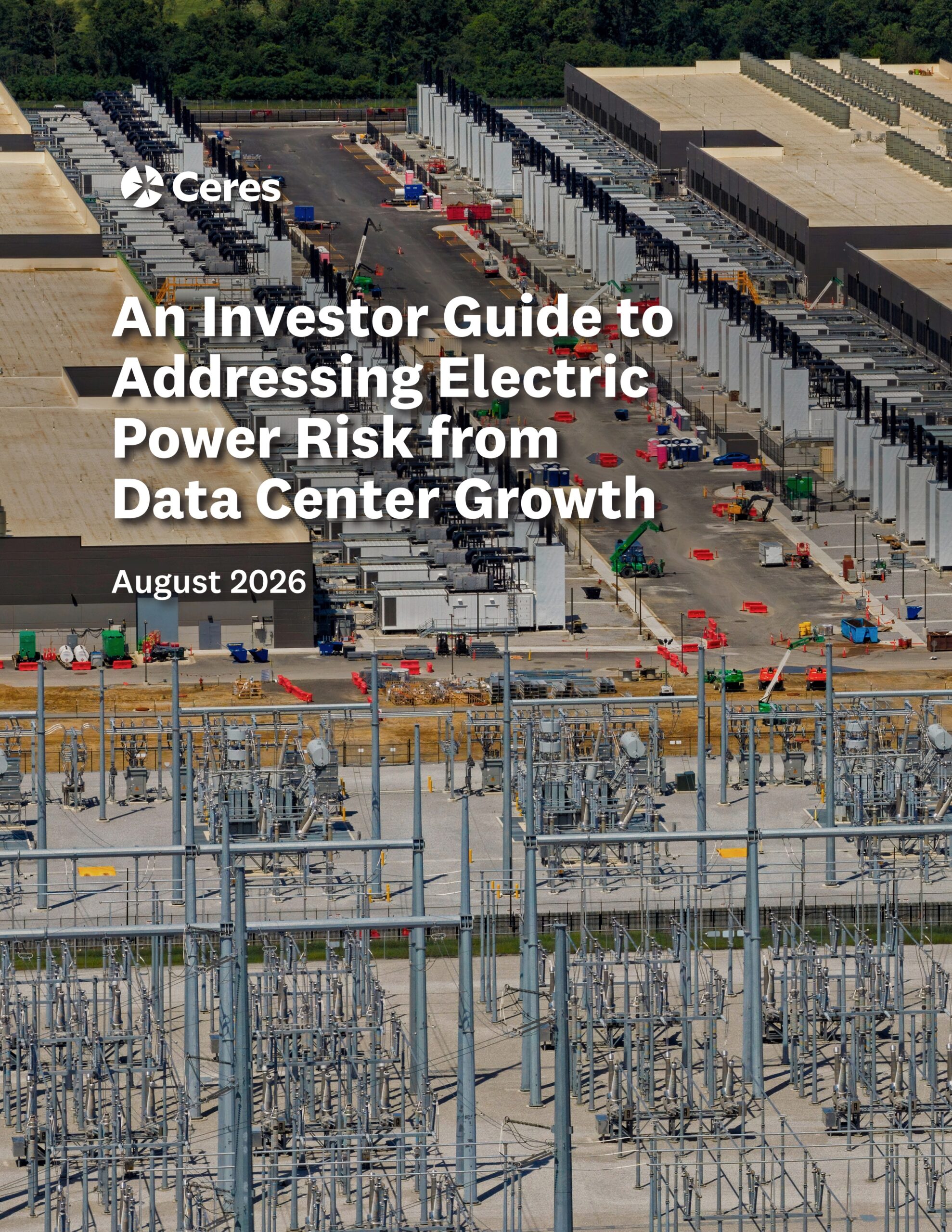
An investor guide to addressing electric power risk from data center growth
This report examines risks to electricity companies from rapid data centre growth, including community opposition and grid reliability. It evaluates solutions like clean energy, flexible contracting, and demand-side management. The guide provides framework questions for shareholder engagement to ensure utilities manage expansion in a financially disciplined and sustainable manner.
Please login or join for free to read more.

OVERVIEW
Introduction
Data centres are expanding at an extraordinary pace, driven by the surge in artificial intelligence (AI) and cloud computing. These facilities currently account for 4% to 5% of U.S. power demand, and this load is expected to increase rapidly over the next decade. Utilities are struggling to accurately forecast these needs because actual power draw is often lower than nameplate capacity, particularly during initial ramp-up periods. This report identifies the significant risks this growth poses to electricity companies and proposes solutions and engagement strategies for investors.
Risks to electricity companies
Affordability and community opposition
The prevalence of data centres has triggered concerns regarding land use, pollution, water stress, and rising electricity costs. While large customers typically pay for distribution upgrades, transmission and generation costs are often socialised across all ratepayers. Community opposition is growing, with an estimated 48 data centre projects totalling over $156 billion stalled or abandoned in 2025. Legislative barriers are also emerging, such as proposed federal pauses on construction until AI safeguards are established. These moratoriums pose regulatory risks, as utilities might commit to infrastructure that later becomes unnecessary, harming shareholders through denied cost recoveries.
Electric infrastructure delays
Delays in securing grid power can materially affect data centre revenue and valuations. If utilities cannot reduce interconnection timelines, developers may turn to on-site fossil fuel generation. This results in lost investment opportunities for utilities and negative community impacts. Slipping project timelines can lead to direct financial consequences and reputational damage, particularly for major projects like the $1.5 billion joint 765kV transmission project in the Mid-Atlantic region.
Data centre utilisation
Economic pressures are driving efficiency gains across chips, cooling systems, and models, which may lower power use below expectations. Overbuilding generation for specific sites could result in underutilisation and cost recovery challenges. Capital allocation strategies must account for these ongoing efficiency improvements rather than assuming permanent baseload operation.
Counterparty credit
Electricity companies face credit risk from long-term contracts. Even when dealing with hyperscalers, risks exist because contracts are often signed by subsidiaries or special purpose vehicles that do not automatically bind the parent company. Furthermore, credit quality can change over time, and general unsecured claims carry higher risk.
Water
Approximately half of U.S. data centres are powered by plants in water-stressed regions. Research indicates that indirect water use for a data centre cluster in Phoenix could increase by nearly 400%. Utilities must consider how water availability might lead to operational curtailments or shutdowns.
Carbon reduction goals
Data centre load growth may force the continued operation of older, inefficient gas and coal plants. For example, Southern Company cited data centre demand as a reason to extend the life of coal plants previously slated for retirement. This undermines net-zero commitments and increases reputational and regulatory risks.
Grid reliability and resiliency
The continuous operation and rapid scaling of data centres create concentrated stress on grid infrastructure. Sudden shifts in electricity use have already led to emergency operator interventions to prevent outages. The inherent variability of data centre power draw can destabilise local grid conditions, requiring utilities to deploy more management assets.
Solutions
Generation
Building new solar, wind, and storage resources is a key strategy, as these can be brought online faster than fossil fuel plants. NextEra Energy’s 2.5 GW partnership with Meta illustrates how clean energy can scale to meet demand. Ideally, procurement should transition from annual accounting to 24/7 hourly matching of carbon-free energy.
Contract design
Flexible interconnection agreements can require data centres to reduce loads during grid emergencies. Additionally, large load tariffs should be designed so that data centre customers bear financial exposure if actual load falls short of forecasts, protecting residential ratepayers through “take-or-pay” provisions.
Demand-side management
Energy efficiency and demand response programmes can free up capacity and avoid underutilised infrastructure. Virtual power plants (VPPs) can aggregate distributed resources like rooftop solar and energy storage to meet system needs. Google has already funded a VPP in PJM and an energy efficiency fund in Arkansas to support these efforts.
Grid assets
Modernising the grid with smart technologies, real-time sensors, and AI-driven management systems allows for better integration of variable renewables. Energy storage provides a critical buffer against sudden load fluctuations and improves reliability.
Planning
Integrated Resource Planning (IRP) must include credible low-demand scenarios to test utility adaptability. In transmission planning, utilities should adopt cost-effective upgrades to existing lines. Advanced conductors can increase capacity by 50% to 110% within 18 to 36 months, while voltage uprates can increase capacity by 100% to 300% within three to five years.
Shareholder engagement
For regulated utilities
Investors should ask how clean energy buildouts are reflected in resource plans and whether comprehensive water risk assessments have been conducted. Engagement should also focus on the percentage of load covered by demand response and the presence of contractual protections against speculative demand.
For independent power producers
Questions should address exposure to capacity and energy market prices, the inclusion of take-or-pay provisions, and the strategy for positioning fleets to serve hyperscalers committed to carbon-free energy.
For contract/PPA generators (including renewable developers)
Investors should investigate counterparty concentration risks and whether new contracts are structured around hourly matching or annual accounting.
Conclusion
The data centre boom represents a defining strategic challenge. Electricity companies that protect themselves from speculative growth and accelerate the transition to a modern, clean, and resilient grid will create the most lasting value for investors while ensuring fairness to all customers.




