

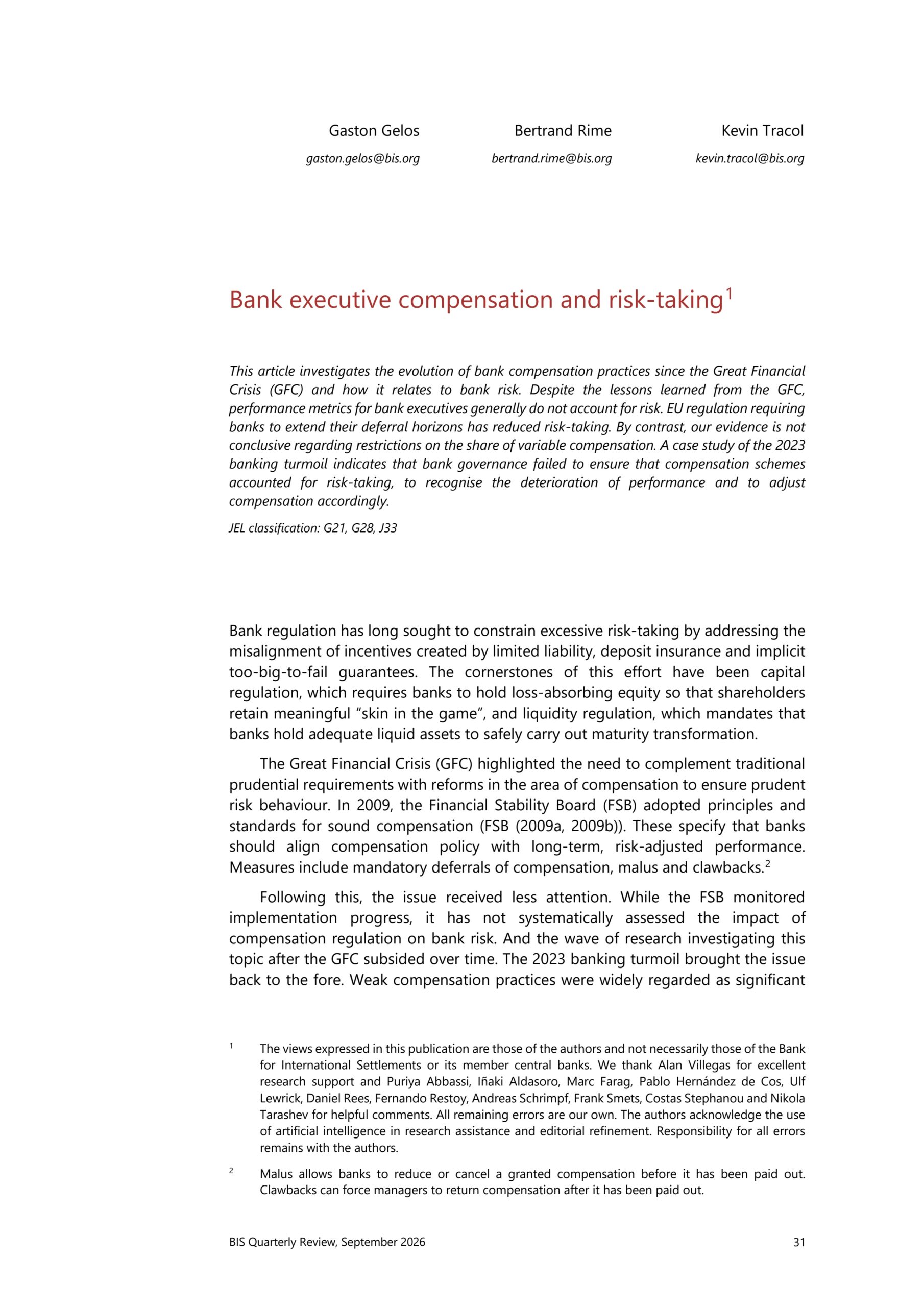
Bank executive compensation and risk-taking
This research investigates bank executive compensation since the Great Financial Crisis. It finds that longer deferral horizons successfully reduce risk-taking and encourage prudent capital management. However, evidence regarding variable pay caps is inconclusive. Case studies from 2023 failures highlight governance shortcomings in risk-adjusting performance metrics and compensation schemes.
Please login or join for free to read more.

OVERVIEW
Bank executive compensation and risk-taking
This article investigates the evolution of bank compensation practices since the Great Financial Crisis (GFC) and their relationship with bank risk. It highlights that despite significant regulatory reforms, performance metrics for bank executives often fail to account for risk. The evidence suggests that European Union regulations requiring banks to extend their deferral horizons have successfully reduced risk-taking and encouraged more prudent capital management. However, findings regarding restrictions on the share of variable compensation, such as bonus caps, remain inconclusive. A case study of the 2023 banking turmoil indicates that bank governance frequently fails to ensure compensation schemes reflect risk-taking or recognise performance deterioration in a timely manner.
Compensation regulation: rationale and post-GFC reforms
Economic theory provides a rationale for regulating bank compensation to address incentive misalignments created by limited liability, deposit insurance, and implicit too-big-to-fail guarantees. While traditional prudential requirements focus on capital and liquidity regulation, compensation reforms are necessary to ensure prudent risk behaviour. The risk-shifting problem—the incentive for shareholders to take excessive risk at society’s expense—can be mitigated by making bonuses contingent on later performance, thereby exposing managers to the long-term consequences of their actions.
Key elements of banks’ compensation schemes
Executive compensation typically combines fixed components with variable elements such as cash, equity, or options. The payment of variable compensation follows a multi-stage process involving the setting of a firm-wide bonus pool and the allocation of grants based on individual performance. A significant portion of this grant is deferred, with payout subject to a vesting process over a predefined horizon. Performance-based vesting determines the final amount of shares or cash based on outcomes like profits or stock market performance. Additional layers of discipline include malus and clawback clauses, which allow banks to reduce, cancel, or reclaim compensation in cases of misconduct or major risk management failures.
FSB principles and standards
In 2009, the Financial Stability Board (FSB) adopted principles and standards for sound compensation, specifying that banks should align pay with long-term, risk-adjusted performance. These standards recommend that a substantial portion—approximately 40–60%—of variable compensation for senior management be deferred over at least three years. The standards emphasise the role of governing boards in overseeing the design and operation of these schemes and call for independent board compensation committees in larger institutions.
Implementation of the standards
National jurisdictions have implemented FSB standards in markedly different ways. The United States, Canada, and Japan adopted principles-based approaches without prescribing binding quantitative parameters. In contrast, the European Union introduced quantitative requirements through the 2014 Capital Requirements Directive (CRD IV), which included a bonus cap limiting variable pay to 200% of fixed compensation and mandatory five-year deferral horizons for at least 60% of variable pay for top executives.
Changes in bank compensation practices following the GFC
Following the adoption of deferral rules, the average horizon for variable pay at EU banks rose by approximately 12 months, now exceeding that of US banks. While the share of performance-based vesting has increased significantly, there is little evidence that banks have adjusted their performance metrics to reflect risk. Return on equity (ROE) remains the most heavily weighted target, despite its susceptibility to artificial inflation through leverage. Conversely, the weighting for risk-adjusted metrics like economic value added (EVA) remains low and is declining.
How does compensation design affect bank risk?
Empirical analysis shows that longer deferral horizons are strongly associated with lower bank risk across multiple metrics, including systemic risk (SRISK) and expected default frequency (EDF). For instance, an increase of one year in the deferral horizon is associated with a reduction in SRISK representing roughly 15% of its year-to-year variability. Longer deferrals also correlate with more prudent capital management, reflected in higher Common Equity Tier 1 (CET1) capital ratios. In contrast, the correlation between the share of variable compensation and bank risk is weak and often inconclusive.
The 2023 banking turmoil (Box A)
Case studies of the failures of Credit Suisse and US regional banks like Silicon Valley Bank (SVB) suggest that their compensation structures were not fundamental outliers compared to their peers. Instead, governance failures meant that performance metrics did not reflect risk-adjusted profitability. Credit Suisse adjusted its metrics to exclude goodwill impairments and litigation provisions, allowing for the distribution of compensation despite heavy accounting losses. SVB tied executive pay to short-term earnings and equity returns without incorporating risk metrics, providing financial incentives to focus on short-term profits over sound risk management.
Broader empirical literature (Box B)
A review of broader empirical literature supports the finding that deferrals are more effective than bonus caps in reducing bank risk. While the introduction of the EU bonus cap yielded mixed results, its subsequent removal in the United Kingdom in 2023 was associated with a significant rise in risk at banks that increased variable compensation beyond previous limits. This underscores the complexity of the relationship between compensation design and financial stability.
Conclusions
The research concludes that longer deferral requirements mandated by regulation lead to reduced bank risk and improved capital management. However, measuring the relationship between compensation and risk remains inherently complex, requiring broad-based regulatory impact analyses. The 2023 turmoil highlights that governing boards and supervisors must play a more active role in overseeing both the design and operation of compensation frameworks to ensure they effectively reflect risk-taking and performance deterioration.




