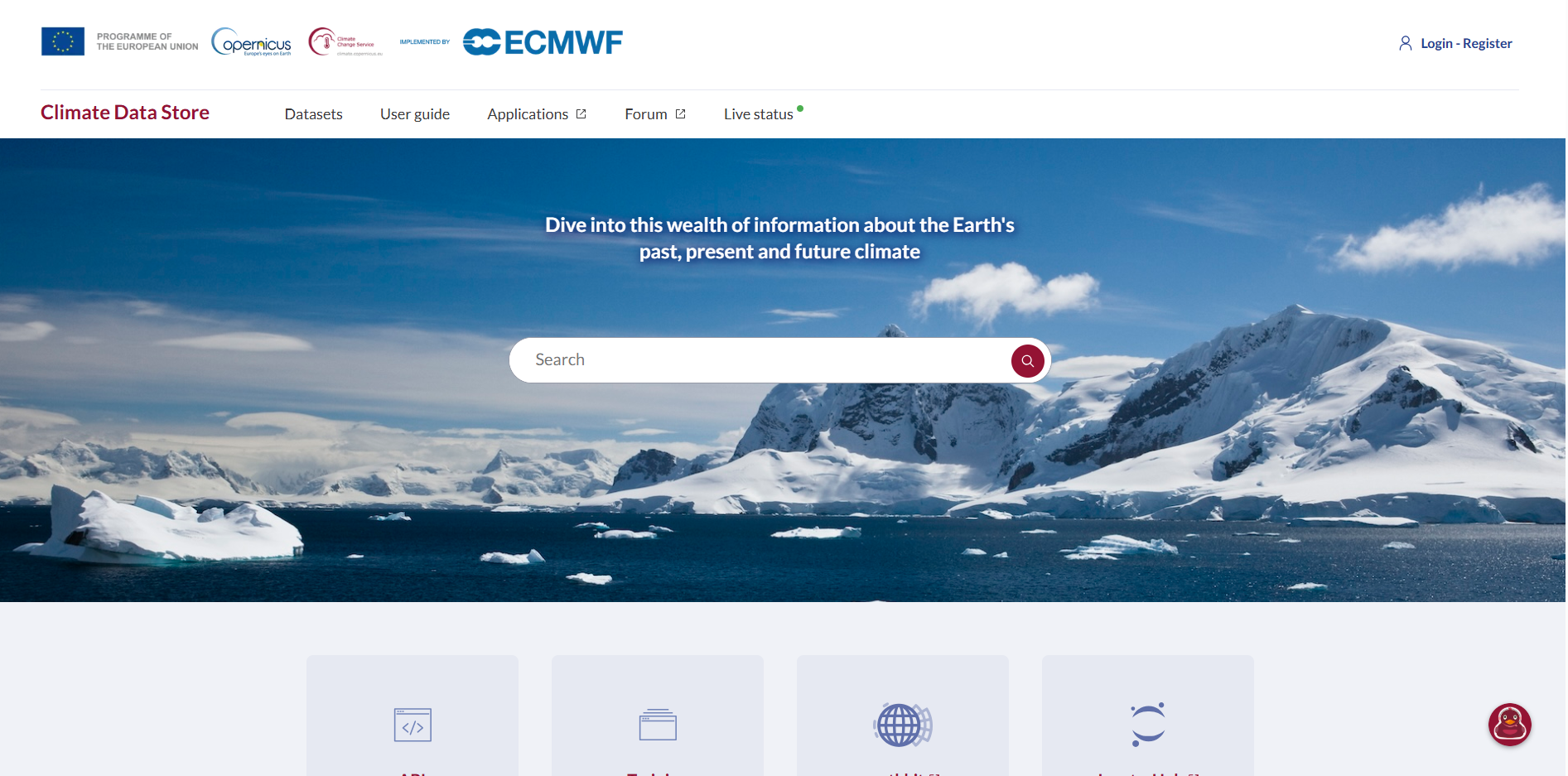
Climate Data Store (CDS)
The Climate Data Store (CDS) is an open-access platform providing authoritative climate datasets, including historical reanalysis and future projections. It enables finance professionals to assess physical climate risks, track greenhouse gas emissions, and integrate evidence-based environmental data into ESG reporting and investment analysis.
Please login or join for free to read more.

OVERVIEW
The Climate Data Store (CDS) is a central digital repository providing free and open access to a vast range of climate datasets. It serves as the primary data infrastructure for the Copernicus Climate Change Service (C3S), designed to turn complex environmental data into actionable intelligence. For finance professionals, the CDS provides the underlying evidence-based insights necessary for assessing physical climate risks and long-term economic trends.
Organisation behind the tool
The Climate Data Store is an initiative of the Copernicus Climate Change Service (C3S), which is implemented by the European Centre for Medium-Range Weather Forecasts (ECMWF) on behalf of the European Commission. It operates in collaboration with various partners, including the World Meteorological Organization (WMO) for specific reports like the European State of the Climate.
What the tool does
- Provides a curated collection of interactive tools and high-quality datasets, including climate reanalysis (such as ERA5 and the upcoming ERA6).
- Offers hourly reconstructions of the Earth system covering more than 75 years of historical data.
- Facilitates access to climate projections, thermal stress indicators, and atmospheric data including methane hotspots and aerosols.
- Features a data applications catalogue that turns environmental data into evidence-based insight for science, policy, and app development.
Target audience
The primary users include scientists, policymakers, researchers, and app developers. It is also intended for secondary audiences such as educators, journalists, and professionals in sectors sensitive to climate change, including finance and insurance.
Relevance to finance professionals
- Risk assessment – Users can access authoritative data to evaluate exposure to climate-related hazards, including temperature extremes and heat stress.
- ESG analysis – The tool provides rigorous environmental metrics and greenhouse gas monitoring essential for corporate reporting and sustainability disclosures.
- Investment context – Long-term historical data and future climate projections assist in understanding the trajectory of environmental trends and their potential impact on assets and infrastructure.
- Market insights – Data on wind energy and other climate variables support investment decisions in renewable energy and commodity markets.