

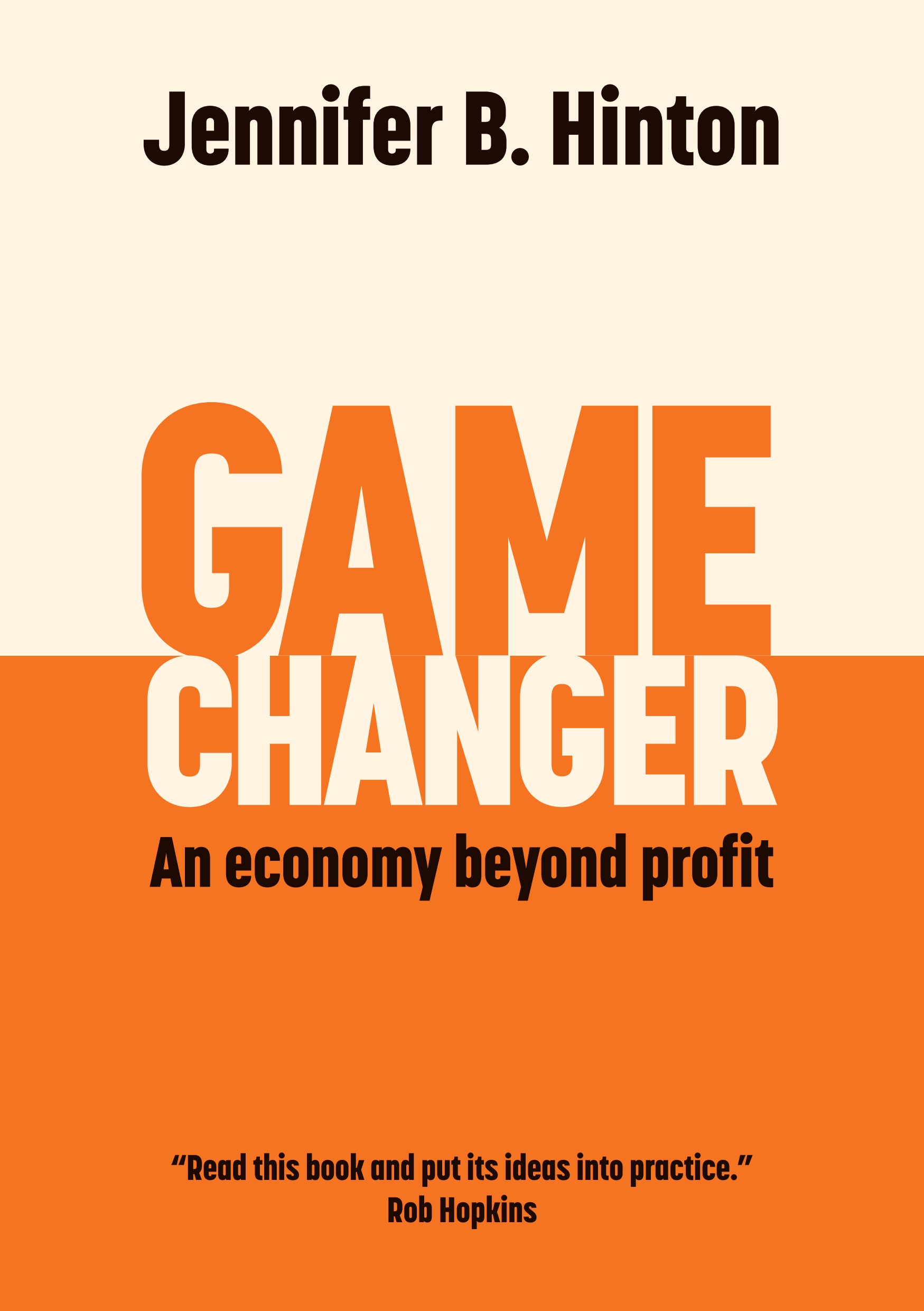
Game changer: an economy beyond profit
This research critiques the for-profit economy’s destructive dynamics, including rising inequality and environmental collapse. It proposes a Not-for-Profit Economy model where businesses legally reinvest all surpluses into social benefit. The report outlines transformation strategies across five fronts to shift towards a sustainable, needs-based global economic system.
Please login or join for free to read more.

OVERVIEW
Introduction: more money, more problems
The author argues that the global pursuit of the ‘American Dream’—prioritising material success above all else—has failed to deliver genuine wellbeing. Personal experiences in the United States and China reveal how economic growth frequently results in social upheaval, environmental destruction, and health crises. The report challenges the mainstream definition of development, questioning whether the purpose of life should be to extract resources and consume goods at the expense of human health and ecosystems.
The set-up of a for-profit economy
For-profit businesses are the central playing pieces of the current economy, defined by a financial gain purpose and private ownership. The economy spans four spheres: the Profit-Driven Market, the Regulating State, Civil Society, and Households. Within the market, investment is guided primarily by perceived profitability, with investors seeking to extract more money than they initially put in. This motive drives the behaviour of entrepreneurs, workers, and consumers alike.
Profit-seeking strategies: let’s get rich!
Businesses employ four primary strategies to generate profit: increasing sales, cutting costs, market consolidation, and market control. Increasing sales often involves manipulative advertising, which can contribute to low self-esteem and eating disorders, and planned obsolescence. Cost-cutting involves shifting burdens onto workers through wage stagnation, ‘gigifying’ work, or even forced labour, which generates an estimated $236 billion in profit annually. Larger firms consolidate power through acquisitions—such as Google’s 260 acquisitions—to reach a ‘wealth siphon’ effect, where profits are extracted from the ordinary economy into an exclusive elite economy.
Destructive dynamics: the winner takes it all
Self-reinforcing feedback loops escalate consumerism, environmental crises, and inequality. The report highlights that between 2020 and 2024, the wealth of the five richest men doubled from $405 billion to $869 billion, while nearly five billion people became poorer. Global debt has surged, rising from 238% to 336% of global GDP between 2022 and 2023. Political capture allows economic elites to influence policy through lobbying and ‘revolving doors’, hollowing out democratic accountability and prioritising private gain over the public interest.
Time to change the game
The report dispels eight ‘for-profit myths’, including the assumptions that the profit motive fuels beneficial innovation and that money is a proxy for wellbeing. It argues that piecemeal solutions like corporate social responsibility (CSR) or small-scale regulations are insufficient to stop the onward march of global crises. True sustainability requires changing the underlying set-up of the economy rather than merely trying to fix its outcomes.
The set-up of a not-for-profit economy
The proposed alternative is a Not-for-Profit Economy where all businesses are set up to achieve social benefit missions. A ‘non-distribution constraint’ ensures that all surpluses are reinvested into meeting community needs rather than being extracted by private owners. This economy includes the Needs-Based Market, the Partner State, Civil Society, and the Commons, all operating within the biophysical limits of the biosphere.
Social benefit strategies: let’s get together and feel alright
In this model, rational players use strategies focused on serving the community, circulating wealth, and cooperating. Businesses identify unmet needs and design durable, repairable products. Strategies include on-demand production, leasing schemes, and circular manufacturing to minimise resource extraction. Communication is transparent, with all organisations required to publish social and environmental impact reports.
Sustainable dynamics: what a wonderful world
A Not-for-Profit Economy naturally leads to economic equality and ecological stewardship. Without the pressure to extract profit, businesses can provide living wages and affordable prices. Automation is used to reduce working hours—typically well under 40 hours per week—rather than to increase dividends. The ‘Partner State’ monitors success through a dashboard of health and environmental indicators rather than GDP.
Two very different games
The report contrasts the extractive, expansionary for-profit market with the regenerative, steady-state needs-based market. It asserts that for-profit structures are inherently incompatible with sustainability because they act as loopholes that eventually disrupt social and ecological goals. A new political economy framework is proposed that moves beyond the state-versus-market dichotomy by focusing on ownership and purpose.
Transforming the economy is possible
Social transformation is described as an exponential process. Research suggests that tipping points occur when 15% to 20% of a population actively supports a new system. The report notes that 72% of people in G20 countries already believe the economy needs significant reform, indicating that a critical mass for change is emerging.
Five fronts of transformation for game changers
The transition involves five fronts: citizens generating social momentum; entrepreneurs building robust not-for-profit businesses; for-profit companies transitioning to not-for-profit structures (such as Patagonia); policymakers implementing structural changes like capping profit distributions; and educators updating research to include heterodox economic ideas. Governments must withdraw subsidies for the for-profit sector and transition support to not-for-profit entities to ensure a fair and sustainable future.




