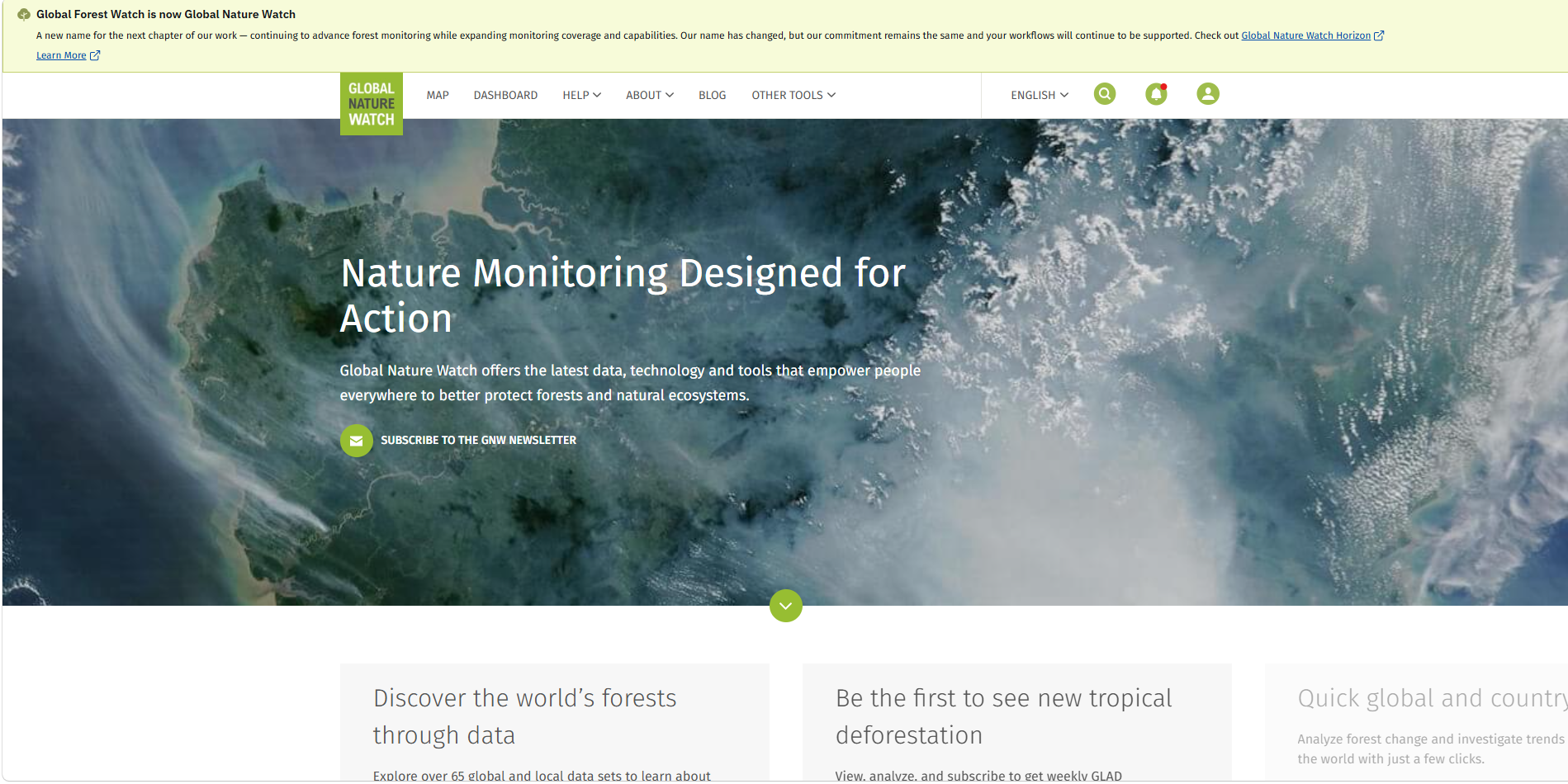
Global Nature Watch
Global Nature Watch is an AI-powered Earth monitoring platform developed by the World Resources Institute and Google. It provides near-real-time data on land-use changes across various ecosystems to support nature-based risk assessment and environmental reporting.
Please login or join for free to read more.

OVERVIEW
Global Nature Watch is an experimental, AI-powered Earth monitoring system and platform that represents the next evolution of Global Forest Watch. Developed to expand data coverage beyond forests, it provides near-real-time and annual satellite data across diverse ecosystems, including grasslands and other landscapes. Finance professionals can use this tool to gain high-resolution, data-driven insights into land-use changes and ecosystem health globally.
Organisation behind the tool
The tool is an initiative of the World Resources Institute (WRI), specifically managed within its Forest Programme and the Land & Carbon Lab. It has been developed in partnership with Google, utilising their AI and cloud technology, with technical contributions from Development Seed.
What the tool does
- Integrates over 80 peer-reviewed datasets into a single, open-access platform.
- Utilises AI to provide near-real-time monitoring of land-use change and ecosystem dynamics.
- Features a chat-style interface designed to simplify complex environmental data into clear, actionable insights.
- Provides broad ecosystem coverage, expanding the monitoring capabilities originally established for forest landscapes to other natural biomes.
Target audience
The primary users include environmental researchers, policymakers, and land managers. It is also intended for corporate sustainability officers and finance professionals requiring transparent environmental data.
Relevance to finance professionals
- Risk assessment – Identification of physical risks related to land degradation, deforestation, and ecosystem instability in specific geographies.
- ESG analysis – Provision of granular, satellite-verified environmental metrics to support biodiversity and nature-related disclosures.
- Investment context – Analysis of long-term environmental trends to inform sustainable land use and natural capital investment strategies.
- Supply chain monitoring – Verification of environmental claims and monitoring of landscape-level changes within commodity supply chains.