

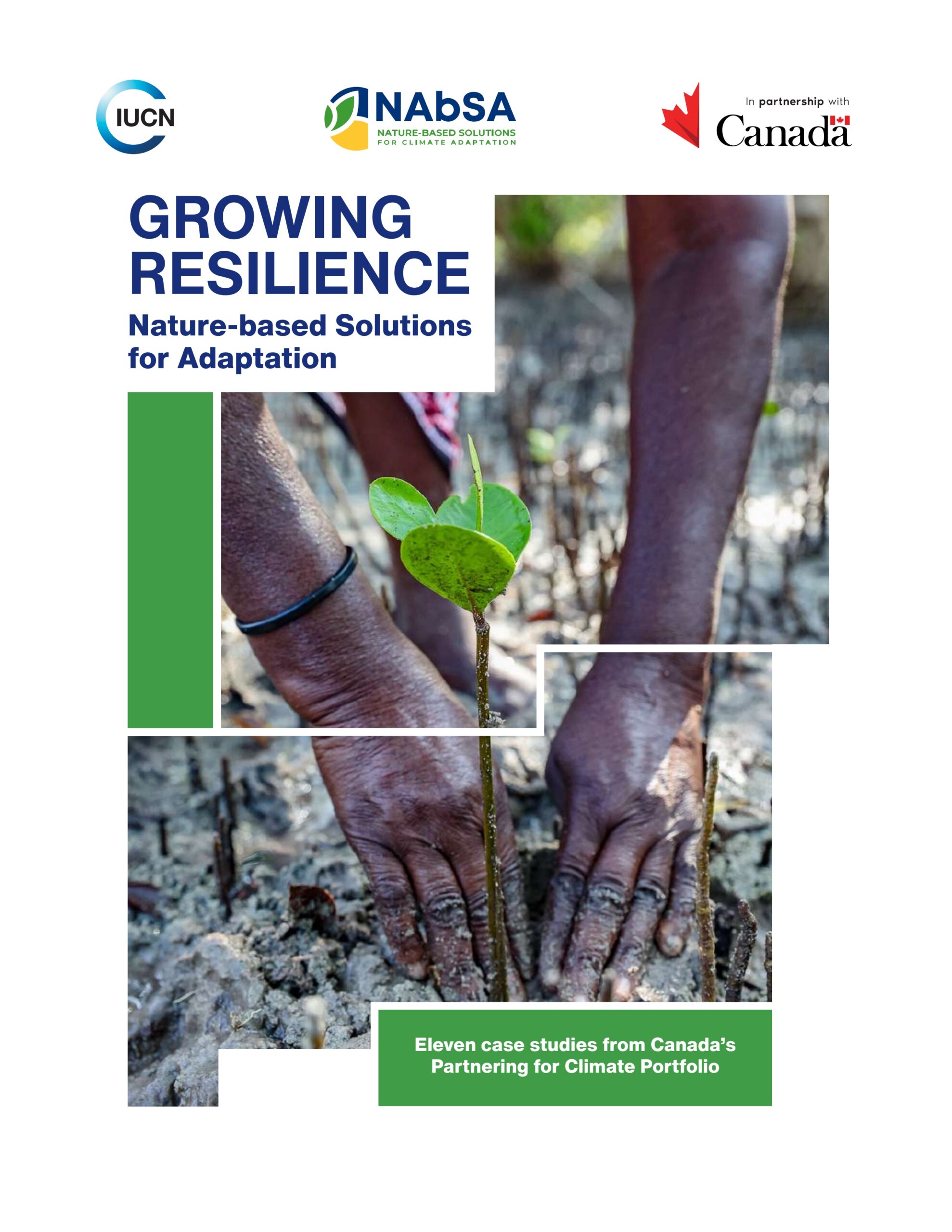
Growing resilience: Nature-based solutions for adaptation
This report assesses eleven Nature-based Solutions projects in Sub-Saharan Africa using the IUCN Global Standard. It evaluates contributions to climate adaptation, biodiversity, and gender equality. Key recommendations include integrating maladaptation risk assessments, extending project timelines, and aligning local actions with national policy frameworks to ensure sustainable resilience.
Please login or join for free to read more.

OVERVIEW
About NAbSA
NAbSA (NAture-based Solutions for climate Adaptation: monitoring & impact evaluation) is a technical community of practice hosted by the International Union for Conservation of Nature (IUCN). Its programme of work is co-created with Global Affairs Canada’s Partnering for Climate (P4C) community. The mission of NAbSA is to accelerate climate resilience across Sub-Saharan Africa through inclusive, gender-responsive Nature-based Solutions (NbS) that safeguard biodiversity, empower local communities, and strengthen adaptation outcomes. It serves as a platform for capacity building, knowledge sharing, and policy influence, reinforcing the role of nature in reducing poverty in vulnerable regions.
Executive summary
This report presents an assessment of 11 projects implemented in Sub-Saharan Africa under Canada’s Partnering for Climate portfolio. These projects demonstrate practical contributions to climate change adaptation through gender-responsive NbS. Project assessments were prepared using the first edition of the IUCN Global Standard for Nature-based Solutions and its associated self-assessment tool. During the assessment process, the second edition of the Standard was released; however, the findings and recommendations remain relevant as the core structure and focus of the Standard Criteria remained consistent between editions.
Introduction
Healthy ecosystems are fundamental to human wellbeing and long-term economic prosperity. Failure to safeguard nature perpetuates unsustainable development and overlooks the critical role natural systems play in addressing societal challenges like disaster risk reduction and food security. NbS offer an alternative to conventional approaches by harnessing ecosystem functions to generate resilient and socially equitable outcomes. Successful application depends on structured, evidence-based, and inclusive planning. The projects assessed in this report pursue gender-transformative outcomes and are implemented with a conflict-sensitive lens, recognizing that women and girls are disproportionately affected by climate change and insecurity.
IUCN global standard for nature-based solutions
The IUCN developed the Global Standard to facilitate the operationalisation of NbS in a consistent and robust manner. It helps identify gaps during the design phase, improve implementation processes, and capture lessons learned. The Standard is built upon eight criteria, including effectively addressing societal challenges, incorporating systems perspectives, resulting in positive biodiversity change, and ensuring financial feasibility. It also emphasizes inclusive governance, adaptive management, and the enhancement of enabling conditions for mainstreaming.
Observations and recommendations
The report provides ten key observations to support practitioners and decision-makers. Firstly, there is a need to move from principles to implementation by providing detailed guidance on translating global principles into concrete actions throughout the project cycle. Secondly, maladaptation risk assessments must be integrated throughout the design and implementation phases to ensure measures do not unintentionally reinforce existing vulnerabilities or shift risks to other groups.
Thirdly, local action should be connected to broader national and international policy and reporting frameworks, identifying clear pathways for communicating climate and biodiversity outcomes to national authorities. Fourthly, monitoring systems must track and report climate and human wellbeing outcomes linked directly to biodiversity actions, providing stronger evidence for the value of investing in nature. Fifthly, the report recommends supporting longer project and monitoring timelines, as the standard three-to-five-year implementation periods are often insufficient to measure tangible biodiversity outcomes or support lasting behavioural change.
Sixthly, projects should build on existing data and systems to avoid duplication and improve relevance. Seventhly, project strategies must be adapted to site-level contexts, avoiding one-size-fits-all approaches in large-scale programmes. Eighthly, long-term monitoring should be strengthened through local partnerships, equipping local organisations with the technical capacity to continue data collection after project completion. Ninthly, the use of local communication channels, such as those utilised by Farm Radio International, can amplify impact and support gender-responsive outcomes. Finally, the report encourages promoting coordination and shared learning across portfolios to transform individual experiences into collective intelligence.
Case studies
The 11 projects assessed cover diverse ecosystems and regions. For example, the ELLESadAPT project in Congo and Chad aims to enhance the economy and food security for 2,100 women entrepreneurs as direct beneficiaries. In Guinea, the FproF project targets 5,000 direct beneficiaries (including 3,500 women) to restore degraded forest ecosystems. The COSME project in Kenya and Tanzania targets over 49,000 direct beneficiaries, focusing on mangrove restoration and sustainable seaweed farming. Other initiatives, such as the Nature+ project, aim to improve food security for 75,000 beneficiaries across Ethiopia, Kenya, Mozambique, and Zimbabwe. Collectively, these projects involve hundreds of thousands of indirect beneficiaries and focus on outcomes ranging from increased blue carbon sinks to climate-resilient rural economies.




