

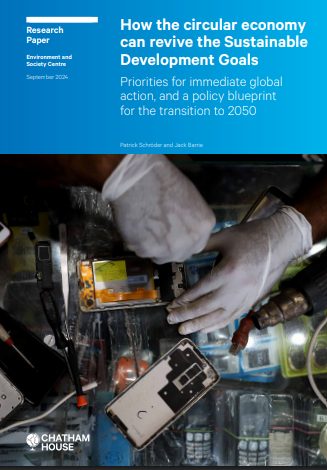
How the circular economy can revive the sustainable development goals: Priorities for immediate global action, and a policy blueprint for the transition to 2050
This report argues that embedding circular economy principles within the Sustainable Development Goals could revive stalled progress. It outlines five global policy priorities and proposes a 2050 blueprint linking circularity, inclusive growth, trade, finance and standards to post-2030 development agendas.
Please login or join for free to read more.

OVERVIEW
Introduction
This research paper examines how the circular economy can be more systematically integrated into the global sustainable development agenda to address stalled progress on the Sustainable Development Goals (SDGs). It argues that current linear economic models are incompatible with achieving the 2030 Agenda and that circular approaches offer a practical pathway to revive momentum while shaping the post-2030 framework.
The circular economy and the SDGs – An interlinked agenda
The report defines the circular economy as an economic system designed to deliver prosperity while minimising raw material extraction, waste and pollution, based on eliminating waste, extending product lifetimes and regenerating natural systems. It demonstrates strong complementarities between circular economy practices and all 17 SDGs, supported by growing empirical evidence and case studies from both the Global North and Global South. Circular strategies could contribute up to 45 per cent of the emissions reductions required for climate mitigation and help reverse biodiversity loss, while reducing poverty through job creation in repair, reuse and recycling sectors. Despite this potential, the global economy is only 7.2 per cent circular, down from 9.1 per cent in 2018, indicating widening implementation gaps.
Five priorities for using the circular economy to reinvigorate the SDGs
Ensuring a just and inclusive circular economy transition
The report emphasises that circular transitions must address equity, inclusion and decent work. Informal workers and MSMEs already underpin many circular activities, particularly waste collection and second-hand markets, yet face limited policy support. Around 80 per cent of the world’s 19–24 million waste workers operate in the informal sector. Policies should prioritise social protection, skills development and access to finance, particularly for women-led and minority-owned enterprises.
Coordinating national policies and strategies
More than 75 countries have adopted national circular economy strategies, with a further 14 in development. However, these initiatives are largely unilateral and fragmented, often focused on competitiveness and reshoring. The report recommends greater international coordination to avoid regulatory fragmentation, reduce trade barriers and align national roadmaps with shared global objectives.
Reforming the international financial architecture
Scaling the circular economy requires significant investment, particularly in developing countries facing financing gaps in waste management, clean energy and circular infrastructure. Multilateral development banks and national development banks are identified as critical actors. The report highlights initiatives such as the Global Environment Facility and African Circular Economy Facility, and calls for expanded blended finance, de-risking instruments and circular-specific financial products.
Rewiring the global trade system
Trade systems are not currently designed to support circular flows of goods, materials and services. Inconsistent standards and inadequate trade classifications hinder circular trade, particularly for secondary materials. The report recommends establishing international working groups, including customs authorities, to improve traceability, harmonise standards and pilot solutions for circular trade facilitation.
Developing common standards and metrics for circularity
The absence of consistent standards and metrics limits measurement, reporting and accountability. The report stresses the need for internationally compatible circularity indicators across value chains, covering product design, procurement, reuse and end-of-life management. Shared taxonomies would support policy alignment, corporate reporting and financial decision-making.
Beyond the SDGs: A proposed blueprint for a circular future for 2050
Looking beyond 2030, the paper presents an indicative blueprint aligning circular economy targets with existing SDGs to 2050. Proposed outcomes include near zero-waste economies, regenerative food systems, elimination of toxic materials, universal access to circular energy and water systems, and widespread circular skills integration. Achieving these goals requires embedding circularity as a core objective within future global development frameworks.
Conclusions: Towards an inclusive circular future
The report concludes that the circular economy is no longer peripheral but central to global development and environmental objectives. Without coordinated action, resource consumption could rise by 60 per cent by 2060, placing over half of SDG targets out of reach. Embedding circular principles into multilateral governance, finance and trade systems is presented as essential for delivering inclusive, resilient and sustainable outcomes beyond 2030.




