

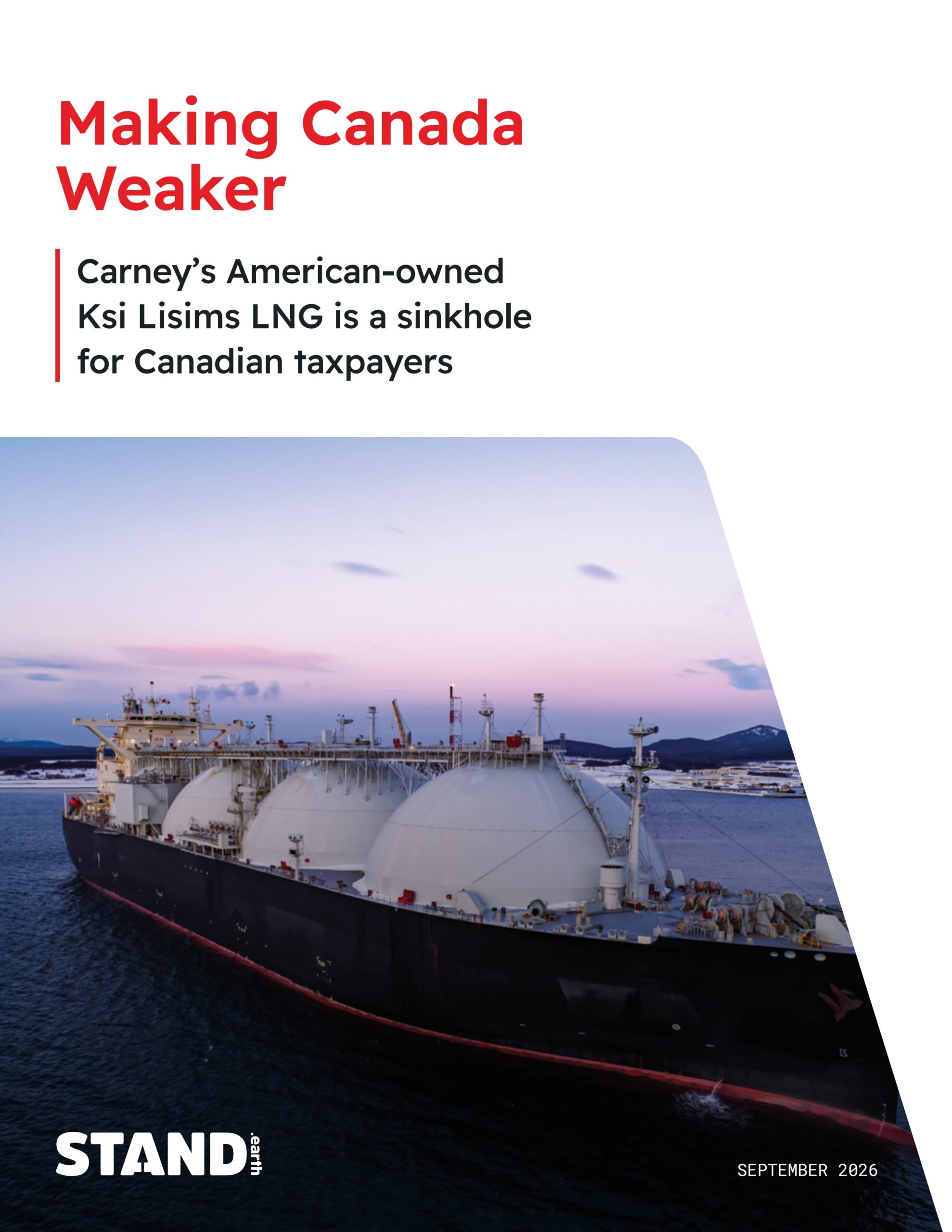
Making Canada weaker: Carney’s American-owned Ksi Lisims LNG is a sinkhole for Canadian taxpayers
This report argues that the Ksi Lisims LNG project is a $30-billion risk to Canada. Wholly American-owned, the facility provides few local jobs while requiring significant public subsidies. It faces Indigenous opposition and environmental threats, including methane emissions, increased air pollution, and risks to critical whale populations.
Please login or join for free to read more.

OVERVIEW
Ksi Lisims LNG is a risky project with few benefits for Canadians
Ksi Lisims LNG is a floating methane gas export facility located on the north coast of British Columbia. Although presented as a nation-building project, it carries a $30-billion price tag, which is triple the original estimate. The facility is 100% American-owned by investors with close ties to Donald Trump. Prime Minister Mark Carney has designated the project for federal fast-tracking, despite it being economically unviable without significant taxpayer support. The project uses offshore labour and steel, and its product faces a highly uncertain future as major Asian and European customers transition their economies to cheaper renewable energy.
Ksi Lisims is entirely owned by a Texas corporation
Despite being billed as an Indigenous-owned project, the Nisga’a Nation does not hold an ownership stake in Ksi Lisims LNG. The facility will be wholly owned by Western LNG, a Texas-based company. Its primary financial backers include the US-based private-equity firm Blackstone, which is valued at over $1.3 trillion. Blackstone’s CEO, Steve Schwarzman, is a major funder of the US MAGA movement. Another owner, Apollo Global Management, has faced scrutiny over its co-founder’s financial ties to Jeffrey Epstein. The project fails various national interest tests, as the floating terminal is slated for construction in South Korea using foreign labour and steel, with profits flowing to US billionaires.
Ksi Lisims is late to the game in a glutted market — and struggling to find buyers
As of mid-2026, the project has failed to attract buyers for 50 percent of its projected capacity. A recent agreement with a German utility covers only one-sixth of the facility’s 12 million tonnes per annum (mtpa) production. Canadian LNG is expensive to produce compared to established exporters like Qatar and the United States, which are building a dozen new facilities. Furthermore, global demand is dwindling as EU countries target a 44 percent reduction in methane gas usage by 2030. In Asia, South Korea’s baseline projections show an 11 percent decline by 2038, and Japan has already cut domestic consumption by nearly 20 percent since 2018. Temporary price spikes driven by global conflicts have destroyed the customer base by accelerating the transition to renewable energy.
Ksi Lisims would create fewer than 350 permanent jobs for Canadians
If the project proceeds, the majority of the facility will be built in South Korea. This trajectory results in the loss of at least 30,000 person-years of construction jobs, which could have kept 7,500 skilled Canadian workers employed for four years. In contrast, local construction labour at the Nass River estuary site is expected to amount to only 2,200 person-years. Once operational, the terminal is promised to create only 200 to 350 long-term operations jobs for Canadian workers. The associated Prince Rupert Gas Transmission pipeline will provide only 23 permanent jobs.
Ksi Lisims will need taxpayer handouts to succeed
The project’s financial viability depends on major public subsidies, including the $6-billion North Coast Transmission Line. The Canada Infrastructure Bank (CIB) has already loaned BC Hydro $139.5 million for preparatory work on this line. Critics argue the federal government is shifting the CIB’s mandate from clean energy to backing fossil fuel megaprojects. Similar local projects, such as the Coastal GasLink (CGL) pipeline, saw costs balloon from $6.2 billion to $14.5 billion, with total public subsidies for LNG Canada and the CGL pipeline amounting to approximately $6 billion.
Ksi Lisims is opposed by multiple Indigenous Nations
Within the Nisga’a Nation, members have filed a lawsuit alleging a breach of fiduciary duty over the deal with the project’s American backers. The Council of the Haida Nation strongly opposes the project, stating it would add 148 LNG tanker transits through Haida waters without their consent. The Prince Rupert Gas Transmission (PRGT) line route crosses 1,000 waterways and contested territories, leading to ongoing opposition and blockades. There are concerns that construction represents a real potential for human rights abuses and police violence, following precedents of RCMP repression during previous pipeline builds.
Ksi Lisims’ methane is a climate disaster, not a solution
The production and use of LNG from this project will generate 36 million tonnes of CO2 equivalent per year, which is comparable to the emissions of ten 850-MW coal plants. Shipping the product will produce an additional 1.2 million tonnes of pollution annually. Methane is 80 times more potent than carbon dioxide over a 20-year timeframe, and leakage rates in the production chain range from 2.3 to 2.8 percent. The greenhouse gas footprint for LNG is estimated to be 33 percent worse than coal when methane leaks are included. Escaped methane from the project would be equivalent to burning 9.3 million tonnes of coal per year.
Ksi Lisims will increase local air pollution, with dangerous health impacts
Communities near existing facilities, such as Kitimat, have experienced increased air pollution, black smoke, and excessive flaring. In 2025, LNG Canada burned more than 350 million cubic metres of gas on site. Local air monitors are often not designed to track volatile organic compounds (VOCs) like benzene. Residents have expressed significant health concerns, yet calls for independent health impact assessments have been rejected.
Ksi Lisims shipping traffic will kill whales
Proposed tanker routes pass through areas designated as critical habitat for humpback whales. Research indicates that fin whale strikes are expected to more than double due to LNG traffic, while humpback deaths are predicted to quadruple to 18 per year. The shipping lanes cross waters vital to several First Nations, including the Haida, Gitga’at, and Nisga’a, threatening species of deep cultural importance.
Ksi Lisims will raise energy prices for Canadians
A pattern has emerged where LNG exports lead to higher domestic gas prices as export markets compete with domestic consumers. In eastern Australia, domestic prices tripled in a decade after exports began, costing households AU$4.3 billion in 2023–24 alone. A 2024 US Department of Energy assessment concluded that unconstrained exports would raise wholesale gas prices by 31 percent by 2050.
Ksi Lisims will starve the clean energy economy
Government prioritisation of fossil fuel expansion underfunds the clean economy. Directing tens of billions in subsidies toward geothermal energy, energy efficiency, and tripling renewable energy would offer far greater jobs and economic returns. Clean energy is noted to provide more jobs per dollar invested and involves fewer Indigenous consent challenges compared to precarious fossil fuel projects.
In conclusion: Ksi Lisims will make Canada weaker
The report recommends that federal decision-makers do not designate the project as being of National Interest and withhold all taxpayer subsidies and tax breaks. It also demands that full Indigenous consent be obtained before any approvals proceed and that public infrastructure investment be redirected toward Canadian-owned clean energy projects.




