

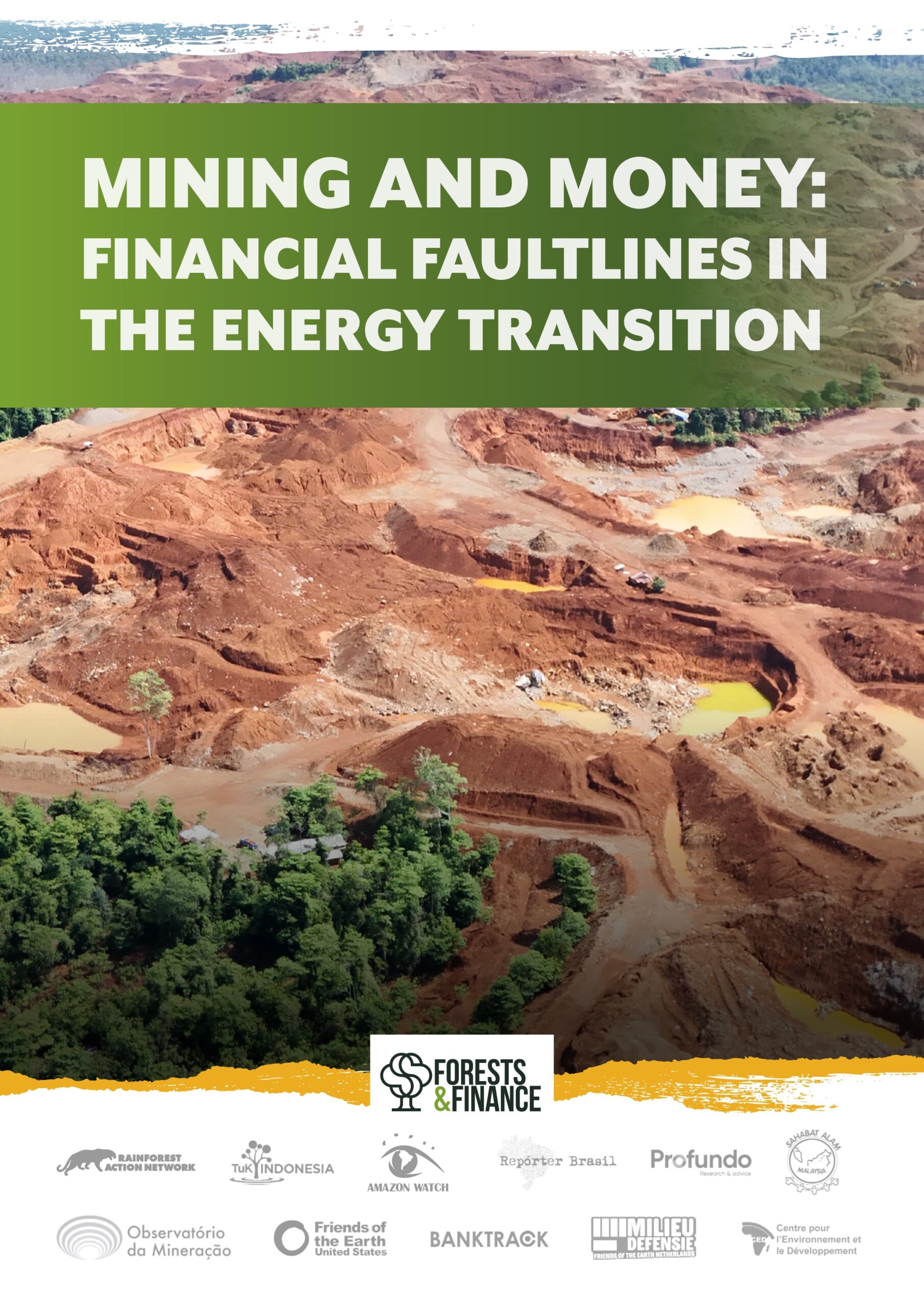
Mining and money: Financial faultlines in the energy transition
This report highlights how global finance enables destructive transition mineral mining. Between 2016 and 2024, banks provided USD 493 billion in credit despite weak ESG policies. Case studies in Indonesia, Brazil, DRC, and Australia reveal widespread environmental damage and human rights abuses, necessitating urgent regulatory and institutional reform.
Please login or join for free to read more.

OVERVIEW
Executive summary
The transition to a low-carbon economy relies on ‘transition minerals’ like lithium and cobalt, with demand projected to triple by 2040. Meeting this demand requires an estimated USD 800 billion in new mining investments. However, research indicates that 70% of transition mineral mines overlap with Indigenous or peasant lands, and up to 71% are located in high-biodiversity regions. Since 2010, over 835 allegations of abuse have been linked to these extractive operations, including land grabs and violence against defenders. Financial institutions are enabling this expansion despite having dangerously weak environmental, social, and governance (ESG) policies, with an average score of just 22% across 30 major institutions.
Introduction
Current economic models driving mineral demand risk repeating the exploitative and unsustainable practices of the fossil fuel era. While decarbonising transport is essential, the report notes that the focus on electric vehicles (EVs) often sidelines urgent energy access needs in regions where 750 million people still lack electricity. The United Nations and civil society have called for structural reforms to align mineral production with human rights and sustainability, ensuring fair benefit-sharing and holding both financial institutions and mining companies accountable for their impacts.
Research overview
The report evaluates financial flows to 111 transition mineral mining companies and assesses the policies of 30 major financial institutions against 34 ESG criteria. It focuses on ten commodities, including aluminium, cobalt, copper, and nickel, while excluding coal. Of the institutions named in the case studies, only Citi and ABN Amro responded to requests for comment. The methodology utilised ‘segment adjusters’ to accurately attribute financing to specific mineral extraction and processing activities rather than general corporate lending.
Mineral financing trends
Between 2016 and 2024, banks provided USD 493 billion in credit, while investors held USD 289 billion in bonds and shares as of June 2025. Financing is highly concentrated; 63% of credit originated from banks in China, the United States, France, Canada, and Japan. Similarly, 80% of investment comes from institutions in the US, Australia, the UK, Japan, and Brazil. Copper, iron, and aluminium received the highest volumes of finance. Glencore was the most financed company, securing USD 64 billion in credit, which is more than double the amount received by the next largest firms.
Financial institution policy assessment analysis
The assessment exposed major policy failings across the sector. Environmental safeguards were the weakest area, averaging a score of 17%, with only 13% of institutions maintaining clear zero-deforestation policies. No institutions had requirements for clients to manage tailings storage risks, and 80% lacked policies regarding the protection of Human Rights Defenders. Furthermore, 60% of institutions had no public grievance mechanism, falling short of UN Guiding Principles. Tax responsibility is another critical gap, with 60% of institutions lacking policy coverage, which facilitates potential profit shifting and capital flight.
Exposing the fault lines: the hidden costs of the energy transition
Case studies from Indonesia, Brazil, the DRC, and Australia illustrate the human and ecological toll of poorly regulated mining finance. In Indonesia, Harita Group’s nickel operations use coal power and have been linked to carcinogenic hexavalent chromium contamination in drinking water. In Brazil, Vale’s iron and nickel operations have caused decades of social conflict and two catastrophic dam collapses. In the Democratic Republic of Congo, China Molybdenum’s Tenke Fungurume Mine is associated with forced displacement, toxic waste dumping, and labour exploitation. In Australia, Alcoa and South32 are clearing Jarrah forests on Noongar Country, threatening water security and destroying irreplaceable ecosystems that have not been successfully rehabilitated.
Recommendations
To align capital with a just transition, policymakers must integrate biodiversity and human rights risks into financial regulation and ensure corporate transparency. Financial institutions should endorse principles that advance justice and equity, such as respecting Free, Prior and Informed Consent (FPIC) and protecting human rights defenders. Specific actions include excluding finance for companies linked to deforestation, strengthening due diligence at the corporate group level, and establishing clear ‘red lines’ to exclude clients with repeated or unresolved ESG violations.
Conclusion
The report reveals that the extractive financing model powering the fossil fuel economy is being recycled in the name of clean energy. A truly just energy transition cannot be realised without strong governance and financial regulation that centres human rights and ecological limits. Governments must adopt and enforce regulations that hold financiers accountable, while financial institutions must transform their financing models to prioritise justice and sustainability as foundational requirements.




