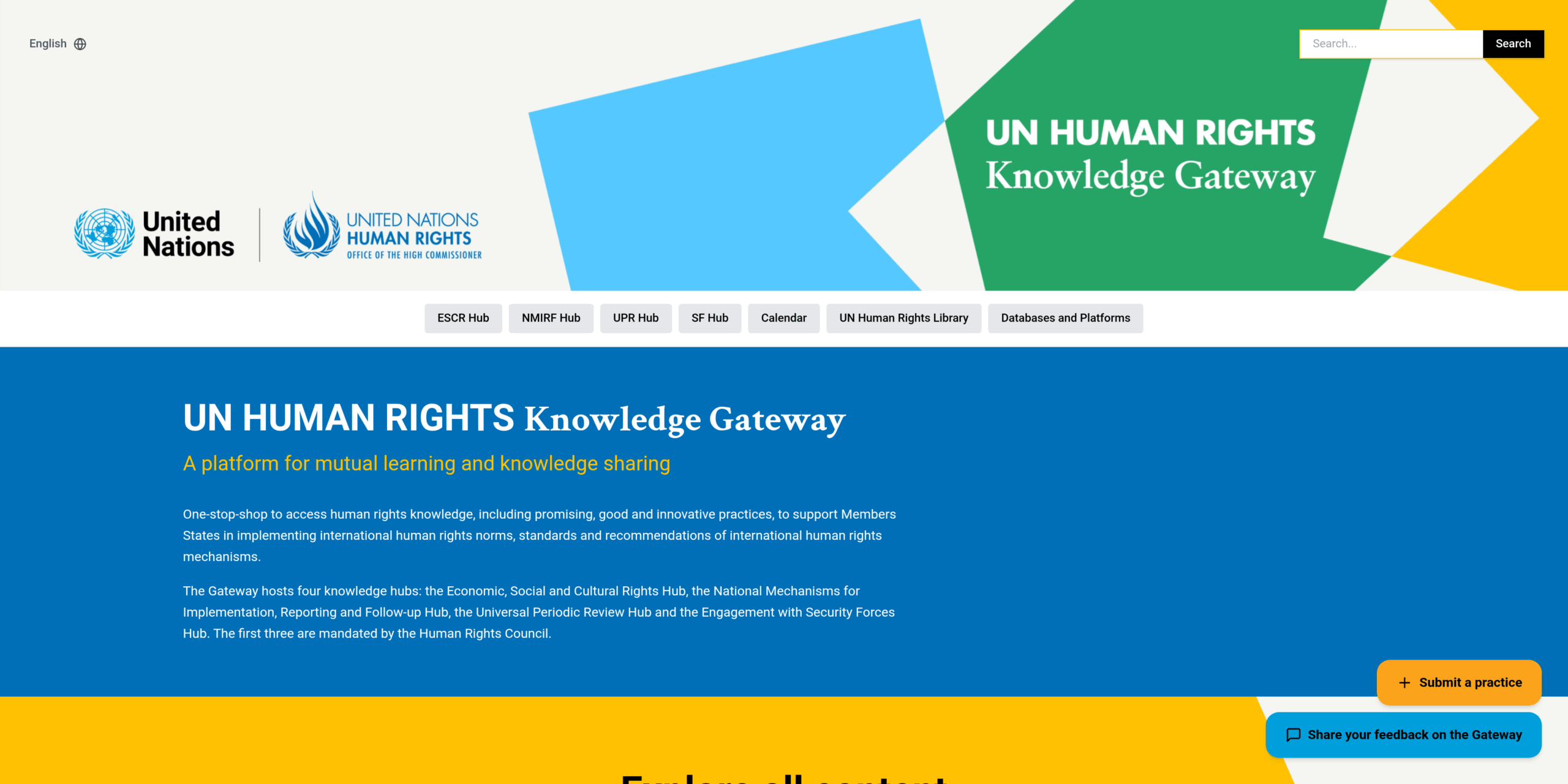
OHCHR Knowledge Gateway
The OHCHR Knowledge Gateway provides access to human rights knowledge, practices, and resources to support implementation of international standards.
Please login or join for free to read more.

OVERVIEW
The OHCHR Knowledge Gateway is a platform for mutual learning and knowledge sharing. It serves as a central access point for human rights knowledge, including promising and innovative practices designed to support Member States in implementing international human rights standards and recommendations. Finance professionals can use the tool to access authoritative data on human rights trends and reporting mechanisms relevant to social risk assessments and ESG reporting.
Organisation behind the tool
The platform is developed and maintained by UN Human Rights (OHCHR). It hosts four specific knowledge hubs, three of which are mandated by the Human Rights Council: the Economic, Social and Cultural Rights Hub; the National Mechanisms for Implementation, Reporting and Follow-up Hub; and the Universal Periodic Review Hub. The fourth is the Engagement with Security Forces Hub.
What the tool does
The Gateway functions as a searchable repository for human rights resources and practices. It provides access to over 400 resources and 80 documented practices, including those submitted by external contributors. Key features include a calendar of international human rights events and direct links to multiple verified databases such as the Universal Human Rights Index, the National Recommendations Tracking Database, and the Status of Ratification of Human Rights Treaties.
Target audience
The tool is primarily intended for Member States, national mechanisms for implementation and reporting, and security forces. It also serves as a resource for researchers, policymakers, human rights practitioners, and the general public seeking access to official UN documentation and curated collections of human rights materials.
Relevance to finance professionals
- ESG analysis – provides authoritative source material for evaluating social performance and human rights compliance in specific jurisdictions.
- Risk assessment – allows for the tracking of national recommendations and treaty body findings to identify potential legal or reputational risks.
- Investment context – offers insights into country-level human rights progress that informs long-term sustainable investment strategies.