

Royal Bank of Canada (RBC): Partnering with survivor support organisations to increase financial access
This case study explains how the Royal Bank of Canada piloted and expanded a financial access programme for survivors of human trafficking, using a risk based approach to customer identification and verification. It shows how regulated banks can advance financial inclusion while meeting compliance requirements through partnerships with support organisations.
Please login or join for free to read more.

OVERVIEW
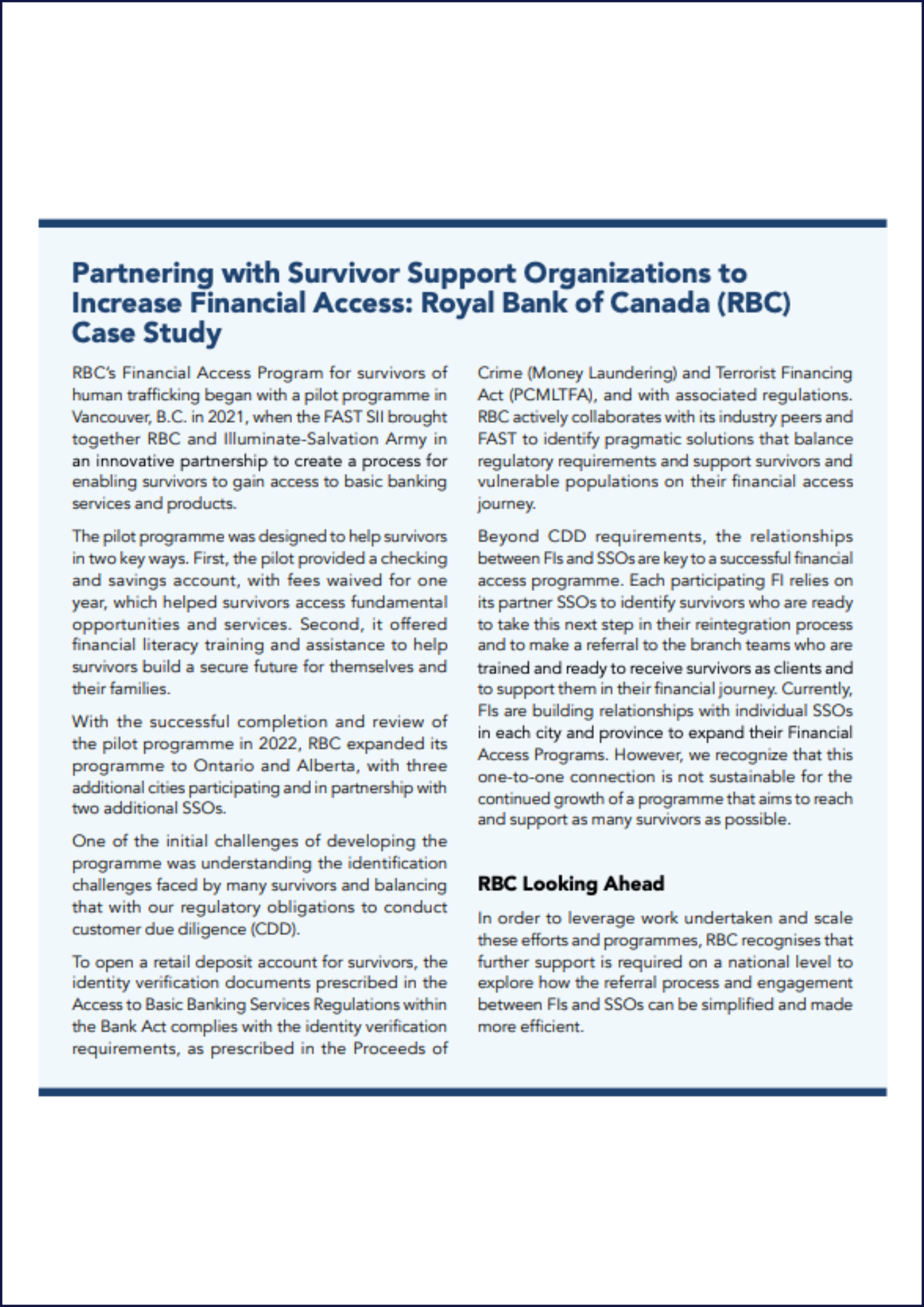
This case study, extracted from Lessons from Canada’s approach to extending financial access to survivors of modern slavery, examines how the Royal Bank of Canada (RBC) designed, piloted, and expanded a Financial Access Program to support survivors of human trafficking in accessing basic banking services. Initiated in 2021 through a partnership with FAST and Illuminate–Salvation Army, the programme addresses a persistent barrier to financial inclusion: survivors’ difficulty meeting standard identification and customer due diligence (CDD) requirements. The case is relevant to sustainable finance because it demonstrates how a large, regulated financial institution can advance social inclusion while maintaining compliance with anti-money laundering (AML) and know-your-customer (KYC) obligations. It provides a practical example of applying risk-based regulation to support vulnerable populations within mainstream retail banking.
Activities relevant to investors / finance audience
- Development and piloting of inclusive retail banking products (chequing and savings accounts with fee waivers)
- Integration of social inclusion objectives into compliance and CDD processes
- Application of a risk-based regulatory approach under existing banking and AML legislation
- Partnership with survivor support organisations to manage referrals and suitability
These activities are relevant to investors and finance professionals as they show how social considerations can be embedded into core financial operations without undermining regulatory integrity or risk management.
Scope
The case focuses on the Canadian retail banking sector and covers the period from 2021 onwards. It centres on basic deposit products, financial literacy support, and regulatory compliance processes related to identity verification. Geographically, it began in Vancouver, British Columbia, and later expanded to Ontario and Alberta. The primary sustainability theme is social inclusion, specifically inclusive finance for survivors of human trafficking.
Who is the case study for?
- Bankers and financial institutions designing inclusive products
- Policymakers and regulators concerned with proportional, risk-based regulation
- Sustainability and ESG analysts assessing social performance in financial institutions
- Investors and asset managers evaluating governance and inclusion practices
Tools, data and methods used
RBC operated within existing legislative frameworks, including the Bank Act and the Proceeds of Crime (Money Laundering) and Terrorist Financing Act, using the Access to Basic Banking Services regulations to meet identity verification requirements. The programme relied on structured partnerships with survivor support organisations (SSOs), which identified suitable participants and referred them to trained branch teams. Internal reviews of the pilot phase informed programme expansion. The approach combined regulatory interpretation, stakeholder collaboration, and staff training to balance inclusion objectives with financial crime risk management.
Findings
The case shows that financial inclusion for highly vulnerable groups can be achieved through pragmatic application of existing regulations rather than regulatory exemptions. RBC’s pilot demonstrated that survivors could safely access basic banking services and financial literacy support while the bank maintained compliance with CDD and AML requirements. Expansion beyond the pilot highlighted both demand and operational challenges, particularly the limits of one-to-one partnerships between financial institutions and SSOs. A key lesson is the importance of scalable referral and engagement models, potentially requiring national-level coordination. For sustainable finance decision-makers, the case illustrates how banks can integrate social objectives into compliance, product design, and organisational strategy, offering a replicable model for inclusive finance that aligns social impact with prudent risk governance.


