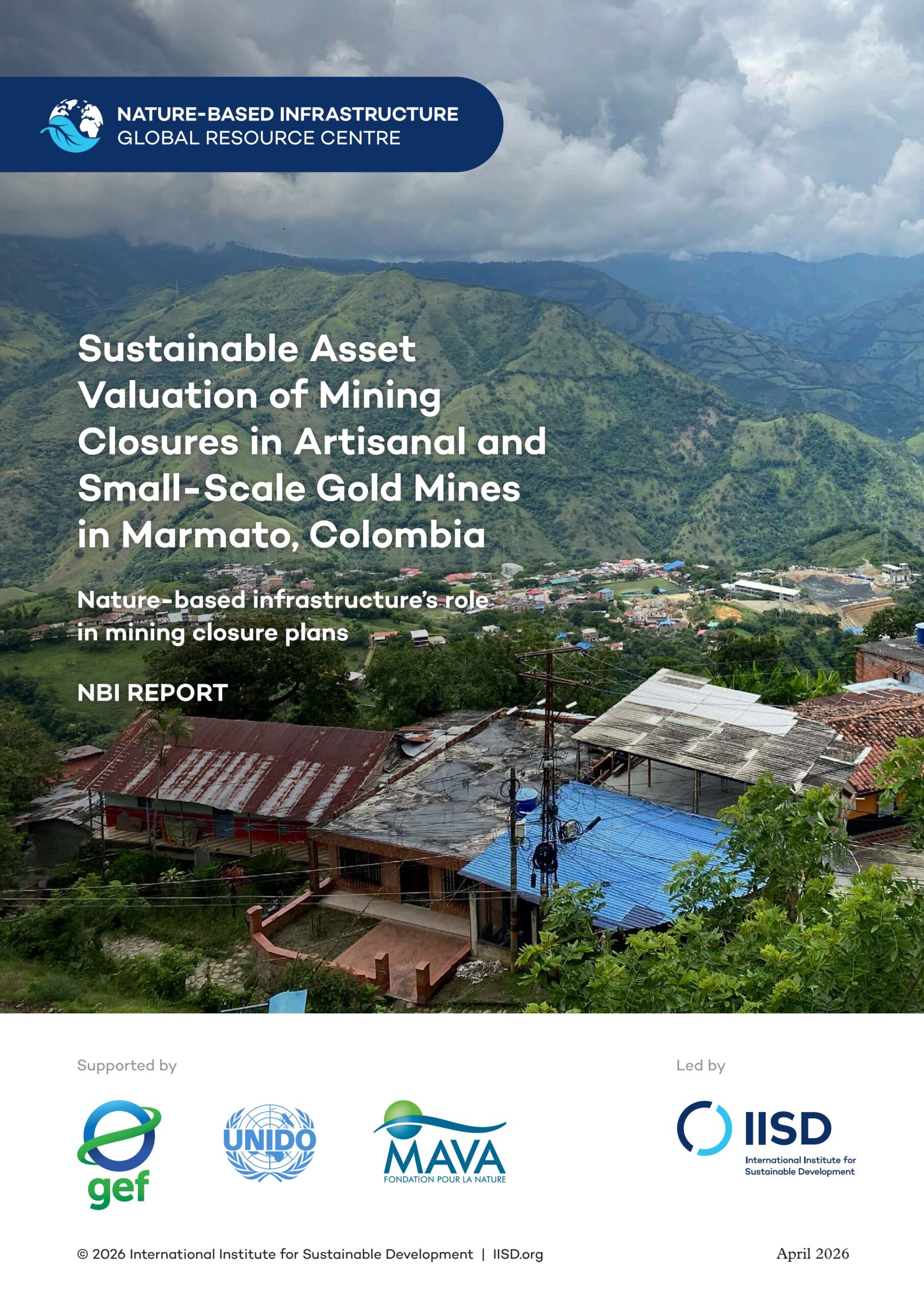
Sustainable asset valuation of mining closures in artisanal and small-scale gold mines in Marmato, Colombia: Nature-based infrastructure’s role in mining closure plans
This report assesses mine-closure strategies for artisanal and small-scale gold mining in Marmato, Colombia. Applying a systems-based valuation methodology, it highlights the economic and environmental benefits of progressive formalisation and closure, emphasising early risk reduction, physical stabilisation, and ecosystem rehabilitation to improve territorial safety.
Please login or join for free to read more.

OVERVIEW
Introduction
Marmato is one of Colombia’s most historic gold-mining regions, where artisanal and small-scale mining (ASM) has shaped the landscape and economy for generations (page 1). Mining remains deeply embedded in local livelihoods, with 482 mining units generating roughly 3,000 direct jobs, intertwined with the daily life of the more than 9,000 Marmato residents (page 1). In 2025, Colombia enacted Decree 1153 to officially recognise ancestral mining and support formalisation (page 1). The formalisation process is still in its early stages; hence Marmato currently has no officially approved mine-closure plans for ASM (page 1). The situation is critical in Cerro el Burro, where 265 mining units operate in one of the municipality’s most geologically sensitive hillsides (page 1).
Savi methodology
The analysis was conducted using the SAVi methodology, which combines systems thinking with project finance modelling to identify and quantify environmental, social, economic, and governance risks (page 3). The process begins with qualitative analysis to create a causal loop diagram (CLD) through co-creation with stakeholders, followed by quantitative analysis that results in an integrated cost-benefit analysis (CBA) (page 3). The assessment evaluates three closure scenarios: a Baseline Scenario, a Comprehensive Closure Plan Scenario, and a Progressive Comprehensive Closure Plan Scenario (page 1).
Qualitative analysis
The qualitative analysis mapped the social, environmental, and economic dynamics influencing ASM in Marmato (page 10). The CLD illustrates how informal mining, environmental degradation, and exposure to geotechnical risks interact with limited economic alternatives to sustain reliance on mining (page v). Formalisation and mine closure emerge as critical leverage points capable of moderating long-term risks (page v). The qualitative analysis reveals that progressive closure interventions, implemented early and integrating physical stabilisation with ecosystem rehabilitation, have the potential to alter reinforcing feedback loops (page v).
Quantitative analysis
The quantitative analysis translates a subset of indicators into an integrated CBA, using a 3.5% social discount rate (page 26). In discounted terms, total costs reach COP 100.7 million under the comprehensive closure scenario, compared to COP 76.9 million under the progressive closure scenario (page 27). The lower cost of progressive closure is largely explained by differences in the timing and execution of capital-intensive activities (page 27). Avoided costs constitute the largest share of total benefits across both scenarios, driven primarily by avoided mortality risk, valued at COP 71.9 million and COP 81.9 million respectively (page 27). These benefits reflect the reduction in fatal accidents from landslides, rockfalls, and tunnel collapses (page 27). The Progressive Comprehensive Closure Plan Scenario yields a benefit–cost ratio of 1.44 (page 27), compared to 0.99 for the comprehensive closure plan at the end of mine life (page 27). Added ecosystem service benefits, including erosion control and nutrient recycling, total COP 4.1 million and COP 5.4 million for the two respective scenarios (page 27).
Conclusions and recommendations
Mine closure in Marmato should be viewed as a necessary investment to reduce accumulated environmental liabilities, enhance territorial safety, and enable a gradual transition toward more resilient land uses (page 31). Progressive closure represents the most robust pathway under conditions of uncertainty, informality, and evolving regulation (page 31). By addressing risks earlier, spreading costs over time, and strengthening outcomes, this approach improves the overall performance of mine-closure strategies (page 31).