

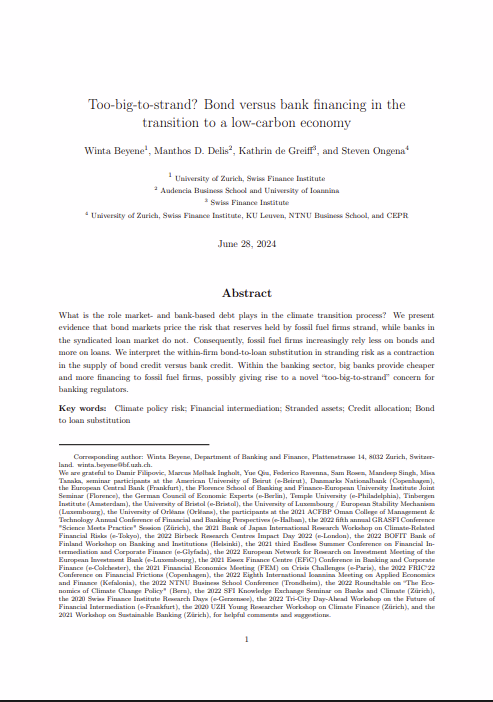
Too-big-to-strand? Bond versus bank financing in the transition to a low-carbon economy
The paper shows bond markets price fossil fuel stranding risk, while syndicated bank loans do not. Firms substitute bonds with bank loans as climate policy risk rises, concentrating exposure in large banks and raising “too-big-to-strand” regulatory concerns.
Please login or join for free to read more.

OVERVIEW
Introduction
This paper examines how market-based debt (corporate bonds) and bank-based debt (syndicated loans) allocate credit to fossil fuel firms during the transition to a low-carbon economy. Using the risk of stranded assets arising from stricter climate policy, the authors assess whether lenders price this risk differently and how this affects firms’ financing choices. The central concern is whether banks, particularly large ones, continue to facilitate fossil fuel investment when markets begin to withdraw.
Data
The analysis combines global corporate bond issuance data and syndicated bank loan data for fossil fuel and non-fossil fuel firms from 2007 to 2017. Climate policy exposure is constructed by weighting firms’ fossil fuel reserves by the climate policy stringency of the countries in which those reserves are located, using the Climate Change Policy Index. Bond data cover over 9,000 priced bond issues, while loan data include more than 10,000 priced syndicated loan facilities. Firm-level financial controls, loan and bond characteristics, and macroeconomic variables are included to isolate the effect of climate policy exposure.
Results
Climate policy exposure and cost of debt
Corporate bond markets price climate policy exposure, while syndicated loan markets largely do not. Fossil fuel bonds carry significantly higher spreads than those of non-fossil fuel firms, and spreads increase further with higher climate policy exposure. A one-standard-deviation increase in exposure raises bond spreads by around 6% relative to the mean. In contrast, syndicated loan spreads show no significant sensitivity to climate policy exposure over the same period. This pricing gap persists after controlling for firm, instrument, and macroeconomic factors.
Bond to loan substitution
Because bond markets price stranding risk more strongly, fossil fuel firms substitute away from bonds towards syndicated bank loans as climate policy exposure increases. Within firms, a one-standard-deviation increase in exposure reduces the share of bond financing by roughly 7%, indicating a contraction in bond supply relative to bank credit. This substitution is observed even after controlling for loan supply conditions, firm characteristics, and aggregate credit cycles, suggesting it reflects lender behaviour rather than borrower demand alone.
Bank heterogeneity and Size Effects
The mispricing of climate policy risk is not uniform across banks. Larger banks provide cheaper and more abundant credit to fossil fuel firms with higher exposure. Loan spreads charged by large banks decline relative to those charged by smaller banks as climate policy exposure rises. Firms with higher exposure are also more likely to borrow from the largest banks: the probability that a top-quintile bank participates in a loan increases by about 8% following a one-standard-deviation rise in exposure. Banks with higher expected government support, measured by Fitch Support Rating Floors, hold loan portfolios with greater climate policy exposure.
Conclusion
The findings show a clear divergence between bond and bank financing in the climate transition. Market discipline operates more strongly through bond markets, which price stranded-asset risk and reduce financing to exposed fossil fuel firms. Banks, particularly large institutions with implicit or explicit government support, do not price this risk to the same extent and absorb financing that markets withdraw. This creates a “too-big-to-strand” concern, where climate-related risks concentrate within large banks’ balance sheets. The results imply that reducing finance for carbon-intensive activities requires attention to debt heterogeneity and bank incentives, as market-based discipline alone may be offset by continued bank lending.




