

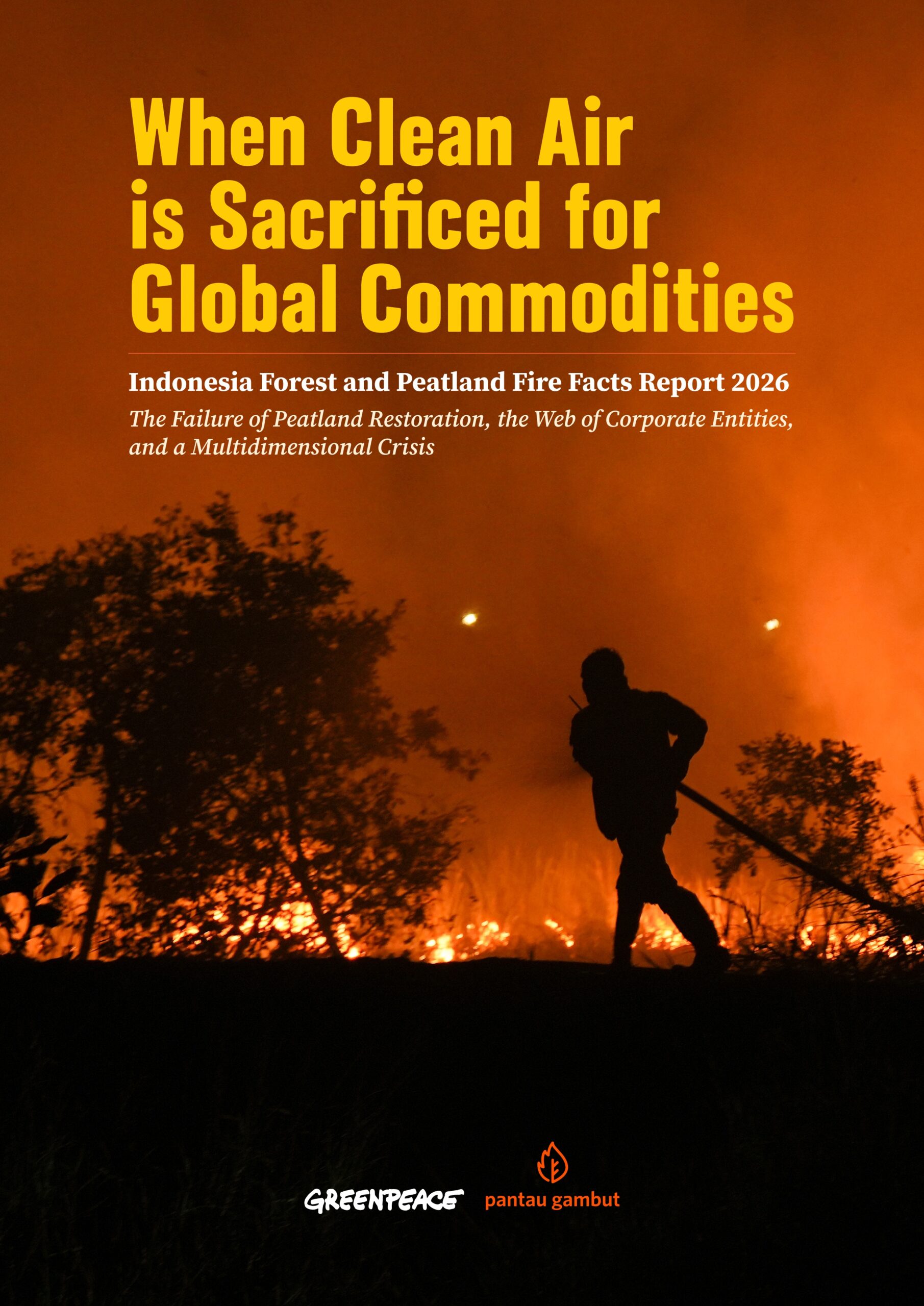
When clean air is sacrificed for global commodities: Indonesia forest and peatland fire facts report 2026
This report examines the 2026 Indonesia forest and peatland fires, highlighting the failure of restoration efforts and the impact of corporate entities. It details health crises affecting 12.5 million people, significant carbon emissions, and transboundary haze while demanding stricter legal accountability for regional governments and global commodity producers.
Please login or join for free to read more.

OVERVIEW
The tragic stories of forest and peatland fire victims
Forest and land fires in Indonesia create a severe health crisis through the persistent haze that disrupts schools, economic activity, and travel safety. The Ministry of Health recorded that fires have affected 12.5 million people, resulting in at least four deaths. In Kayong Utara Regency, 934 cases of acute respiratory infection (ISPA) were recorded between May and August 2026. Individual accounts highlight the multidimensional impact: fisherfolk in Penang face dangerous visibility and the inability to dry catches; families in Kuala Lumpur are trapped in homes using air purifiers to protect infants; and farmers in Johor report harvest drops of 50% due to reduced sunlight.
Peatland degradation and its multidimensional impacts
Peatland vulnerability is exacerbated by chemical changes, particularly the oxidation of pyrite (FeS₂). When drained, these layers produce high acidity, lowering the pH of soil and water. Fire haze carries particulate matter, including PM2.5, which penetrates deep into lungs and bloodstreams. The World Health Organization (WHO) links long-term exposure to respiratory disorders, cardiovascular disease, and adverse pregnancy effects. Guideline concentrations are set at 15 µg/m³ for 24-hour exposure, yet fires often cause concentrations to exceed these levels significantly.
The government’s faltering response to forest and peatland fires
By mid-August 2026, nine provinces and 41 regencies had declared emergency response status. While regional governments have established oxygen rooms, a visible national response commensurate with the crisis is lacking. Coordination is critical as haze travels across administrative boundaries, making local governments the main bearers of the burden for an environmental crime that strips residents of their rights.
A portrait of the destruction of Indonesia’s peatland ecosystems
Of Indonesia’s 24.2 million hectares of Peatland Hydrological Units (KHG), approximately 16.4 million hectares are prone to burning and 6 million hectares are highly vulnerable to flooding. The ecosystem has been systematically altered by a canal network 281,253.51 km long—equivalent to 120 round trips across Java. This drainage facilitates agro-extractive business concessions, which control 8.3 million hectares of KHG across 936 concessions.
Phases of exploitation and planned disaster
The report traces a history of exploitation from the 1970 timber boom to the 1995 One Million Hectare Peatland Project (PLG). Major fires in 1982-1983 burned 3.2 million hectares, while 1997-1998 fires burned 9.7 million hectares. More recently, 2015 fires burned 2.61 million hectares. In 2026, 351,195 hotspots were recorded between January and September, many located within National Strategic Project (PSN) areas.
Transboundary haze
Haze frequently crosses national borders, affecting neighbouring countries. In late 2026, haze persisted for 55 days in Sarawak, 16 days in Sabah, and 5 days in Singapore. It was also detected in Brunei, the Philippines, Vietnam, Cambodia, and Thailand. This regional dimension necessitates mechanisms for source tracing and corporate responsibility beyond domestic responses.
ASEAN Transboundary Haze Pollution Act
Despite the existence of the ASEAN Agreement on Transboundary Haze Pollution (AATHP) for over two decades, haze recurrences persist. The report argues for a shift towards accountability for damage sources rather than mere response. A clear chain of accountability—from evidence and attribution to restoration and the protection of victims’ rights—is required to address the failures of law enforcement and state oversight.
The web of corporate entities in forest and land fires
Analysis of 6,811 haze source spots between August and October 2026 shows a clear pattern: 970 points were inside 120 Forest Utilisation Business Licence (PBPH) concessions and 980 points were inside 233 oil palm concessions. PT Bumi Mekar Hijau (Sinarmas) recorded the highest number of haze source spots (213), followed by PT Mohairson Pawan Khatulistiwa (66). Repeated fires within the same concessions suggest that law enforcement and sanctions are not commensurate with the scale of the problem.
Peatland fire emissions and the climate crisis
As of October 2026, Indonesia’s fire emissions reached an estimated 126.88 million tonnes of CO₂e, making it the country with the second-highest fire emissions globally. Central Kalimantan alone contributed 47 million tonnes. Peat drainage creates a vicious circle where stored carbon is released, worsening the climate crisis and increasing future fire risks.
Fires and their links to Malaysian and Singaporean entities
Several concessions with significant haze source spots are linked to foreign business groups. PT Damai Agro Sejahtera is affiliated with Singapore-based Bumitama Agri Ltd, while PT Menteng Jaya Sawit Perdana is part of Malaysia’s Kuala Lumpur Kepong (KLK) Group. Other entities linked to Singaporean groups include PT Mitra Karya Sentosa and PT Arjuna Utama Sawit.
Demands
The report demands that the Indonesian government stop peatland exploitation, rehabilitate degraded landscapes, and review PSN policies to prevent over-exploitation. Corporations must bear strict liability for their concessions, and financing institutions should tighten environmental audits. Malaysia is urged to enact a Clean Air Act, while Singapore should strengthen the use of its Transboundary Haze Pollution Act and implement mandatory supply chain traceability for listed companies. ASEAN must integrate environmental rights into its frameworks and overhaul the AATHP to set binding legal standards.




