

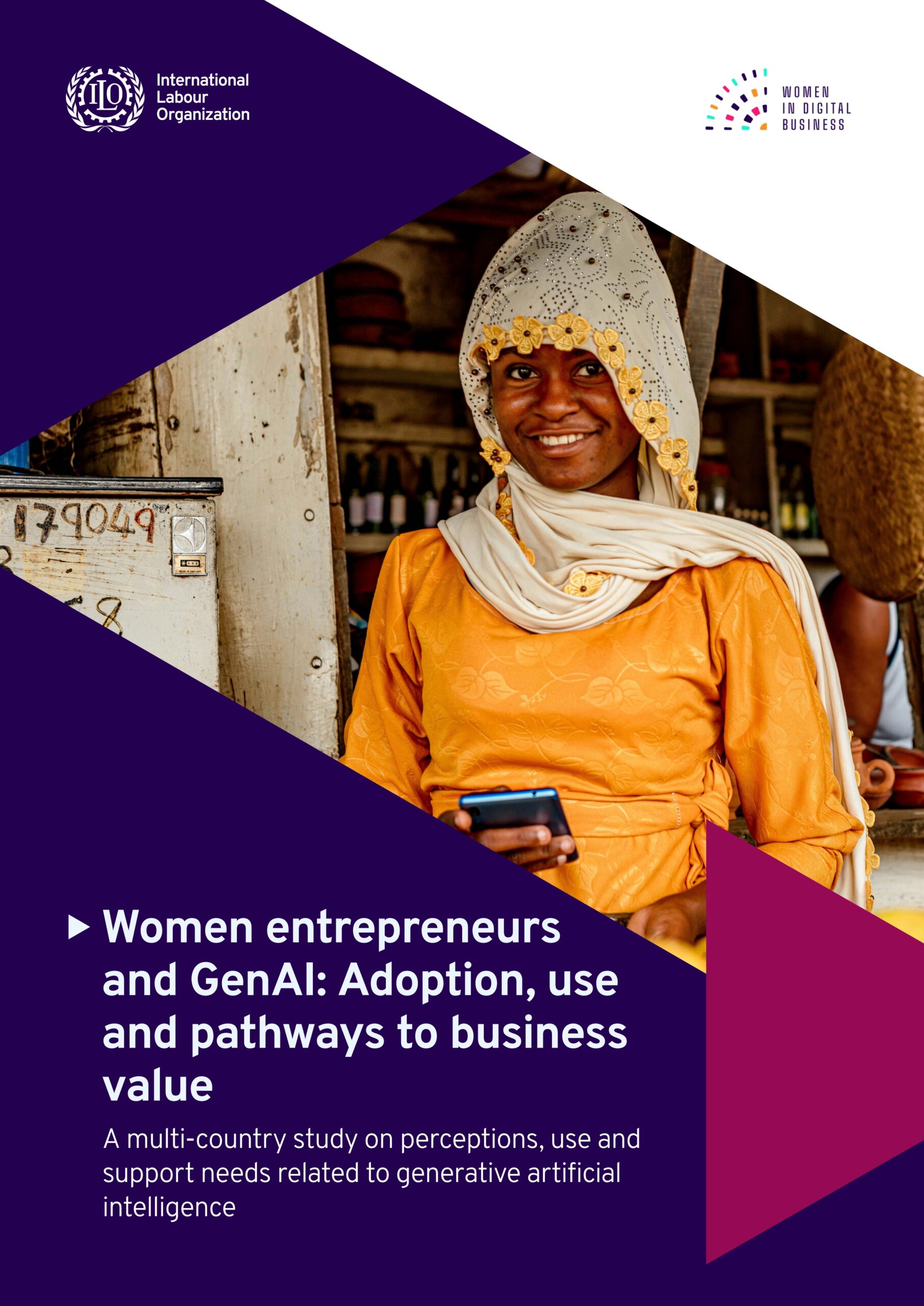
Women entrepreneurs and GenAI: Adoption, use and pathways to business value
This multi-country study examines generative artificial intelligence (GenAI) adoption among women entrepreneurs. Based on a survey of 17,957 participants, it identifies key barriers including digital skill gaps, internet affordability, and social norms. The report provides recommendations for organisations to offer tailored support and improve digital safety for women.
Please login or join for free to read more.

OVERVIEW
Executive summary
Generative artificial intelligence (GenAI) is rapidly transforming business operations, particularly for micro, small, and medium-sized enterprises (MSMEs). This report presents findings from a survey of 17,957 eligible women entrepreneurs across 79 countries, primarily Kenya, Nigeria, and Egypt. The data reveals that 56 per cent of participants already use GenAI for business purposes, though adoption remains recent, with 61 per cent of users starting within the previous year. While uptake is significant, its integration into core business functions is still in the early stages, often limited by the gender digital divide, internet affordability, and social constraints.
Introduction
GenAI provides new avenues to improve productivity, reduce time spent on routine tasks, and enhance customer engagement. For MSMEs, these tools are often inexpensive or free, lowering the technical barriers to entry. However, the benefits are not equally distributed. Women entrepreneurs continue to face structural inequalities relating to connectivity, digital skills, and financial resources. This study aims to identify the conditions that allow women to translate technological opportunities into meaningful business outcomes and identifies pathways to more inclusive digital transformation.
Methodology
The survey was conducted between June and November 2025 through the Women in Digital Business (WIDB) trainer network and partner organisations. It collected 23,618 total responses, of which 17,957 met the eligibility criteria of identifying as a woman and owning or managing a business. The analysis is primarily descriptive, utilizing frequencies and cross-tabulations to examine awareness, adoption patterns, and support needs. The study acknowledges limitations, including a geographical concentration in three countries and the use of convenience sampling.
Women entrepreneurs: Profile, context and dynamics
Respondents were generally young and well-educated; 67 per cent were aged 40 or younger, and 47 per cent held a college or university degree. Most operated micro-enterprises, with 45 per cent working as own-account workers and 43 per cent employing between one and nine people. Access to digital hardware is uneven; while 81 per cent have regular access to a smartphone, only 23 per cent have access to a laptop. Furthermore, 59 per cent reported that unpaid care responsibilities affected their ability to manage their businesses, highlighting a significant time-poverty barrier.
Awareness and adoption of GenAI
Awareness of GenAI is high, with 62 per cent of women reporting at least some knowledge of the technology. ChatGPT is the most widely used tool (85 per cent), followed by Canva (32 per cent) and Gemini (30 per cent). Current use is concentrated in accessible applications: 64 per cent use GenAI for writing and content creation, while 49 per cent use it for research and information gathering. Users expressed high satisfaction, with 91 per cent stating the tools improved their skills, resulting in an average recommendation score of 8.2 out of 10.
Drivers and barriers associated with adoption
Digital skills are strongly linked to adoption; 65 per cent of women who can use spreadsheets independently reported using GenAI, compared to 24 per cent who cannot. Affordability also remains a constraint, as adoption rose from 30 per cent among those who find internet costs difficult to afford to 64 per cent among those who find it affordable. Social norms are equally critical; adoption was 76 per cent in communities where women’s use of digital tools is strongly supported, but fell to 23 per cent where such use is generally not accepted.
Online safety and digital participation
The survey found that 24 per cent of respondents had personally experienced or knew someone who had experienced technology-facilitated gender-based violence. The impacts are severe, with 49 per cent reporting negative effects on mental health and 10 per cent noting adverse impacts on their business activities. Response mechanisms are predominantly informal, as 52 per cent of victims chose to block perpetrators, while only 4 per cent reported incidents to legal authorities. Barriers to formal reporting include a lack of trust in authorities and limited knowledge of where to report.
Support needs and learning preferences
A substantial 73 per cent of respondents reported having no access to formal training or coaching for digital tools. Consequently, there is strong demand for support, with 84 per cent wanting to develop their GenAI skills. Preferred learning formats include self-paced online courses (46 per cent) and in-person training (44 per cent). The most requested topics are marketing and customer service (66 per cent), introductory GenAI training (63 per cent), and time management for daily tasks (38 per cent).
Key findings and recommendations
The report recommends positioning GenAI within broader entrepreneurship and digital transformation policies rather than treating it as an isolated issue. Actionable steps include expanding access to affordable connectivity, investing in foundational digital skills, and addressing the disproportionate burden of unpaid care work. Support should be differentiated based on a woman’s adoption stage, offering practical, business-oriented demonstrations for non-users and advanced functional training for existing users. Finally, stakeholders must promote safe digital environments by strengthening reporting mechanisms and accountability for online harassment.




