

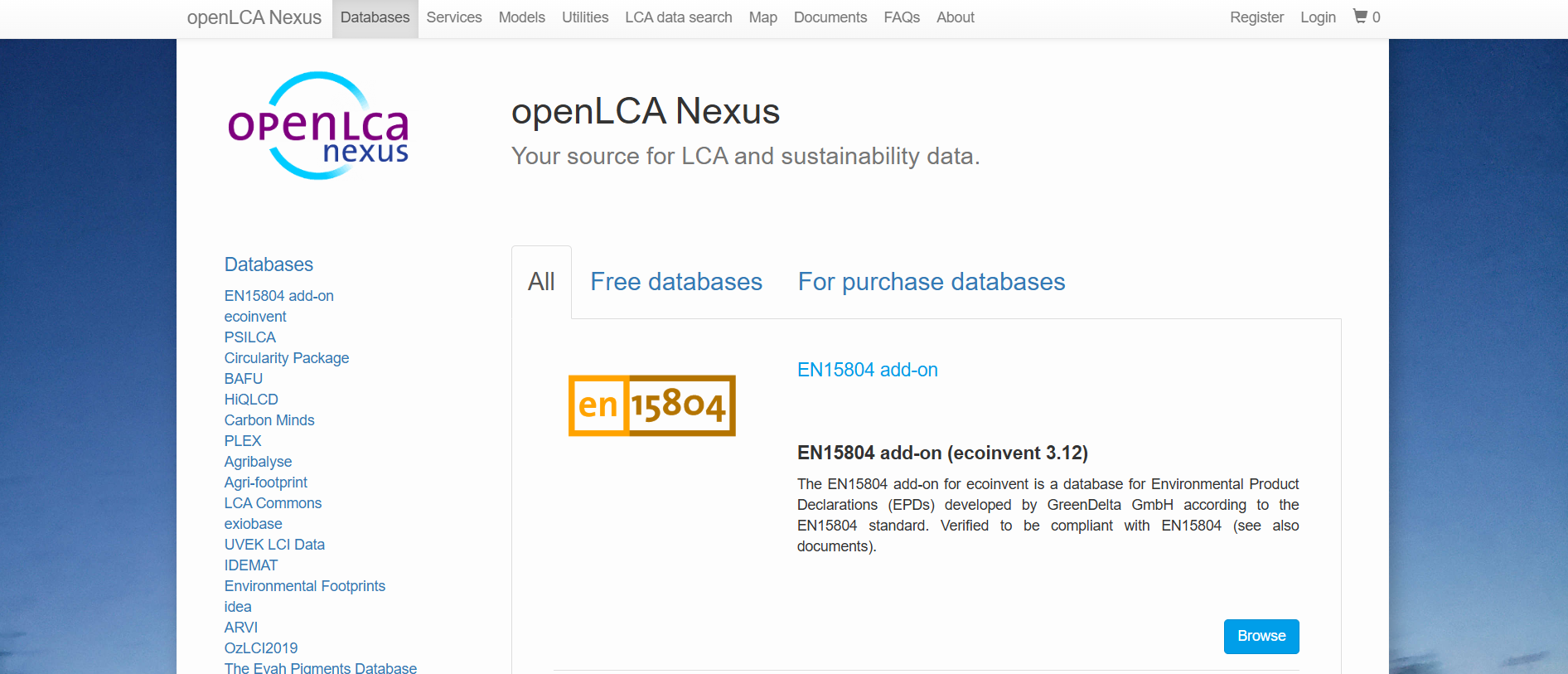
openLCA Nexus
openLCA Nexus is an online repository providing access to life cycle assessment databases for environmental and sustainability analysis. It hosts free and licensed datasets from multiple providers, covering energy, materials, agriculture, transport and waste, designed for use within the openLCA software environment.
Please login or join for free to read more.

OVERVIEW
Overview
openLCA Nexus is an online repository providing access to life cycle assessment (LCA) databases used to quantify environmental impacts of products, services and supply chains. Its main purpose is to centralise, distribute and manage LCA datasets for use in environmental modelling. Finance professionals may find it relevant for understanding the data foundations behind carbon accounting, ESG metrics and transition risk analysis.
Organisation behind the tool
The platform is developed and maintained by GreenDelta, a sustainability software provider best known for developing the openLCA modelling software. openLCA Nexus hosts databases from a range of third-party providers, including public agencies, research institutions and commercial data owners, under different licensing conditions.
What the tool does
- Provides a central catalogue of LCA databases compatible with openLCA software.
- Hosts free and licensed datasets covering life cycle inventories and impact assessment methods.
- Allows users to browse databases by provider, sector, geography and licence type.
- Enables downloading of complete databases for local use in LCA modelling.
- Covers data related to energy, materials, manufacturing, agriculture, transport, waste and emissions.
The platform does not perform analysis itself; it supplies structured data inputs for environmental assessment tools.
Target audience
The primary audience is LCA practitioners and sustainability analysts. Other users include environmental consultants, corporate sustainability teams, researchers and academics. Policymakers and organisations involved in environmental reporting may also rely indirectly on outputs derived from Nexus-hosted datasets.
Relevance to finance professionals
Risk assessment
- Supports evaluation of environmental and transition risks across value chains, including emissions intensity and resource use.
- Provides context for assessing exposure to regulatory and policy changes linked to environmental impacts.
ESG analysis
- Underpins lifecycle-based carbon footprints and other environmental indicators used in ESG reporting.
- Helps assess the robustness and assumptions behind disclosed environmental data.
- Market and commodity insights
- Enables environmental impact analysis of key sectors such as energy, agriculture, materials and industrial production.
- Relevant for commodity-linked portfolios and sectoral risk assessments.
Investment context
- Informs long-term environmental performance of technologies and production systems.
- Useful in due diligence where lifecycle impacts influence asset valuation or investment screening.




