

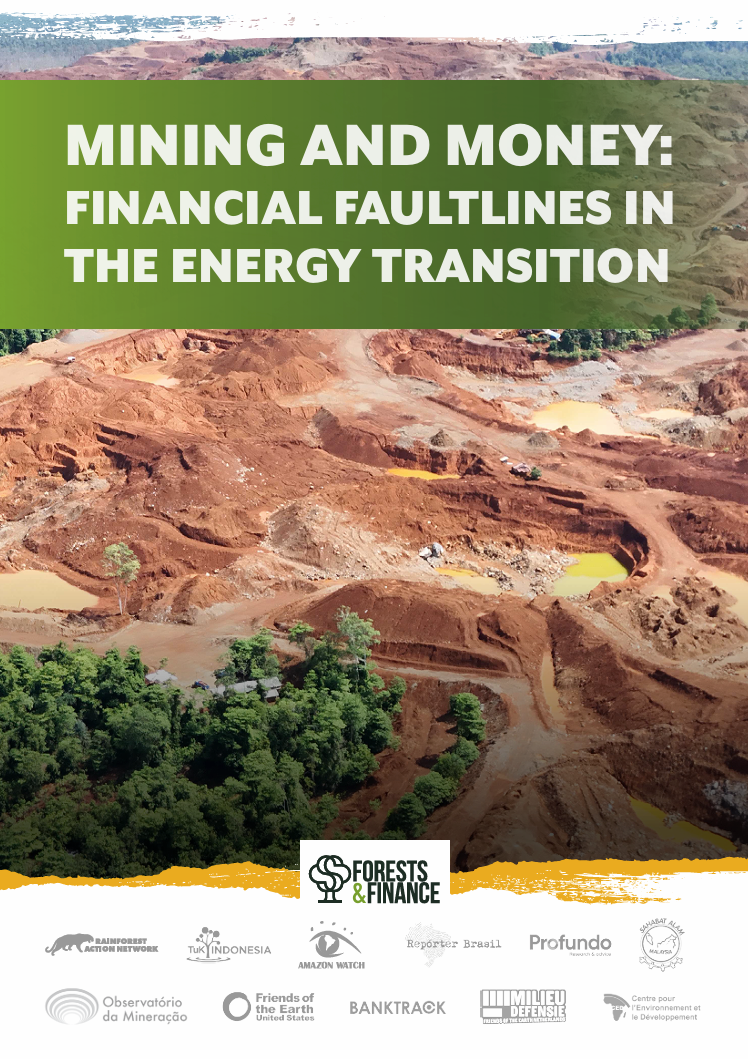
Mining and money: Financial fault lines in the energy transition
This report analyses global financing of transition mineral mining, showing concentrated capital flows, weak financial institution policies, and material environmental and human rights risks. It links bank and investor finance to mining harms across key regions and calls for stronger regulation and safeguards to enable a just energy transition.
Please login or join for free to read more.

OVERVIEW
Introduction
The report examines how rising demand for transition minerals to support decarbonisation is reshaping global mining and finance. It finds that, without reform, the energy transition risks reproducing the extractive, environmentally damaging and socially harmful model of the fossil fuel era, with disproportionate impacts on Indigenous Peoples, workers and high-biodiversity regions.
Research Overview
The analysis combines financial mapping and policy assessment. It tracks lending and investment to major transition mineral mining companies between 2016 and 2024 and assesses the mining-related policies of 30 large banks and investors against 34 environmental, social and governance criteria. The study covers ten transition minerals central to clean energy technologies, including copper, lithium, nickel, cobalt and iron.
Mineral Financing Trends
Between 2016 and 2024, banks provided USD 493 billion in loans and underwriting to transition mineral mining companies, while investors held USD 289 billion in bonds and shares as of June 2025. Finance is highly concentrated: 63% of credit originated from banks in five countries, and 80% of investment from institutions in five countries. Copper, iron and aluminium received the largest shares of finance. Extraction and processing are similarly concentrated geographically, heightening environmental, social and supply-chain risks.
Financial Institution Policy Assessment Analysis
The average policy score across assessed institutions was 22%, indicating weak safeguards. Environmental criteria scored lowest, with few institutions committing to zero deforestation, safe tailings management or mine closure and rehabilitation. Social protections averaged 19%, with 80% of institutions lacking policies to protect human rights defenders and none addressing Indigenous Peoples in voluntary isolation. Governance gaps include limited group-wide application of policies, weak grievance mechanisms and poor climate alignment, exposing institutions to material financial and reputational risks.
Exposing The Fault Lines: The Hidden Costs Of The Energy Transition
Case studies illustrate how finance enables harm. In Indonesia, coal-powered nickel operations have driven deforestation, pollution and health impacts. In Brazil, Vale’s operations are linked to catastrophic tailings dam failures and long-running conflicts with Indigenous communities. In the Democratic Republic of Congo, cobalt mining has involved displacement, pollution and labour exploitation. In Australia, bauxite mining has damaged irreplaceable forests, water catchments and Indigenous Noongar Country. These cases show consistent links between weak financial oversight and severe social and environmental outcomes.
Recommendations
The report calls for governments to embed biodiversity, climate and human rights risks into financial regulation and mandate robust due diligence. Financial institutions are urged to strengthen mining policies, apply them across corporate groups, require credible 1.5°C-aligned transition plans, exclude high-risk activities such as deforestation and unsafe waste management, and ensure access to effective grievance and remedy mechanisms.
Conclusions
The report concludes that current financing of transition minerals reinforces systemic risks and injustice. Without stronger regulation and higher standards from financial institutions, the energy transition will continue to externalise social and environmental costs. Aligning finance with international human rights, climate and nature frameworks is presented as essential to achieving a just and sustainable energy transition.




