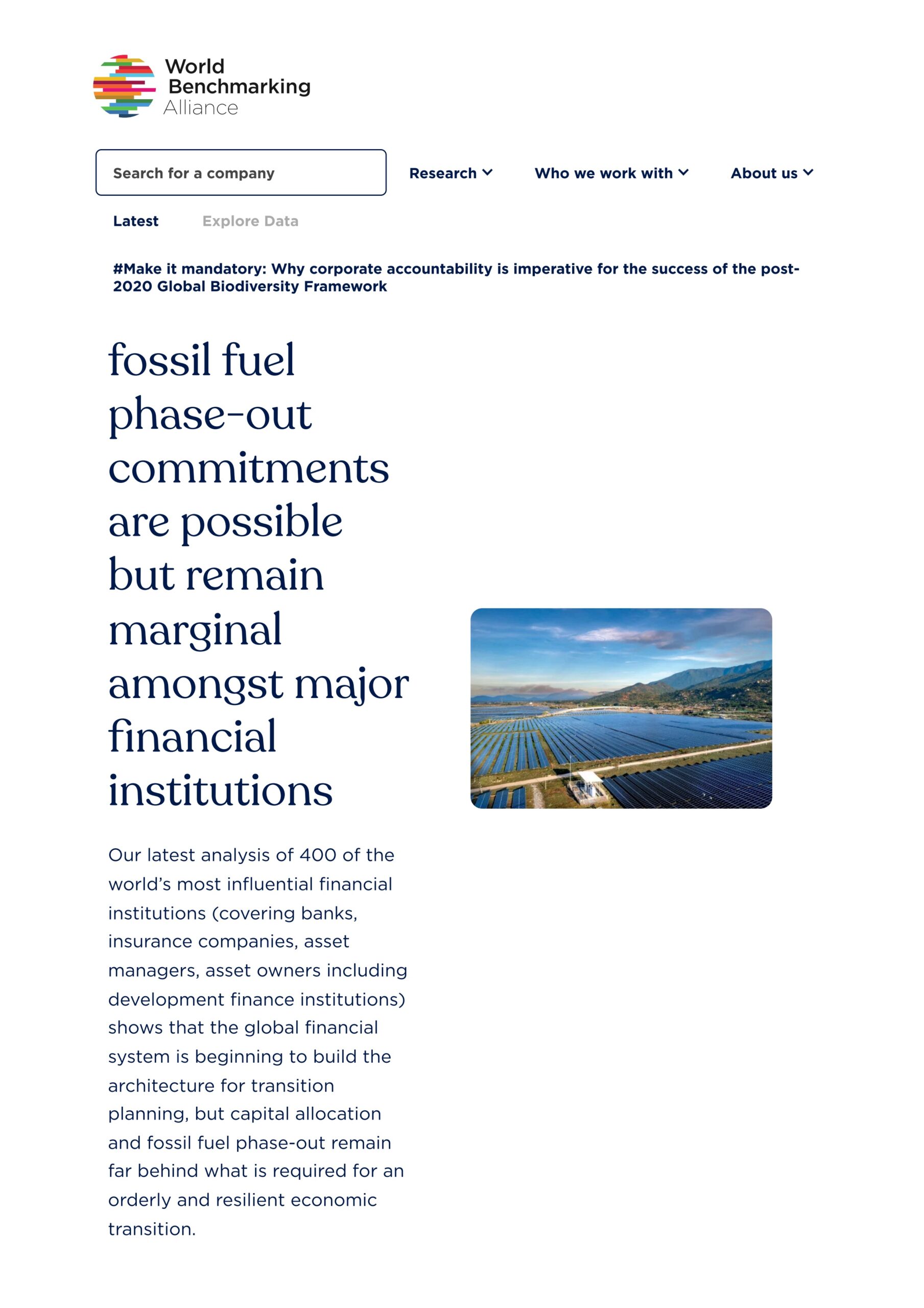
Credible climate financing and fossil fuel phase-out commitments are possible but remain marginal amongst major financial institutions
WBA’s analysis of 400 major financial institutions finds that transition planning is emerging but capital allocation to low-carbon solutions and fossil fuel phase-out commitments remain marginal. Only two institutions demonstrate robust fossil-fuel restrictions, and low-carbon activities account for an average of just 2.7% of total financed activities globally.
Please login or join for free to read more.

OVERVIEW
Background
The International Energy Agency (IEA) estimates that achieving a 1.5°C pathway would require around USD 4.5 trillion to be invested annually by the early 2030s (p.2). Previous WBA research suggests that real economy companies could potentially mobilise USD 1.3 trillion in low carbon investments to close this gap (p.2).
Financial institutions are central to this transition, as their decisions on allocating capital to low-carbon solutions — and withholding finance from fossil fuel activities — will determine how far and how fast the real economy decarbonises. This report presents WBA’s latest analysis of 400 of the world’s most influential financial institutions, covering banks, insurance companies, asset managers, asset owners and development finance institutions (p.2).
For every institution with a transition plan addressing financial activities, there are two others without one
Just over a third (146) of the 400 companies have climate transition plans addressing at least some of their financial activities, including metrics and targets to drive and monitor progress, or embedding transition planning in their governance structure (p.2).
Regionally, just over 60% of those headquartered in Europe & Central Asia have such a plan, in sharp contrast with those based in North America (18%), with East Asian institutions (42%) in between (p.3). An additional 49 financial institutions have less relevant transition plans covering only the emissions of their own operations, while over half of the assessed institutions lacked even the basics of transition planning (p.3).
For every transition plan with a well-defined financing target, there are four others without one. Among institutions with transition plans, about a quarter (47) have embedded one or more short-term (by 2030) targets for financing low-carbon solutions aligned with a 1.5°C pathway, while only 2% of those without a transition plan have them (p.3).
This gap is pronounced between banks and asset managers: a fifth of banks’ transition plans report a time-bound financing target for low-carbon solutions aligned with 1.5°C, and less than 3% of asset managers do so. Insurers and pension funds rank in-between, with 10% and 7% of their respective transition plans including a financing target (p.3).
Follow the money
Financial institutions with a transition plan are about eight times more likely to provide clarity on the share of financed activity allocated to low-carbon solutions than those without one (p.4). In total, 26% (103) of the investigated financial institutions provide such clarity — a figure that has remained unchanged since the last evaluation of the same set of institutions in 2025 (p.4).
Low-carbon activities represent on average a modest 2.7% of the total financed activities of the 400 financial institutions. Europe & Central Asia and North America perform above the global average, putting 3.6% and 3.2% of their total financing towards low-carbon activities respectively. East Asia & Pacific records the lowest share at just over 1% (p.4).
None of the companies demonstrated both sufficient ambition in capital allocation and sufficient reduction of their financed emissions — which would be needed to score above “D” (initial planning) in WBA’s assessment (p.4).
Marginal fossil fuel phase out plans as bottleneck of plan credibility
Transparency on low-carbon financing must be paired with credible fossil-fuel exit commitments. Only two companies, ING and Zürcher Kantonalbank, demonstrate robust fossil-fuel (coal, oil and gas) restrictions, including commitments to both phase out existing exposure and cease new financing flows (p.4).
Many institutions are not yet applying comprehensive and unconditional restrictions — a requirement for a credible transition plan. The report highlights the urgent need for this leading practice to be scaled up, in order to align with the demands of a 1.5°C economy (p.4–5).