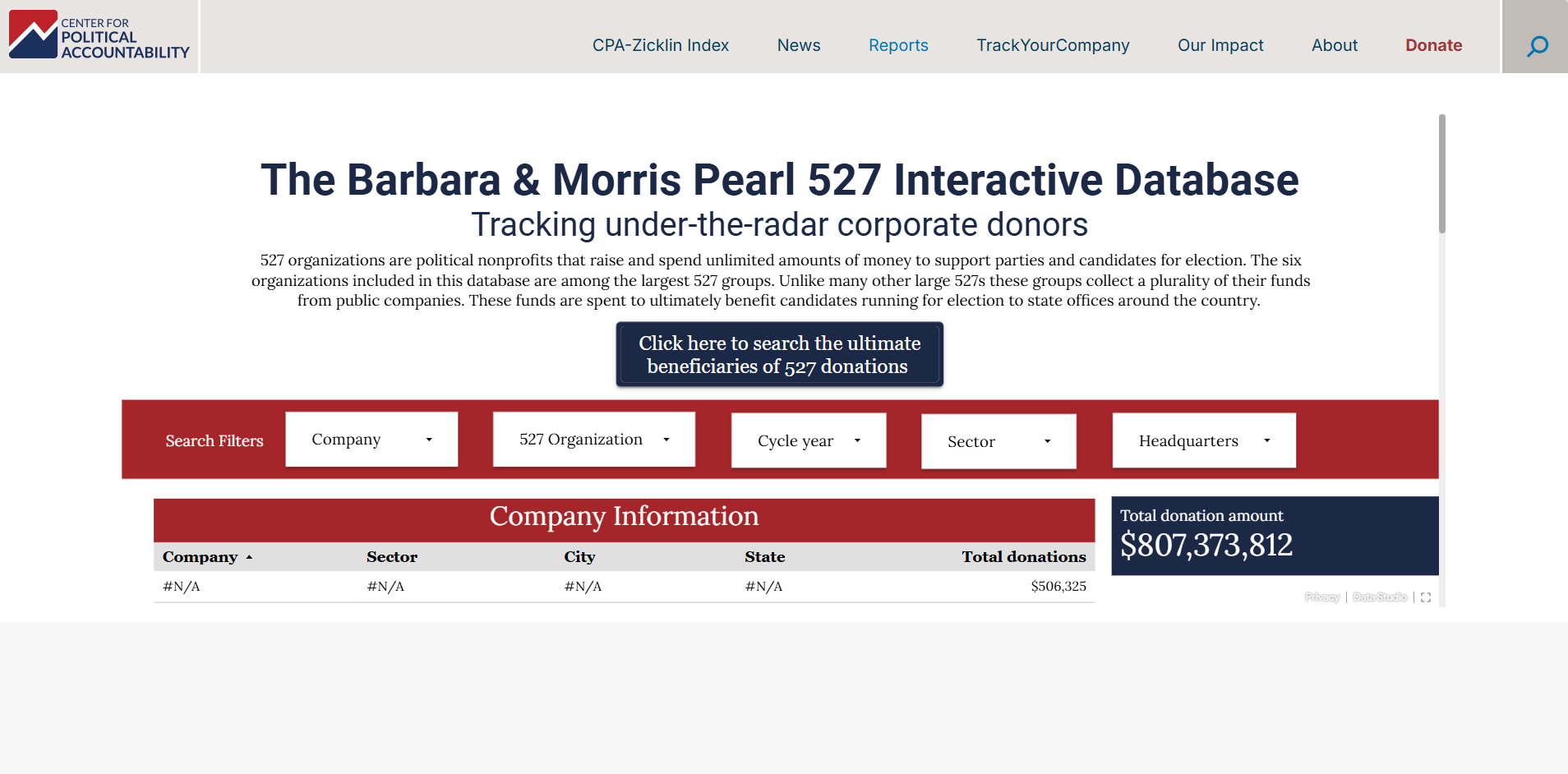
The Barbara and Morris Pearl 527 Interactive Database
The Barbara and Morris Pearl 527 Interactive Database tracks political donations from publicly traded US companies to 527 committees. Developed by the Center for Political Accountability, it helps finance professionals assess corporate governance and reputational risks related to political spending.
Please login or join for free to read more.

OVERVIEW
The Barbara and Morris Pearl 527 Interactive Database is a digital tool designed to bring transparency and accountability to corporate political spending in the United States. It tracks donations made by publicly traded American companies to 527 committees, which are partisan organisations that influence state-level elections and policy. Finance professionals can use this resource to monitor corporate political alignments and evaluate potential reputational or governance risks associated with political expenditure.
Organisation behind the tool
The database was developed and is maintained by the Center for Political Accountability (CPA), a non-partisan, non-profit organisation focused on corporate political spending disclosure. The tool is named in honour of Barbara and Morris Pearl.
What the tool does
The tool provides a user-friendly interface to track and analyse financial flows into political groups. Key features include:
- Tracking corporate and individual contributions to 527 political organisations.
- Allowing users to look up specific donations made by publicly traded American companies.
- Providing data on contributions to major partisan organisations and issue-advocacy groups.
- Offering searchable records to identify which companies are funding specific political agendas or state-level election efforts.
Target audience
The primary audience includes institutional investors, ESG analysts, corporate governance professionals, researchers, and policymakers interested in corporate political transparency.
Relevance to finance professionals
- Risk assessment – Identifying reputational risks if a company’s political donations contradict its public values or sustainability commitments.
- ESG analysis – Evaluating the ‘Governance’ component of ESG by assessing the level of transparency and oversight a company exercises over its political spending.
- Investment context – Understanding how corporate capital is used to influence the regulatory and legislative environments in which companies operate.
- Market insights – Analysing trends in corporate political activity to gauge collective industry shifts or lobbying priorities.