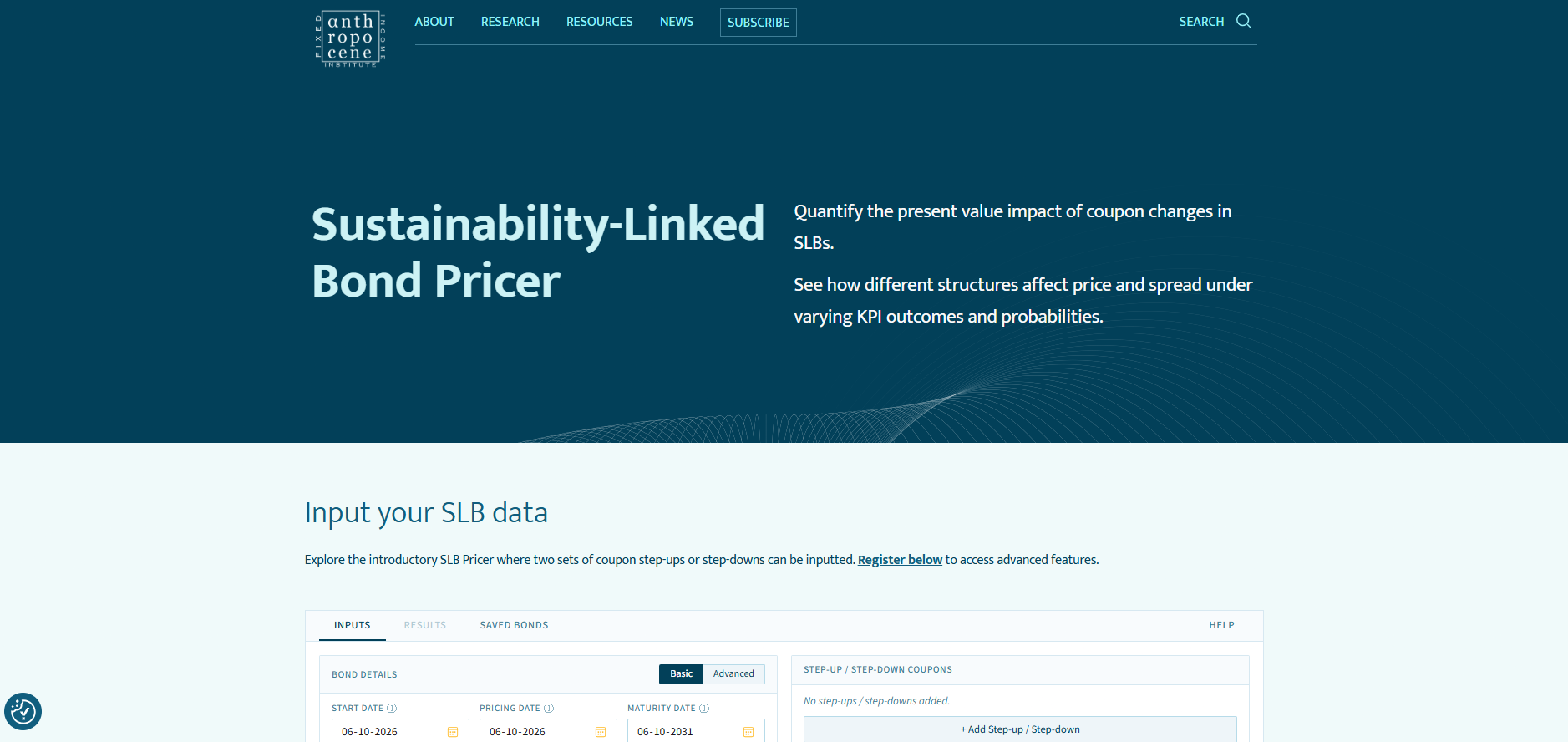
Sustainability-Linked Bond (SLB) Pricer
Developed by the Anthropocene Fixed Income Institute, the SLB Pricer helps investors value the embedded options and step-up features of Sustainability-Linked Bonds. It provides a quantitative framework to ensure bond structures remain robust and ambitious.
Please login or join for free to read more.

OVERVIEW
The SLB Pricer is an analytical tool developed to assist investors in valuing the embedded optionality of Sustainability-Linked Bonds (SLBs). Built on the research base of the Anthropocene Fixed Income Institute (AFII), the tool provides a quantitative framework to determine the financial value of step-up features and other performance-linked triggers within fixed income instruments. It is particularly relevant for finance professionals seeking to ensure that SLB structures include robust and ambitious key performance indicators (KPIs).
Organisation behind the tool
The tool is maintained by the Anthropocene Fixed Income Institute (AFII), a non-profit research organisation focused on empowering fixed income markets to drive the climate transition. The AFII develops such resources to facilitate more accurate pricing of climate risks and opportunities in credit markets.
What the tool does
The SLB Pricer enables users to perform the following functions:
- Calculate the present value of embedded bond features based on current market data.
- Analyse the financial implications of step-up coupons and sustainability-linked options.
- Evaluate whether the pricing of a specific SLB adequately reflects its structured KPIs.
- Conduct comparative analysis between affected SLBs and unaffected instruments from the same issuer.
Target audience
The primary intended users are fixed income investors, portfolio managers, and credit analysts. It is also suitable for sustainable finance researchers and issuers looking to benchmark their bond structures against market expectations.
Relevance to finance professionals
Finance professionals can apply the tool in several areas:
- Risk assessment – identifying whether the financial penalties in a bond are sufficient to incentivise corporate climate action.
- ESG analysis – translating qualitative sustainability commitments into quantitative financial metrics and bond valuations.
- Investment context – assessing the relative value of sustainable debt compared to traditional fixed income securities.
- Market insights – monitoring how the market reacts to KPI misses or achievements by major issuers.