

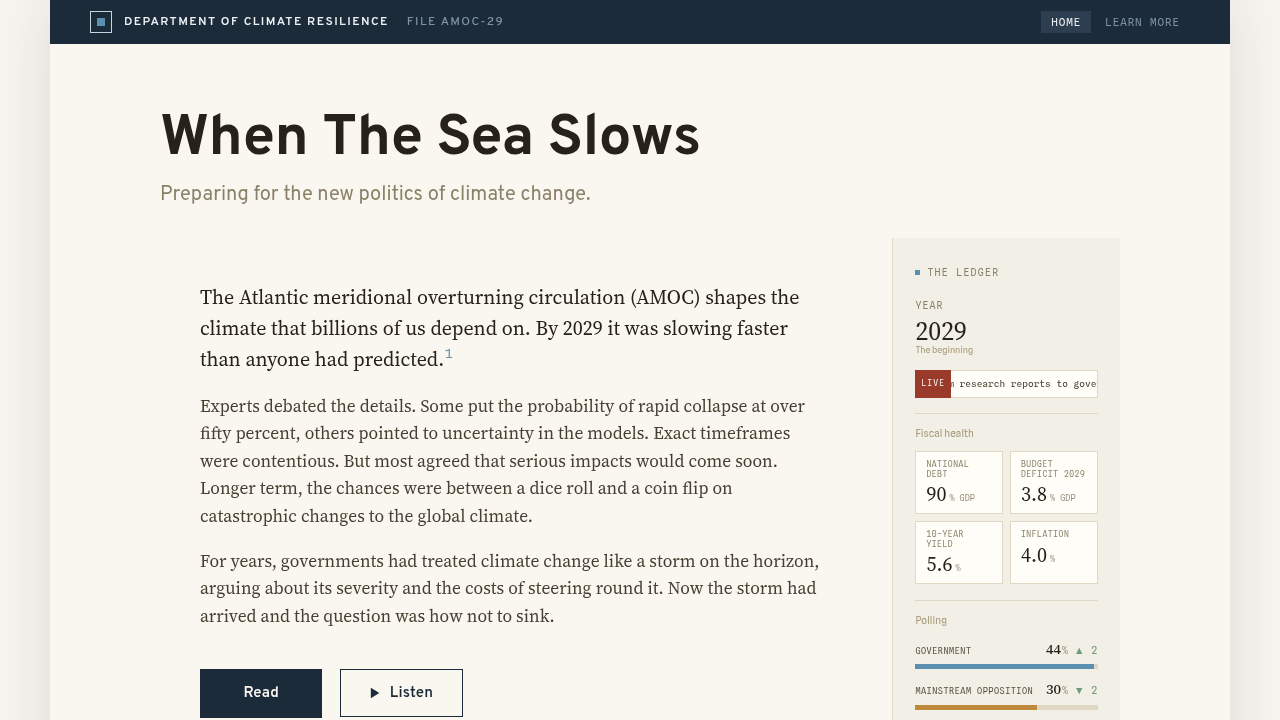
AMOC 2029
AMOC 2029 is an interactive scenario tool from the ASRA Network that models the cascading risks and policy trade-offs resulting from a potential collapse of the Atlantic Meridional Overturning Circulation.
Please login or join for free to read more.

OVERVIEW
AMOC 2029 is an interactive scenario tool designed to model the potential socio-economic and environmental consequences of a slowdown or collapse of the Atlantic Meridional Overturning Circulation (AMOC). By presenting a chronological series of events, the tool allows users to explore how a fictional government might navigate the trade-offs and cascading risks associated with this climate tipping point. For finance professionals, it provides a structured framework to visualise the systemic nature of climate-related disruptions across global supply chains and regional economies.
Organisation behind the tool
The tool is an initiative of the ASRA Network, which developed the interactive scenario to highlight the implications of ocean circulation changes.
What the tool does
- Provides a step-by-step interactive timeline exploring a potential AMOC collapse scenario.
- Visualises the links between physical climate changes and societal impacts, such as agricultural shifts and infrastructure challenges.
- Includes a “Story Map” flow diagram that traces the progression from initial climate signals to systemic outcomes.
- Offers insights into government decision-making processes under high-uncertainty climate conditions.
Target audience
The primary audience includes policymakers, climate researchers, risk managers, and finance professionals interested in long-term systemic risk and scenario analysis.
Relevance to finance professionals
- Risk assessment – Assisting in the identification of cascading risks and tail-end climate scenarios that could impact global portfolios.
- ESG analysis – Providing a narrative-based approach to understanding environmental dependencies and the potential for rapid regional climate shifts.
- Market/commodity insights – Illustrating potential disruptions to agriculture, energy, and water security caused by changes in heat and nutrient transport.
- Investment context – Offering a framework for stress-testing long-term investments against low-probability, high-impact climate events.




