

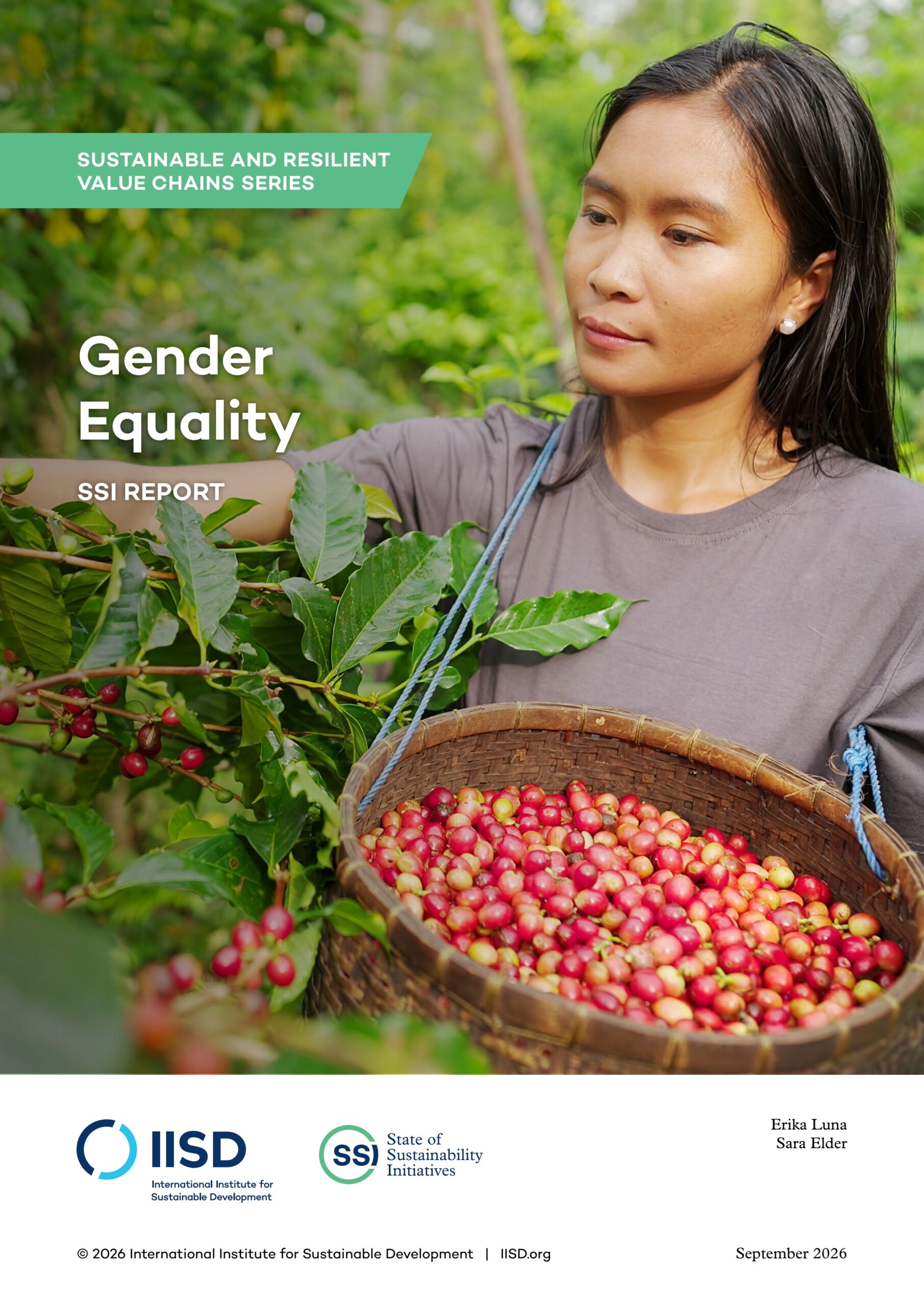
Gender equality: SSI report (Sustainable and Resilient Value Chains series)
This research examines how voluntary sustainability standards and private sector initiatives address gender equality in agricultural value chains. Applying the Sustainable and Resilient Value Chains framework, it evaluates efforts across five commodities and recommends a ‘smart mix’ of solutions to transform structural inequalities and empower women producers.
Please login or join for free to read more.

OVERVIEW
Introduction
Gender inequality remains a significant sustainability challenge within global agricultural value chains. Although women contribute substantially to production, they continue to face barriers regarding access to land, finance, training, and leadership positions. This report, the second in the Sustainable and Resilient Value Chains (SRVC) series, explores how voluntary sustainability standards (VSSs) and private sector companies address women’s economic empowerment (WEE). It employs a four-phase framework—Plan/Prepare, Respond, Recover, and Adapt—to assess the roles of selected VSSs, including Fairtrade International, Rainforest Alliance, Better Cotton Initiative (BCI), and the African Organisation for Standardisation (ARSO).
Why WEE in global agricultural value chains matters
Women are indispensable contributors to global food security. Globally, approximately 36% of women’s employment is in agrifood systems, rising to over 66% in sub-Saharan Africa and 71% in Southeast Asia. Despite this, women face systematic exclusion from formal markets and productive resources. The gender gap in land productivity is estimated at 24%, driven by unequal access to inputs and extension services rather than differences in ability. Evidence suggests that providing women with the same access to resources as men could increase yields by 20%–30%, potentially raising total agricultural output in developing countries by 2.5%–4%.
VSS approaches to addressing WEE
The analysis of VSSs reveals that Plan/Prepare and Respond measures are the most consistently covered, though they remain focused on compliance. All four standards examined include criteria addressing gender-based discrimination. BCI and Rainforest Alliance go further by requiring gender-responsive risk assessments and the collection of sex-disaggregated data. However, protections for seasonal, migrant, and informal workers remain uneven. Recover and Adapt measures, such as grievance mechanisms and gender committees, show potential but are often limited in scale. For instance, Fairtrade Africa has supported gender committees on certified flower farms in Kenya to create ongoing organisational functions for equity.
Private sector approaches to addressing WEE
Private sector companies are increasingly moving beyond VSS compliance to adopt measures that directly address inequalities. Large buyers such as Nestlé/Nespresso, Cargill, and Unilever have signed the UN Women’s Empowerment Principles (WEPs). Recovery mechanisms are predominantly focused on financial inclusion through Village Savings and Loan Associations (VSLAs). Mars’s Women for Change initiative has scaled VSLAs across cocoa-growing communities, supporting at least 100,000 members and generating over USD 20.8 million in savings. While these initiatives provide pathways for expanding access to finance, they must be accompanied by changes in social norms to ensure income gains are not captured by male household members.
In some cases, small and medium-sized enterprises (SMEs) are integrating WEE directly into their business models. Divine Chocolate, for example, is built around a co-ownership model with the Kuapa Kokoo cooperative in Ghana, which has pursued a target of 33% women ownership. Other models, such as Kaffee Kooperative’s Fair Chain model, keep value-added processes like roasting and packaging under the control of producers in Rwanda.
A smart mix of solutions to advance SRVCs
The report argues that no single actor or instrument can deliver WEE alone. A ‘smart mix’ of solutions combining certification schemes with complementary private sector initiatives is required. While VSSs can identify and mitigate risks through audits, they lack the mandate to directly connect producers to finance or markets. Proactive private sector efforts are therefore an indispensable complement. The most effective initiatives are those that build direct, accountable sourcing relationships with women producers and integrate them into governance and value creation.
Conclusions and recommendations
The report concludes that many interventions still focus on risk mitigation rather than addressing the underlying power relations that perpetuate inequality. Key recommendations for VSSs include strengthening gender-responsive risk assessments and extending protections to all categories of workers, including seasonal and informal staff. For the private sector, it is recommended that companies translate corporate gender commitments into operational requirements, such as embedding gender objectives into procurement practices and sourcing decisions. Furthermore, both VSSs and private sector actors should move beyond preventing discrimination toward addressing structural inequalities in land tenure, market access, and control over income.




