

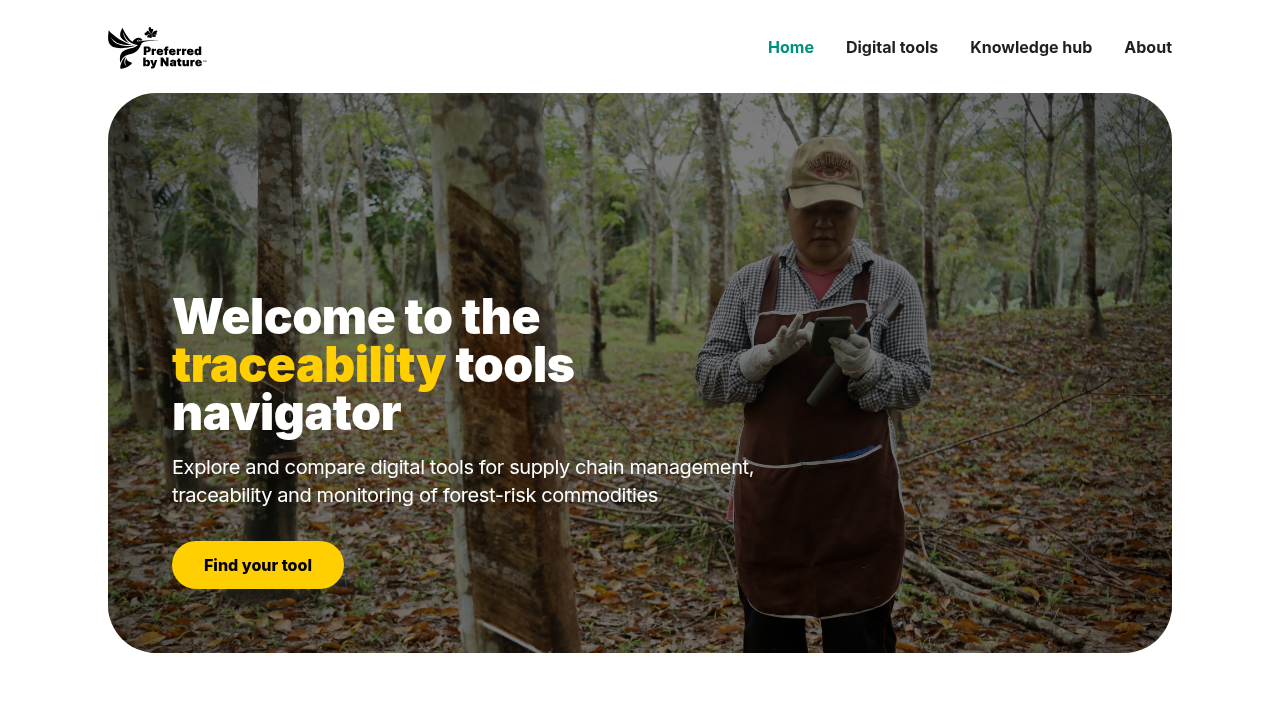
Traceability Tools Navigator
The Traceability Tools Navigator, developed by Preferred by Nature and WWF, allows users to compare digital tools for supply chain monitoring. It provides a standardised framework to evaluate traceability and risk assessment capabilities for forest-risk commodities.
Please login or join for free to read more.

OVERVIEW
The Traceability Tools Navigator is a digital platform designed to help organisations explore and compare digital tools for supply chain management, traceability, and the monitoring of forest-risk commodities. Developed by Preferred by Nature in collaboration with WWF, it addresses the fragmentation in the sustainability tech market by providing a centralised, transparent framework for evaluating compliance and due diligence solutions. Finance professionals can utilise this resource to assess the robustness of corporate supply chain disclosures and identify potential environmental risks in agricultural and forestry investments.
Organisation behind the tool
The tool is developed and maintained by Preferred by Nature. The project was realised with support from WWF and a grant from the ISEAL Innovations Fund, which is supported by the Swiss State Secretariat for Economic Affairs (SECO) and UK International Development.
What the tool does
- Allows users to explore and compare digital tools side-by-side using a standardised set of criteria.
- Provides detailed information on tool features including use cases, commodity scope, and geographical focus.
- Filters tools based on specific capabilities such as interoperability, traceability, or risk assessment.
- Categorises tools into ‘First Mile’ (origin-site data), ‘Downstream’ (complex network management), and ‘Geospatial’ (satellite-powered monitoring).
- Includes a verification system where data disclosed by tool providers is independently verified by Preferred by Nature.
Target audience
The primary users include companies, certification schemes, tool providers, NGOs, and researchers seeking to navigate traceability requirements and sustainability compliance goals.
Relevance to finance professionals
- Risk assessment – Assists in evaluating the effectiveness of a portfolio company’s supply chain monitoring, particularly regarding deforestation and land-use change.
- ESG analysis – Provides a framework to verify the quality of data sources used for corporate environmental reporting and due diligence.
- Investment context – Helps identify best-in-class technology solutions for mitigating regulatory risks associated with forest-risk commodities.
- Market insights – Offers transparency into the evolving landscape of digital traceability and supply chain compliance technology.




