

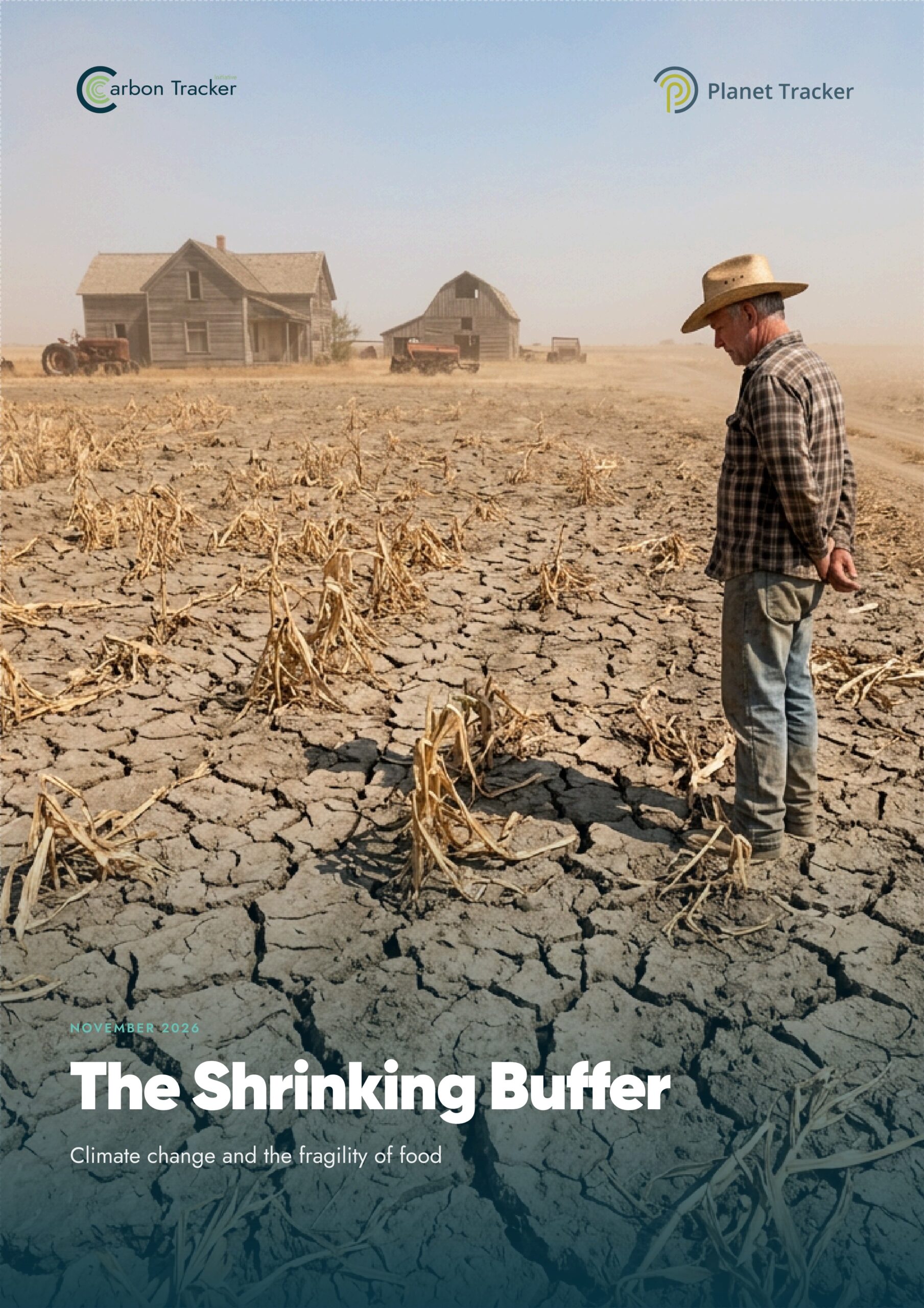
The shrinking buffer: Climate change and the fragility of food
This report examines immediate threats to global food security from a record El Niño, geopolitical conflicts, and fertiliser shortages. It highlights how climate change erodes long-term resilience through thermal limits and simultaneous crop failures, urging policymakers and investors to address systemic risks to inflation, economic growth, and financial stability.
Please login or join for free to read more.

OVERVIEW
The global food system is under long-term threat from climate change and is currently facing three immediate tests of its resilience. These crises—a record-breaking ‘super’ El Niño, the closure of the Strait of Hormuz, and intensified attacks on Black Sea grain infrastructure—are expected to reverberate through 2027. The consequences are particularly severe for vulnerable communities, with the United Nations World Food Programme estimating that an additional 49 million people could be pushed into acute hunger globally by this year’s El Niño alone.
Near-term challenges to the food system
The current El Niño is projected to be exceptional, with sea-surface temperatures expected to peak around the end of the year at approximately 4°C above normal, surpassing the previous 2015 record of 2.72°C. The US National Oceanic and Atmospheric Administration’s index recorded a new monthly peak anomaly of 2.82°C for September 2026. This has already resulted in delayed rainfall in Brazil, leading to a 253% increase in Amazon wildfires, and a 13% reduction in India’s monsoon rainfall, which is critical for the world’s largest rice producer. In East Africa, rainfall deficits of 45% or more are expected to reduce crop production and livestock productivity, while unusually dry conditions in Indonesia have affected 1.9m hectares of land through wildfires.
Geopolitical instability in the Middle East has further constrained the food system. The Middle East accounts for 47% of global seaborne trade in sulphur and 35% of urea, with up to 30% of international fertiliser trade passing through the Strait of Hormuz before its closure. Consequently, nitrogen exports from Saudi Arabia and Qatar have fallen by 63% and 37% respectively. While other regions such as China and the US have cushioned global supply, the disruption threatens future agricultural yields as prolonged uncertainty leads to reduced fertiliser use. Simultaneously, attacks on grain storage in Russia and Ukraine—countries representing 27% of global wheat exports—could reduce wheat exports by up to 86 million tonnes this year.
Overall, the United Nations Food and Agriculture Organisation food price index was up 6% year-on-year in September. Cereal prices have risen 17% over the last year, with wheat prices up 31% as heat and drought diminish harvests in major producing countries like Australia, where output is projected to fall 17% for the 2026-27 season.
Longer-term fragility
Beyond immediate shocks, climate change is eroding the buffers of the global food system. Rising baseline temperatures narrow the thermal safety margins for biological processes. Agricultural crop yields begin to suffer above 30°C, and a temperature failure point is reached for most major crops when air temperatures exceed 35°C. Heat stress for livestock, including cattle, chickens, and pigs, begins above 25°C. The likelihood of extreme heat days is roughly twice as high at 2°C of warming compared to 1.5°C, and four times as likely at 3°C.
There is also an increasing risk of simultaneous crop failures across multiple breadbaskets. Research indicates that the risk of multiple maize failures could reach 54% between 1.5°C and 2°C of warming. Climate tipping points, such as the collapse of the Atlantic Meridional Overturning Circulation (AMOC), could further destabilise production, potentially reducing the share of land suitable for arable farming in Britain from 32% to just 7%. While food reserves have remained steady at approximately 30% of annual consumption, they are increasingly concentrated and may be insufficient to cushion against future global-scale interruptions.
The economic cost of food-system fragility
The downward pressure on yields is expected to place a permanent floor under inflation. Climate-related shocks could add between 0.9% and 3.2% to the annual rate of global food inflation by 2035. Emerging economies are particularly exposed, as food typically accounts for 20% to 50% of total consumer expenditure. Persistently high food costs could also strain the financial resilience of companies across the food value chain, which operate on modest EBITDA margins, such as 8% for farming companies and 4% for wholesalers. This vulnerability is reflected in the MSCI World Agriculture & Food Chain Index, which has underperformed the broader market since mid-2022 and now trades at a substantial valuation discount.
Conclusions and recommendations
Policymakers must adopt a whole-of-government approach to food security, treating it as a national security and economic imperative. Key recommendations include stress-testing food-system buffers against compound shocks, scaling up investment in both climate mitigation and food-system adaptation, and creating incentives for companies to invest in resilience. Currently, adaptation finance for agriculture fell to $5.5 billion in 2024, significantly below the UN estimate of $80 billion required annually at 2°C of warming.
Investors should also recognise food insecurity as a long-term portfolio risk. They are encouraged to embed realistic food-system risks into climate scenario models, invest in climate-resilient production such as drought-tolerant crops and soil health, and engage with policymakers to strengthen systemic resilience. Finally, capital and stewardship should be aligned with limiting climate change to protect the long-term productive capacity of the food system.




